
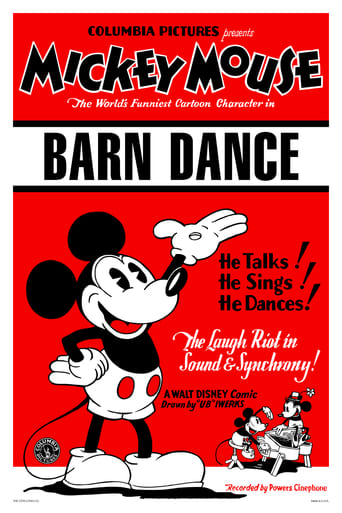
The Barnyard Battle
"Peg-Leg Pete is depicted as a leading soldier of the former army"
Keys: Space play/pause · ←/→ 10s · F fullscreen · M mute · </> speed
About this film
Peg-Leg Pete is depicted as a leading soldier of the former army, and Mickey as a conscript of the latter one. Before joining the army, Mickey has to pass a physical examination. This scene depicts Mickey becoming the subject of physical and emotional abuse.
Cast & crew
More films like this
More Animation films
View all →



More from Ub Iwerks
View all →


More about this film
About the production
Release dateApril 25, 1929
Box officeBox office figures for individual short subjects were not tracked separately in 1929
ProductionWalt Disney Productions
Filmed inDisney Brothers Cartoon Studio, Hyperion Avenue, Hollywood, California
This was the first Mickey Mouse cartoon to depict warfare, reflecting the recent memories of World War I. Ub Iwerks animated nearly the entire cartoon himself, as was typical for early Disney productions. The cartoon was produced during the transition period when Disney was moving from silent films to sound, requiring new synchronization techniques.
Themes
Themes & topics
battlearmycats vs miceWorld War Itrench warfarecartoon violencemilitary parodyheroismunderdog
Historical background
The Barnyard Battle (1929) emerged during the silent-film era. Peg-Leg Pete is depicted as a leading soldier of the former army, and Mickey as a conscript of the latter one. Archival records and catalog entries help place the work within film-history surveys of the period.
Why this film matters
Preserved under Wikidata ID Q2948566, The Barnyard Battle is valued as a animated work within catalog and archive collections. Wikipedia's "The Barnyard Battle" entry connect it to broader histories of cinema exhibition and restoration.
Making of
The production of 'The Barnyard Battle' represented a significant milestone in Disney's early sound animation efforts. Ub Iwerks, Disney's primary animator at the time, worked nearly single-handedly on the animation, often putting in 16-hour days to meet deadlines. The synchronization of sound effects with the action was particularly challenging, as the technology was still new. The Disney team created many of the battle sounds using household items - for instance, they used whisks and colanders to create metallic combat sounds. The decision to use a wartime theme was somewhat controversial, as some felt it was too soon after World War I to make light of military conflict. Walt Disney himself had to convince distributors that the cartoon was meant as a parody rather than a serious war depiction. The animation techniques used were groundbreaking for their time, including the use of perspective in the battle scenes and more complex character movements than in earlier Disney shorts.
What critics said
Trade and archival sources offer limited day-one review coverage for The Barnyard Battle. Modern reception rests on its availability in collections, repertory screenings, and reference works that document 1929 cinema.
Did you know?
- This was the 7th Mickey Mouse cartoon produced and the first to feature Mickey in a military context
- The cartoon was initially rejected by some distributors for its wartime theme, which they felt was too soon after World War I
- Ub Iwerks reportedly animated over 700 drawings per day to complete this cartoon
- This is one of the few early Mickey Mouse cartoons where Mickey wears shoes throughout the entire film
- The cat soldiers were designed to resemble German soldiers from WWI, complete with pointed helmets reminiscent of the Pickelhaube
- This cartoon was included in the 1932 Mickey Mouse review film 'Mickey's Mellerdrammer'
- The sound effects were created live in the studio using everyday objects, including kitchen utensils for the battle sounds
- This cartoon marked one of the first times Mickey was shown as a hero defending a community rather than just getting into mischief
- The original negative was nearly lost in a studio fire in the 1940s but was saved by quick-thinking employees
- This cartoon was banned in Germany in the 1930s due to its anti-German military imagery
Visual style
The cinematography of 'The Barnyard Battle' represents the cutting edge of 1929 animation technology. The cartoon features sophisticated camera movements for its time, including pans across the battlefield and zooms to emphasize action. The use of perspective shots, particularly in the trench scenes, creates a sense of depth that was advanced for animated shorts of this era. The battle sequences utilize multiple camera angles to build tension and excitement, a technique that was relatively new to animation. The contrast between close-ups of Mickey's determined expressions and wide shots of the chaotic battlefield demonstrates a sophisticated understanding of visual storytelling. The animation also features detailed backgrounds with multiple layers of action, creating a rich visual environment that enhances the storytelling. The black and white photography makes excellent use of contrast and shadow to create dramatic effects during the battle scenes.
Innovations
'The Barnyard Battle' showcased several technical innovations that were significant for 1929 animation. The cartoon featured advanced synchronization of sound effects with animation, a relatively new achievement that Disney was pioneering. The animation itself demonstrated improved fluidity and more complex character movements compared to earlier Disney shorts. The battle scenes featured multiple layers of animation, creating a sense of depth and complexity that was technically demanding for the time. The cartoon also employed sophisticated perspective techniques in its backgrounds, giving the illusion of three-dimensional space. The use of shadows and lighting effects to create mood and drama was particularly advanced for an animated short of this era. The production also benefited from Disney's development of the multiplane camera concept, though the full implementation would come later. The cartoon's success demonstrated that technically complex animated shorts could be produced efficiently and profitably.
Music
The soundtrack for 'The Barnyard Battle' was groundbreaking for its time, featuring synchronized sound effects and musical accompaniment. The music was likely composed by Carl Stalling, Disney's primary musical arranger during this period, though specific credits are unclear for early shorts. The score incorporates patriotic military themes adapted for the cartoon's humorous context. Sound effects were created using innovative techniques, including the use of kitchen utensils and other household items to simulate battle sounds. The cartoon features diegetic sounds such as marching, explosions, and weapon noises, all synchronized with the on-screen action. The voice work for Mickey Mouse was performed by Walt Disney himself, using his characteristic falsetto voice that would become synonymous with the character. The soundtrack represents an early example of how sound could enhance animated storytelling beyond mere accompaniment, actively contributing to the humor and drama of the narrative.
Famous quotes
I'm ready for the cats!" - Mickey Mouse
Forward, mice! For cheese and country!" - Mouse army commander
Memorable scenes
- The opening scene where Mickey enthusiastically enlists in the mouse army, transforming from a civilian to a soldier with makeshift equipment. The battle sequence in the trenches where Mickey uses his wits to outsmart the larger cat soldiers, including a memorable moment where he uses a piece of cheese as bait. The final confrontation where Mickey leads a charge against the cat army, riding a plow horse like a cavalry officer.
What audiences thought
Audiences in 1929 responded enthusiastically to 'The Barnyard Battle,' which was a popular attraction in theaters where it was shown. The cartoon's combination of humor, action, and the increasingly popular Mickey Mouse character made it a hit with both children and adults. Moviegoers were particularly impressed by the sound effects and the synchronized action, which were still novel experiences for most theater patrons. The cartoon's wartime theme resonated with the many Americans who had personal connections to World War I, whether through their own service or that of family members. Letters to Disney studios from the period indicate that audiences appreciated Mickey's portrayal as a brave soldier, seeing it as a positive representation of American values. The cartoon's success contributed to the growing popularity of Mickey Mouse merchandise, which was becoming increasingly common by late 1929.
Film connections
Influenced by
- World War I propaganda films
- Buster Keaton's 'The General' (1926)
- Charlie Chaplin's 'Shoulder Arms' (1918)
- Contemporary newspaper comics
This film influenced
- Various WWII-era Disney propaganda cartoons
- Later Tom and Jerry battle episodes
- Looney Tunes wartime cartoons
Film restoration
The film has been preserved and restored by Disney. A 35mm nitrate original exists in the Disney archives, and it has been transferred to modern safety film stock. The cartoon was included in the 'Walt Disney Treasures: Mickey Mouse in Black and White' DVD collection released in 2001, where it was digitally restored. The restoration process involved cleaning up damage to the original film elements and improving the audio quality of the soundtrack. The cartoon remains in good condition and is regularly screened at animation festivals and Disney retrospectives.
Where to watch
- Disney+ streaming service
- Walt Disney Treasures: Mickey Mouse in Black and White DVD collection
- Various public domain animation websites
- Museum of Modern Art film collection screenings
- Academic animation archives