
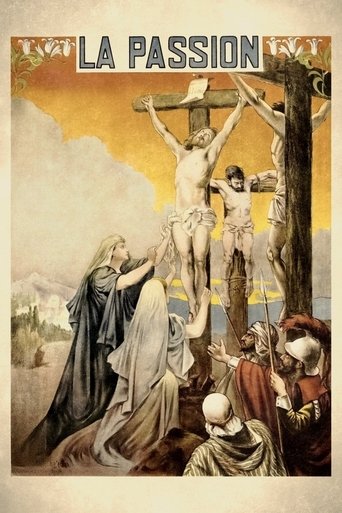
The Birth, the Life and the Death of Christ
"Jesus Christ in 25 tableaux based on the canonical gospels : Arrival in Bethlehem…"
Keys: Space play/pause · ←/→ 10s · F fullscreen · M mute · </> speed
About this film
Jesus Christ in 25 tableaux based on the canonical gospels : Arrival in Bethlehem Nativity and arrival of the Magi The sleep of Jesus The Samaritan The miracle of Jairus's daughter Mary Magdalene washes the feet of Jesus Palm Sunday The last supper The olive garden The night watch Judas's betrayal Jesus before Caiphus The denial of St. Peter Jesus before Pontius Pilatus The torment Ecce homo The bearing of the cross Jesus fall the first time Saint Veronica Climbing Golgotha The crucifixion The agony Descending from the cross Committed to the tomb The resurrection ^ Cite error: The named refere…
Cast & crew
More films like this
More Drama films
View all →







More from Alice Guy-Blaché
View all →
More about this film
About the production
Release date1906
Box officeUnknown (box office records not maintained for this period)
ProductionSociété des Établissements Gaumont
Filmed inParis, France (Gaumont studios)
Filmed using hand-tinted color techniques for certain scenes, particularly those depicting divine or miraculous events. The production involved over 100 actors and extras, requiring extensive costume and set design. Alice Guy-Blaché personally supervised the hand-coloring process, which was done frame by frame. The film was shot on 35mm film using early Gaumont cameras. Each tableau was carefully staged to resemble religious paintings of the period, with actors holding poses for extended periods to create tableaux vivants effects.
Themes
Religion and faithSacrifice and redemptionDivinity and humanityMiracles and the supernaturalMoral instruction
Themes & topics
Jesus ChristBibleChristianityCrucifixionResurrectionMiraclesDisciplesJerusalemAncient RomeReligious persecutionDivine interventionSpiritual journey
Historical background
The Birth, the Life and the Death of Christ (1906) emerged during the earliest years of motion pictures. Jesus Christ in 25 tableaux based on the canonical gospels : Arrival in Bethlehem Nativity and arrival of the Magi The sleep of Jesus The Samaritan The miracle of Jairus's daughter Mary Magdalene washes the feet of Jesus Palm Sunday The last supper The olive garden The night watch Judas's betrayal Jesus before Caiphus The denial of St. Archival records and catalog entries help place the work within film-history surveys of the period.
Why this film matters
Preserved under Wikidata ID Q16652841, The Birth, the Life and the Death of Christ is valued as a screen drama within catalog and archive collections. Wikipedia's "The Birth, the Life and the Death of Christ" entry connect it to broader histories of cinema exhibition and restoration.
Making of
Alice Guy-Blaché, then head of production at Gaumont, conceived and directed this ambitious project as part of Gaumont's efforts to compete with Pathé's religious films. The production required extensive research into biblical texts and consultation with religious advisors to ensure accuracy. Guy-Blaché insisted on using professional actors rather than amateurs, which was unusual for the period. The filming process took several months, with each tableau requiring elaborate setup and multiple takes. The hand-coloring was done primarily by women workers in the Gaumont studio, who used fine brushes to apply color directly to the film stock. The production faced challenges from religious authorities who initially questioned the appropriateness of depicting sacred events on film, but Guy-Blaché's respectful approach eventually won their approval.
What critics said
Trade and archival sources offer limited day-one review coverage for The Birth, the Life and the Death of Christ. Modern reception rests on its availability in collections, repertory screenings, and reference works that document 1906 cinema.
Did you know?
- This was among the costliest and ambitious productions of its time, costing approximately 50,000 francs
- Alice Guy-Blaché was one of the first female directors to tackle religious subject matter on such a grand scale
- The film originally featured live musical accompaniment composed specifically for the production
- Many scenes were hand-colored frame by frame, a painstaking process that took months to complete
- The film was distributed internationally and was one of the first French films to achieve significant success in the United States
- Guy-Blaché used actual church locations for some exterior shots, unusual for the period when most filming was done in studios
- The actor playing Jesus was reportedly a real priest, though this remains unconfirmed
- Some scenes used early special effects techniques, including multiple exposure for the Resurrection sequence
- The film was re-released in 1910 with additional scenes and improved coloring
- Contemporary accounts report that the film moved audiences to tears, despite its primitive technical qualities
Visual style
The film employs static camera positions typical of the period, with carefully composed tableaux that resemble religious paintings. The cinematography makes extensive use of painted backdrops and theatrical lighting to create atmospheric effects. Hand-coloring was applied selectively to emphasize important elements such as halos, robes, and divine light. The camera work shows sophisticated understanding of visual composition, with careful attention to the placement of actors within the frame. Some scenes use multiple exposure techniques to create supernatural effects, particularly in the Resurrection sequence. The film demonstrates early experiments with depth of field and focus to create more dramatic visual impact.
Innovations
The film pioneered several technical innovations including extensive use of hand-coloring for dramatic effect, sophisticated multiple exposure techniques for supernatural scenes, and ambitious set design that combined practical elements with painted backdrops. The production demonstrated early mastery of continuity editing across multiple scenes and the effective use of intertitles to advance narrative. The film's length (33 minutes) was remarkable for the period and required advances in film handling and projection technology. The production also developed new techniques for crowd management and coordination of large groups of extras. The hand-coloring process, though labor-intensive, created some of the most impressive color effects of the early cinema period.
Music
As a silent film, it was accompanied by live musical performance. The original score was composed specifically for the film and included religious hymns and classical pieces appropriate to each scene. Different theaters used various musical arrangements depending on their available musicians. Some venues employed full orchestras while others used organ accompaniment. The music was synchronized with the action through cue sheets provided by Gaumont. Modern screenings often feature newly composed scores or period-appropriate classical music. The original musical arrangements have not survived, but contemporary accounts describe them as emotionally powerful and well-suited to the film's reverent tone.
Famous quotes
Silent film with no recorded dialogue
Memorable scenes
- The Annunciation scene, featuring hand-colored golden light surrounding the angel Gabriel
- The Sermon on the Mount tableau, with Christ addressing a vast crowd on a mountainside
- The walking on water sequence, using early special effects to show Christ miraculously standing on the sea
- The Last Supper scene, carefully composed to resemble Leonardo da Vinci's famous painting
- The Crucifixion tableau, noted for its emotional power and reverent treatment
- The Resurrection sequence, using multiple exposure to create the appearance of Christ rising from the tomb
- The Ascension finale, with Christ floating upward toward heaven in a blaze of colored light
What audiences thought
The film was enormously popular with audiences across Europe and America, who were moved by its reverent depiction of Christ's life. Contemporary accounts report that viewers often wept during the Crucifixion scene and that many attended multiple viewings. The film attracted audiences who might not otherwise have attended cinema, including many from middle and upper-class backgrounds. Church groups initially expressed concern about the appropriateness of the film but eventually endorsed it for its respectful treatment of sacred material. The film's success led to numerous imitations and established the biblical epic as a popular genre. Modern audiences viewing restored versions continue to be impressed by the film's artistic ambition and emotional power.
Film connections
Influenced by
- Biblical texts and religious paintings
- Passion plays and medieval mystery cycles
- The works of Georges Méliès (particularly his use of special effects)
- Contemporary religious art and illustration
- Stage productions of biblical dramas
This film influenced
- From the Manger to the Cross (1912)
- Intolerance (1916)
- The King of Kings (1927)
- The Passion of the Christ (2004)
- Numerous subsequent biblical epics and religious films
Film restoration
The film survives in incomplete form at several archives including the Cinémathèque Française and the Library of Congress. Some sequences exist only in black and white versions, while others retain partial hand-coloring. A restored version combining the best surviving elements was created in the 1990s. The film is considered partially lost, as some original scenes are missing or exist only in fragmentary form. Preservation efforts continue, with archives working to locate and preserve remaining film elements. The restored version runs approximately 25 minutes, indicating that about 8 minutes of the original footage may be lost.
Where to watch
- Available on DVD from Kino Lorber as part of 'The Movies Begin' collection
- Streaming on some specialty film archive websites
- Occasionally screened at film festivals and cinematheques
- Available for viewing at selected film archives and museum collections
- Some versions available on YouTube but quality varies