
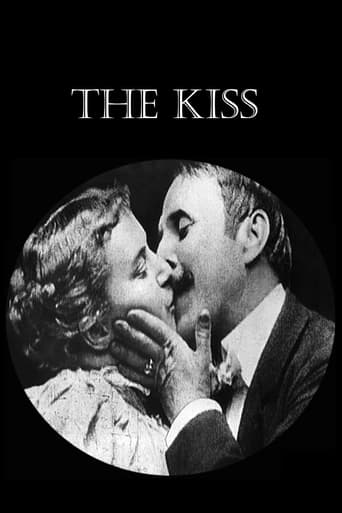
The Kiss
""Nothing new, but an old thing done over again and done well"
Keys: Space play/pause · ←/→ 10s · F fullscreen · M mute · </> speed
About this film
"Nothing new, but an old thing done over again and done well. Some one has attempted to describe a kiss as "something made of nothing," but this is not one of that kind, but one of those old fashioned "home made" kind that sets the whole audience into merriment and motion, and ha. The Kiss (also known as The May Irwin Kiss, The Rice-Irwin Kiss and The Widow Jones) is an 1896 short film, and was one of the first films ever shown commercially to the public. Around 18 seconds long, it depicts a re-enactment of the kiss between May Irwin and John Rice from the final scene of the stage musical The…
Cast & crew
More films like this
More Romance films
View all →




More from Edwin S. Porter
View all →


More about this film
About the production
Release date1900
ProductionEdison Manufacturing Company
Filmed inEdison Studio, New York
This film was produced during the early period of Edison's film manufacturing when the company was creating short, sensational subjects to appeal to vaudeville audiences. Fred Ott was one of Edison's regular employees who appeared in several of their early films. The film was likely shot in Edison's rooftop studio in New York City, which replaced the famous Black Maria studio around 1901. Like many Edison films of this era, it was designed to be inexpensive to produce while maximizing audience appeal through its slightly risqué subject matter.
Themes
Themes & topics
Historical background
Photography and projected motion were still experimental in 1900, when short actualities and staged scenes competed for public curiosity. Archival sources describe The Kiss as 1896 american short silent film. Contemporary context can be traced through sources such as the Wikipedia article on The Kiss (1896 film).
Why this film matters
Early works like The Kiss help map how filmmakers, exhibitors, and viewers developed the visual language of cinema during the medium's first decades. Later revivals, archive screenings, and digitization have kept such titles accessible to researchers and dedicated viewers long after their first commercial runs.
Making of
The production of this film represents Edison's continued efforts to capitalize on successful formulas from their early catalog. Fred Ott, being a trusted Edison employee, was likely chosen for his reliability and willingness to participate in these experimental productions. The film was probably shot quickly in one take, as was typical for Edison productions of this era. The Edison studio system was highly efficient, with films often being produced in rapid succession to meet the growing demand for motion picture content. The use of a kiss as subject matter was deliberately chosen for its universal appeal and slightly scandalous nature, which helped draw curious audiences to the new medium of motion pictures.
What critics said
Trade and newspaper reviews from the silent period for The Kiss survive only in fragments, making precise reception history difficult to reconstruct. Modern assessment tends to emphasize historical value, craft, and cultural context rather than box-office performance.
Did you know?
- This is one of several Edison films featuring Fred Ott, who also famously appeared in 'Fred Ott's Sneeze' (1894), one of the earliest copyrighted motion pictures
- The film should not be confused with the more famous Edison film 'The Kiss' (1896) starring May Irwin and John C. Rice, which was one of the first films ever shown commercially
- Early Edison films like this were often marketed as 'smoking' or 'risqué' entertainment, though by today's standards they're quite tame
- The film was part of Edison's strategy to produce sensational subjects that would attract audiences to their new Kinetoscope viewing machines
- Fred Ott was an Edison employee rather than a professional actor, which was common in early Edison productions
- The Edison catalog description suggests this was a remake or reimagining of the popular 1896 kiss film, described as 'an old thing done over again'
- Early films like this were often shown in vaudeville theaters as part of variety programs
- The film was shot on 35mm film using Edison's proprietary format and equipment
Visual style
The cinematography would have been typical of Edison productions of the era - a single static camera positioned to capture the full action. The camera would have been hand-cranked, likely at about 16 frames per second, which was standard for the period. The lighting would have been natural or simple artificial light, as sophisticated studio lighting systems had not yet been developed. The composition would have been straightforward, centering the subjects in the frame to ensure clarity of the action. The film was shot on 35mm stock using Edison's proprietary equipment, which produced relatively clear images for the time.
Innovations
While not technically groundbreaking, this film represents the refinement of Edison's film production process. The company had by 1900 established efficient methods for creating short, commercially viable films. The use of regular employees like Fred Ott as performers was itself a cost-effective production strategy. The film demonstrates the early understanding of what content worked best for the new medium - brief, clear, sensational subjects that could be easily understood by diverse audiences. The preservation of such simple, single-shot films was easier than more complex productions, which is why many examples of this type survive today.
Music
As a silent film, it had no synchronized soundtrack. When exhibited, it would have been accompanied by live music provided by the venue - typically a pianist or small ensemble who would improvise appropriate music. The music would have been light and playful to match the cheerful nature of the subject matter. Some exhibitors might have used sound effects or commentary, but this would have varied by venue and was not part of the original production.
Famous quotes
Nothing new, but an old thing done over again and done well." - Edison Film Catalog
Some one has attempted to describe a kiss as 'something made of nothing,' but this is not one of that kind, but one of those old fashioned 'home made' kind that sets the whole audience into merriment and motion." - Edison Film Catalog
Memorable scenes
- The entire film consists of one memorable scene: Fred Ott and his partner sharing a brief kiss directly for the camera, a simple but effective moment that captures the essence of early cinematic entertainment
What audiences thought
According to the Edison catalog, audiences responded with 'merriment and motion' to this type of content, indicating that it was well-received as entertaining spectacle. Early film audiences were often drawn to slightly risqué material that they couldn't see in other public venues, and a kiss on screen would have been considered somewhat daring for the time. The fact that Edison continued to produce similar kiss films suggests they were commercially successful. These short films were often shown as part of variety programs, and their brief, sensational nature made them perfect for holding audience attention between longer acts.
Film connections
Influenced by
- The Kiss (1896 Edison film)
- Fred Ott's Sneeze (1894)
- Vaudeville performance traditions
This film influenced
- Later Edison 'kiss' films
- Early romantic shorts
- Vaudeville film adaptations
Film restoration
The film is preserved and available through various film archives. It exists in the collection of the Library of Congress and other early film repositories. Like many Edison films of this era, it has survived due to the company's practice of copyrighting their films by depositing paper prints with the Library of Congress.
Where to watch
- Library of Congress National Screening Room
- Internet Archive
- Early cinema collections at major film archives
- Various public domain film websites