The Ocean Hop
"Balloons, a dachshund, and sky-high cheating."
Keys: Space play/pause · ←/→ 10s · F fullscreen · M mute · </> speed
About this film
Oswald the Rabbit enters an airplane race with a makeshift aircraft and ends up riding a dachshund lifted into the air by balloons. Meanwhile, his peg-legged rival tries to cheat his way to victory.
Cast & crew
More films like this
More Comedy films
View all →







More from Walt Disney
View all →


More about this film
About the production
Release dateOctober 10, 1927
Box officeUnknown - distributed as part of Universal Pictures' theater packages
ProductionWalt Disney Productions, Universal Pictures
Filmed inLos Angeles, California - Disney's Hyperion Avenue studio
This was one of 26 Oswald the Lucky Rabbit shorts produced by Disney in 1927. The animation was primarily created by Ub Iwerks and Disney himself, with the team working under intense deadlines to meet Universal's demanding schedule. The film showcases early innovations in character animation, particularly in Oswald's expressive movements and the physics-based gags involving the dachshund aircraft. The peg-legged villain character was an early prototype of what would become Peg-Leg Pete in later Mickey Mouse cartoons.
Themes
Competition and rivalryInnovation and ingenuityHonesty versus cheatingAviation and technological progressUnderdog triumph
Themes & topics
airplane racecheatingdachshundballoonsrivalrycompetitionaviationinventioncomedycartoon violencetriumphunderdog
Historical background
By 1927, The Ocean Hop was shaped by late silent cinema technology, distribution, and audience expectations.
Why this film matters
The Ocean Hop (1927) helps trace genre evolution, performer careers, and exhibition practices of its period.
Making of
The Ocean Hop was created during a remarkably productive but stressful period for Walt Disney and his small animation team. Working from their modest Hyperion Avenue studio, Disney and Ub Iwerks often worked through the night to meet Universal's demanding delivery schedule of one Oswald cartoon every two weeks. The film's production coincided with growing tensions between Disney and Universal producer Charles Mintz over budget and creative control. The peg-legged villain character was reportedly animated by Les Clark, one of Disney's earliest animators who would later become one of Disney's 'Nine Old Men'. The dachshund balloon sequence required careful planning to achieve believable physics while maintaining comedic effect, showcasing the team's growing expertise in combining technical skill with humor. This short was completed just before Disney's fateful trip to New York where he would learn that Universal had hired away most of his animators and taken control of the Oswald character, leading directly to the creation of Mickey Mouse.
What critics said
Where contemporary reviews survive, The Ocean Hop is read against the tastes of 1927; revival screenings keep it in circulation.
Did you know?
- This was the 8th Oswald the Lucky Rabbit cartoon produced by Disney
- The peg-legged antagonist character was an early version of Peg-Leg Pete, who would become Mickey Mouse's primary nemesis
- The dachshund balloon gag demonstrates Disney's early fascination with unconventional transportation methods
- Universal producer Charles Mintz demanded increasingly faster production schedules, contributing to Disney's eventual loss of the Oswald character
- The cartoon features early examples of the 'rubber hose' animation style that would define 1920s animation
- Oswald's design in this short shows the character before his final redesign with longer ears
- The airplane race theme was popular in 1927, coinciding with Charles Lindbergh's historic transatlantic flight
- This short was one of the last Oswald cartoons completed before Disney traveled to New York to negotiate with Universal
- The film's title 'Ocean Hop' was a play on the popular term 'transoceanic flight' used in aviation circles
- Animation historians consider this short significant for its development of chase sequences and comedic timing
Visual style
The Ocean Hop employed the standard black and white silent film cinematography of the era, shot on 35mm film with an aspect ratio of 1.33:1. The animation utilized the traditional cel animation process with backgrounds painted on separate cels to create depth and movement. The film demonstrates early mastery of perspective shots, particularly in the aerial sequences where the camera appears to follow the action from above. The cinematography incorporates dynamic camera movements that were innovative for the time, including tracking shots that follow the racing aircraft across the screen. The visual composition emphasizes the vertical dimension in the balloon sequences, creating a sense of height and danger. The animation team used multiple exposure techniques to create the illusion of speed and movement in the race scenes. The contrast between light and shadow is carefully controlled to maintain clarity in the character designs, particularly important for distinguishing Oswald from his rival during the fast-paced action sequences.
Innovations
The Ocean Hop showcased several technical innovations for its time, particularly in the fluidity of character movement and the complexity of the aerial sequences. The animation demonstrated early mastery of secondary motion, with the dachshund's body and the balloons moving independently to create realistic physics. The film employed sophisticated perspective drawing techniques to create the illusion of three-dimensional space during the flying sequences. Disney's team developed new methods for animating fast-paced action while maintaining character clarity and readability. The cartoon featured some of the earliest examples of smear animation techniques to convey rapid motion. The production team also innovated in timing and pacing, using the full six-minute runtime effectively to build comedy and maintain audience engagement. The film's survival in relatively good condition has allowed modern animators to study these early techniques in detail.
Music
As a silent film, The Ocean Hop was originally presented with live musical accompaniment provided by theater organists or pianists. The typical score would have included popular songs of 1927, classical pieces adapted for action sequences, and original musical motifs composed specifically for the cartoon. The musical accompaniment would have emphasized the comedic timing of the gags, with stinger chords for physical comedy moments and racing music during the competition sequences. The aviation theme would have been supported by popular aviation-themed songs of the period. When the cartoon was later re-released or shown in revival screenings, it was sometimes accompanied by compiled scores using period-appropriate music. Some modern restorations have included newly composed scores that attempt to recreate the silent film experience while incorporating historical musical elements from 1927.
Famous quotes
(Silent film - no dialogue, but includes intertitles such as 'The Great Ocean Hop Race - $10,000 Prize!' and 'Oswald enters the big race!')
Memorable scenes
- The iconic sequence where Oswald transforms a dachshund into an aircraft by attaching numerous balloons to the long dog's body, creating a flying machine that bounces and floats comically through the air while the dog's legs paddle frantically below
What audiences thought
The Ocean Hop was well-received by theater audiences in 1927, who particularly enjoyed the visual comedy of the dachshund balloon sequence and the competitive rivalry between Oswald and his peg-legged opponent. The aviation theme resonated strongly with audiences still captivated by Lindbergh's recent achievement, making the cartoon especially timely and popular. Children's reaction to the character of Oswald was enthusiastic, contributing to the character's growing popularity before Disney lost the rights. The short's physical comedy and inventive gags made it a favorite among theater owners who programmed it as part of their animated shorts lineup. Audience letters to exhibitors mentioned the cartoon's memorable moments, particularly the unconventional aircraft design and the satisfying conclusion where the cheating villain receives his comeuppance. The positive reception helped establish Oswald as a major cartoon character of the late 1920s, though the character's popularity would later be overshadowed by Mickey Mouse.
Film connections
Influenced by
- Felix the Cat cartoons
- Charlie Chaplin comedies
- Buster Keaton films
- Contemporary aviation news coverage
- Vaudeville comedy routines
- Earlier Disney Laugh-O-Grams
This film influenced
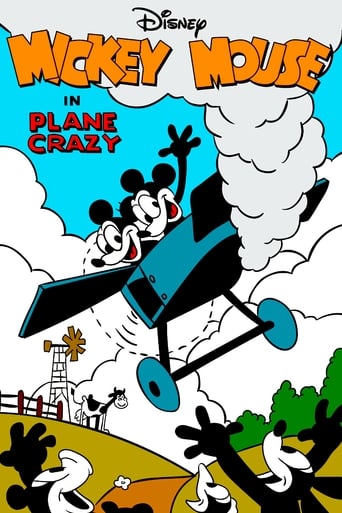
- Plane Crazy (1928)
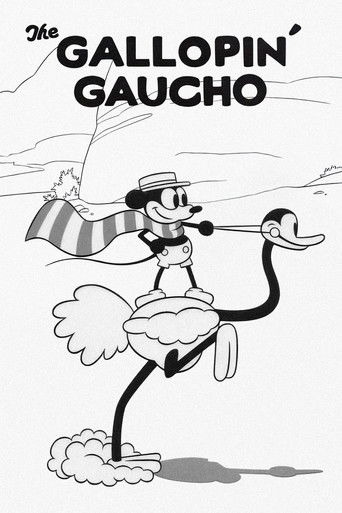
- The Gallopin' Gaucho (1928)
- Steamboat Willie (1928)
- Later Mickey Mouse competition cartoons
- Warner Bros. Looney Tunes racing shorts
Film restoration
The Ocean Hop survives in 16mm and 35mm film copies held in various archives including the Library of Congress and the Disney Animation Research Library. The film has been digitally restored and is available on Disney+ as part of the Oswald the Lucky Rabbit collection. While some original nitrate elements have deteriorated over time, sufficient material exists for high-quality preservation. The restoration has stabilized the image and corrected speed issues common in silent films transferred to video. The cartoon is considered one of the better-preserved Oswald shorts from the Disney period.
Where to watch
- Disney+ (as part of the Oswald the Lucky Rabbit collection)
- The Walt Disney Family Museum archives
- Various animation festival screenings
- Academic film archives and libraries
- Some public domain streaming sites (quality may vary)