The Ol' Swimmin' Hole
“A Splash of Fun with Oswald the Lucky Rabbit!”
About The Ol' Swimmin' Hole
The film follows Oswald the Lucky Rabbit as he leads a group of animal friends to a local watering hole for a day of summer recreation. The plot centers on the playful antics of the group as they engage in various swimming stunts, diving competitions, and slapstick humor involving the water. Oswald attempts to impress a female rabbit with his aquatic prowess, but his efforts are frequently thwarted by a mischievous goat and other woodland creatures. The story culminates in a series of surreal visual gags where the characters' bodies are distorted by the water, leading to a frantic and comedic chase sequence before the sun sets on their pastoral outing.
Cast & crew
More films like this
More from Walt Disney
View all →



More about The Ol' Swimmin' Hole
Production
- Release date
- February 6, 1928
- Country
- USA
- Budget
- Approximately $2,500 per short
- Production
- Walt Disney Studio, Universal Pictures (Distributor)
- Filmed in
- Hyperion Studio, Los Angeles, California
This short was produced during the final months of Walt Disney's contract with Charles Mintz and Universal. It was created using the 'rubber hose' style of animation which allowed for extreme flexibility in character movement. The production was marked by high tension as Disney was beginning to realize he was losing the rights to the Oswald character to Mintz. Despite this, the animation quality remained high, featuring sophisticated character interactions and fluid movement that surpassed many of Disney's earlier Alice Comedies.
Themes & topics
Historical background
In 1928, the film industry was in the midst of the 'talkie' revolution following the success of 'The Jazz Singer' (1927), yet most cartoons remained silent. This film represents the pinnacle of silent era animation, where storytelling relied entirely on visual pantomime and title cards. Historically, it sits at the edge of a major corporate fallout; Walt Disney would soon travel to New York to discover that his distributor had poached his animators and legally seized the Oswald character, leading directly to the birth of Mickey Mouse.
Why this film matters
Oswald the Lucky Rabbit was Disney's first major success and the first character to have a distinct personality rather than just being a vehicle for gags. 'The Ol' Swimmin' Hole' exemplifies the 'Everyman' quality of Oswald that resonated with Depression-era audiences. The film's focus on leisure and the outdoors reflected a nostalgic American sentiment for rural life during a period of rapid urbanization.
Making of
The making of 'The Ol' Swimmin' Hole' occurred during a pivotal transition in animation history. Walt Disney and Ub Iwerks were experimenting with ways to make characters feel more weighted and three-dimensional within a 2D space. The animation team worked in a small studio on Hyperion Avenue, often working late nights to meet the rigorous delivery schedule demanded by Universal. The 'water' effects were particularly challenging to animate by hand, requiring hundreds of individual drawings of ripples and splashes to create a sense of fluid motion.
What critics said
At the time of release, Trade publications like 'The Moving Picture World' praised the Oswald series for its 'cleverness and originality.' Modern critics and film historians view it as a masterclass in silent comedic timing. It is often cited by scholars as evidence of Disney's growing sophistication in character-driven storytelling compared to the more abstract 'Alice' shorts.
What audiences thought
Audiences in 1928 received the film with great enthusiasm, as Oswald was a major box-office draw. The slapstick elements and the relatable theme of a summer swimming trip made it a hit in both urban and rural theaters. Today, it is cherished by animation enthusiasts as a rare glimpse into the pre-Mickey era of Disney's creativity.
Visual style
As an animated short, the 'cinematography' involves the layout and staging of the hand-drawn cells. The film uses a 'flat' perspective typical of the era but introduces depth through the use of foreground elements like reeds and trees. There are notable 'camera' pans where the background moves behind the characters to simulate a tracking shot as Oswald runs toward the water.
Innovations
The film is noted for its sophisticated use of 'cycles'—repeated animation sequences—that were hidden so well they didn't detract from the narrative. It also showcased advanced liquid animation, which was notoriously difficult to render convincingly in black-and-white line art.
Music
Originally released as a silent film with a synchronized musical score provided by theater organists or small orchestras. Modern restorations often feature a new jaunty ragtime score to match the 1920s aesthetic.
Film restoration
The film was considered lost for many decades but was eventually rediscovered and restored. It is now part of the Disney archives and has been released on the 'Walt Disney Treasures: Wave 7' DVD set.
Did you know?
- This was one of the last Oswald shorts produced by Walt Disney before he lost the character to Charles Mintz.
- The title is a reference to the famous James Whitcomb Riley poem of the same name.
- Ub Iwerks, Disney's chief animator, was responsible for the majority of the animation, known for his incredible speed and precision.
- The film features a recurring gag involving a goat, which was a favorite comedic foil in early Disney shorts.
- During this era, Oswald was more popular than Felix the Cat, making this a 'prestige' animated release for Universal.
- The short utilizes 'squash and stretch' principles that would later become a cornerstone of the 12 basic principles of animation.
- The character design of Oswald in this film is notably different from his 1927 debut, appearing more rounded and expressive.
- This film was released just months before the creation of Mickey Mouse.
Memorable scenes
- The scene where Oswald uses his own ears as a flotation device while paddling across the pond.
- The sequence where a goat eats Oswald's clothes while he is swimming, forcing him to find a creative way to cover himself.
- The finale where the characters create a 'water ladder' by jumping on splashes to reach a high diving board.
Influenced by
- The poetry of James Whitcomb Riley
- The comedies of Buster Keaton
- Felix the Cat shorts by Pat Sullivan
This film influenced
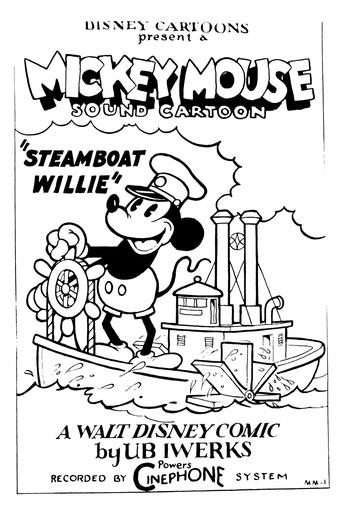
- Steamboat Willie (1928)
- The Pointer (1939)
- Various Looney Tunes 'swimming' shorts
Where else to watch
- Walt Disney Treasures: The Lucky Rabbit Oswald DVD
- Disney+
- YouTube (Public Domain/Archival uploads)
Famous quotes
Title Card: 'The Ol' Swimmin' Hole - Where the water is fine and the fun is free!'