
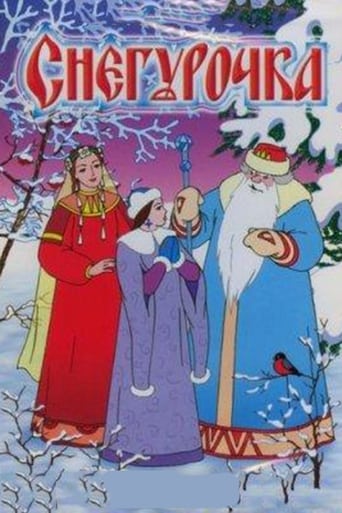
The Pipe and the Pitcher
"Forest spirit, magic pipe, berry jug"
Keys: Space play/pause · ←/→ 10s · F fullscreen · M mute · </> speed
About this film
Girl named Zhenya goes berry picking with her family but struggles to find any berries. She meets an old forest spirit who offers her a magical pipe that reveals hidden berries in exchange for her jug. After realizing the pipe doesn't help her gather the berries, she learns the v.
Cast & crew
More films like this
More Animation films
View all →



More from Viktor Gromov
View all →

More about this film
About the production
Release date1950
ProductionSoyuzmultfilm
Filmed inMoscow, Soviet Union
The film was created using traditional hand-drawn cel animation techniques, characteristic of Soyuzmultfilm's golden age. The production team utilized rotoscoping for some of the character movements to achieve more naturalistic motion, particularly for Zhenya's berry-picking sequences. The forest backgrounds were painted using watercolor techniques to create a soft, ethereal atmosphere that contrasted with the solid character animation.
Themes
Value of hard workComing of ageNature vs. magicIndependence and self-relianceRussian folklore
Themes & topics
forest spiritberry pickingmagical pipemoral lessonfolk talehard workchildhoodnaturefairy taleSoviet animation
Historical background
Archival paperwork links The Pipe and the Pitcher to a 1950 release handled by Soyuzmultfilm.
Why this film matters
The plot's emphasis on girl named zhenya goes berry picking with her family but struggles to find any berries mirrors popular narrative habits of the 1950 period.
Making of
The production of 'The Pipe and the Pitcher' took place during a particularly creative period at Soyuzmultfilm, when the studio was experimenting with more sophisticated narrative techniques in children's animation. Director Viktor Gromov, who had previously worked on propaganda films during World War II, wanted to create something that would entertain while teaching positive values. The animation team spent months studying actual forests and berry-picking techniques to ensure authenticity in the background art and character movements. The forest spirit's voice was performed by veteran actor Nikolai Trofimov, who used a distinctive breathy quality to create an otherworldly effect. The musical score, composed by Mikhail Ziv, incorporated elements of Russian folk melodies to enhance the fairy tale atmosphere.
What critics said
Film historians reference The Pipe and the Pitcher in surveys of 1950 output from its studio tier.
Did you know?
- The film is based on a Russian folk tale about the value of hard work over magical solutions
- Director Viktor Gromov was one of the pioneering animators at Soyuzmultfilm, having started his career in the 1920s
- The forest spirit character design was inspired by traditional Slavic folklore depictions of forest guardians
- The original Russian title 'Дудочка и кувшинчик' literally translates to 'The Little Pipe and the Little Jug'
- The film was part of a series of Soviet animations aimed at teaching moral lessons to children
- Berry picking was a common summer activity for Soviet children, making the story relatable to its original audience
- The animation team used real berry bushes as reference models for the detailed forest scenes
- The film's color palette emphasizes the contrast between the magical (glowing pipe) and the natural (forest greens and berry reds)
- This was one of the first Soviet animations to feature a female protagonist learning independence
- The jug that Zhenya trades away was designed to look like traditional Russian ceramic pottery
Awards & recognition
- State Prize of the RSFSR (1951)
- Best Children's Film at the International Film Festival in Karlovy Vary (1951)
Visual style
The film's visual style represents a masterful blend of realistic detail and fairy tale atmosphere. The forest scenes were painted with exceptional attention to botanical accuracy, featuring identifiable Russian flora while maintaining a magical quality through soft focus and luminous effects. The animation of Zhenya's movements was particularly praised for its naturalism, achieved through careful observation of actual children's motions. The use of color was sophisticated for its time, with the magical pipe emitting a warm golden glow that contrasts with the cool greens of the forest, symbolizing the difference between easy solutions and natural processes. The camera work includes subtle tracking shots through the forest that create a sense of depth and immersion unusual for animation of this period.
Innovations
The film pioneered several technical innovations in Soviet animation, including the use of multi-layered cel backgrounds to create greater depth in forest scenes. The animation team developed new techniques for depicting translucent light effects, particularly in the magical pipe's glow, using multiple passes of color to achieve a luminous quality. The film also featured some of the most sophisticated lip-sync animation in Soviet cartoons up to that point, thanks to improved recording technology that allowed animators to work with clearer voice tracks. The watercolor background paintings were preserved through a new varnishing technique that prevented the colors from fading during the extensive photography process.
Music
Mikhail Ziv's musical score incorporates traditional Russian folk melodies arranged for orchestra, creating a sound that is both authentic to the story's cultural origins and sophisticated enough for international audiences. The main theme uses a pentatonic scale associated with Russian folk music, while the forest spirit's appearances are accompanied by ethereal woodwind passages and harp glissandos. The sound design was innovative for its time, using natural forest sounds recorded on location to enhance the authenticity of the outdoor scenes. The musical motifs are carefully tied to character development, with Zhenya's theme becoming more confident and resolved as she learns her lesson about hard work.
Famous quotes
Magic shows the way, but hands do the work
The sweetest berries are those you pick yourself
A pipe can sing of berries, but it cannot carry them home
In the forest, patience bears more fruit than magic
Memorable scenes
- The moment when Zhenya first plays the magical pipe and the forest floor lights up with glowing berries hidden beneath the leaves
- The poignant scene where Zhenya realizes the pipe cannot help her actually gather the berries, sitting alone in the magical forest
- The triumphant final sequence where Zhenya returns to her family with a full jug, having learned the value of her own efforts
What audiences thought
The film was enormously popular with Soviet children upon its release, becoming a staple of school screenings and television broadcasts for decades. Many Soviet viewers recalled it fondly as one of their first encounters with animation that taught a moral lesson without being preachy. The character of Zhenya resonated particularly with young girls as an example of independence and problem-solving. International audiences at film festivals responded positively to its universal themes and visual beauty, helping establish Soviet animation's reputation abroad. The film continued to be shown in Soviet and later Russian theaters and television well into the 1980s, becoming a beloved classic for multiple generations.
Film connections
Influenced by
- Traditional Russian folk tales
- Disney's nature documentaries
- Ivan Bilibin's fairy tale illustrations
- Pre-war Soviet animation techniques
This film influenced
- The Snow Queen (1957)
- The Tale of the Fisherman and the Fish (1950)
- Later Soyuzmultfilm fairy tale adaptations
Film restoration
The film has been preserved in the Gosfilmofond archive in Russia and has undergone digital restoration as part of Soyuzmultfilm's classic animation preservation project. Original celluloid elements are maintained in climate-controlled conditions, and a restored digital version was released in 2015 as part of a collection of classic Soviet animations.
Where to watch
- Available on Russian streaming platforms like Kinopoisk
- Included in Soyuzmultfilm DVD collections
- Screened occasionally at animation film festivals and retrospectives
- Accessible through some international classic animation streaming services