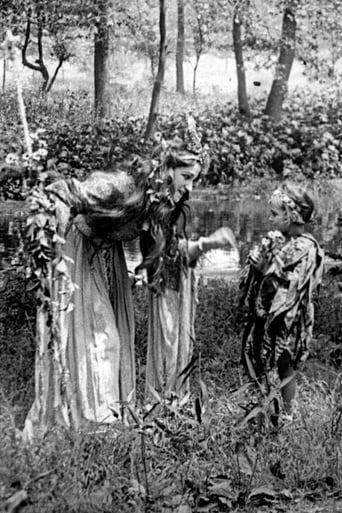
The Tempest
"There Prospero."
Keys: Space play/pause · ←/→ 10s · F fullscreen · M mute · </> speed
About this film
Prospero and his daughter Miranda must take refuge on an enchanted island. There Prospero, who himself has magical powers, releases the spirit Ariel from a spell, and also meets the savage Caliban. Then Prospero uses his powers to create a tempest that shipwrecks some of the persons who caused his exile.
Cast & crew
More films like this

More Fantasy films
View all →

More from Percy Stow
View all →More about this film
About the production
Release dateMarch 1908
ProductionClarendon Film Company
Filmed inLondon, England
This was one of the earliest cinematic adaptations of Shakespeare's work, produced during the pioneering era of British filmmaking. The production utilized primitive special effects techniques to represent the magical elements, including multiple exposures and dissolves to create the illusion of spirits and supernatural phenomena. The film was shot on a single set designed to represent the enchanted island, with painted backdrops to suggest the tempest and magical atmosphere. Due to the technical limitations of 1908 cinematography, the actors had to use exaggerated gestures and facial expressions to convey the dramatic emotions of Shakespeare's text.
Themes
Betrayal and revengeForgiveness and redemptionMagic and supernaturalColonialism and powerNature versus civilization
Themes & topics
Historical background
Production circa 1908 meant fixed cameras, intertitles or early sound rigs, and studio economies that shaped every scene in The Tempest.
Why this film matters
Historians treat The Tempest as evidence of what typical 1908 audiences could see in a program slot.
Making of
The production of this 1908 adaptation took place during the infancy of cinema, when filmmakers were still discovering how to translate theatrical works to the new medium. Director Percy Stow, working with the Clarendon Film Company, faced the challenge of condensing Shakespeare's complex play into a 12-minute format suitable for early cinema audiences. The cast would have been drawn from stage actors who were adapting their theatrical techniques for the camera, requiring them to modify their performances for the intimacy of film versus the distance of the stage. The magical elements of the play presented particular technical challenges, with the crew using early special effects techniques such as multiple exposures, dissolves, and stop-motion photography to create the illusion of supernatural events. The tempest scene itself would have been created using miniature models, wind machines, and creative editing to simulate the storm that shipwrecks Prospero's enemies.
What critics said
Press files from 1908 mention The Tempest in roundup columns of what played that week.
Did you know?
- This is believed to be the first film adaptation of Shakespeare's 'The Tempest' and one of the earliest Shakespeare films ever made
- The film was produced by the Clarendon Film Company, one of Britain's early film production studios
- Director Percy Stow was a pioneer of British cinema who made over 100 short films between 1905 and 1915
- The film's runtime of approximately 12 minutes was typical for dramatic films of this period
- No complete print of is known to survive, though fragments may exist in film archives
- The production predated the feature film era, when movies were typically shown as part of variety programs
- Early film adaptations like this were often heavily condensed, with only the most dramatic scenes included
- The film was released during the peak of the British film boom before American dominance of the market
- Silent Shakespeare films of this era often used intertitles to explain the plot since dialogue couldn't be heard
- The special effects for the tempest scene would have been considered quite sophisticated for 1908
Visual style
The cinematography of this 1908 adaptation reflects the technical limitations and aesthetic conventions of early British cinema. The film was likely shot using a hand-cranked camera with black and white film stock, requiring careful exposure control in the studio setting. The camera would have remained largely static, as mobile camera techniques were not yet developed, with movement created through actor blocking rather than camera movement. The enchanted island setting would have been created using painted backdrops and theatrical set pieces, typical of the period. Lighting would have been rudimentary, primarily using natural light from studio skylights supplemented by arc lamps when needed. The magical elements, including Ariel's appearances and the tempest sequence, would have been achieved through early special effects techniques such as multiple exposures, dissolves, and matte shots. The visual style would have emphasized clarity and legibility over artistic composition, as the primary goal was to ensure audiences could follow the condensed narrative.
Innovations
This 1908 adaptation demonstrated several technical achievements for its era, particularly in the realm of special effects. The creation of the tempest sequence required innovative use of miniature models, wind machines, and creative editing to simulate a storm at sea. The magical appearances and disappearances of Ariel would have been accomplished through multiple exposure techniques, allowing actors to appear and disappear within the same frame. The film likely employed dissolves and fade transitions, which were relatively sophisticated editing techniques for the period. The production team would have had to solve numerous technical challenges in representing supernatural phenomena using the limited equipment available in 1908. The condensation of Shakespeare's complex narrative into a 12-minute format required careful planning and efficient storytelling techniques. The film also represents an early example of literary adaptation, demonstrating how filmmakers were developing methods to translate theatrical works to the new medium of cinema.
Music
As a silent film produced in 1908, this adaptation of 'The Tempest' had no synchronized soundtrack. During exhibition, the film would have been accompanied by live musical performance, typically a pianist or small ensemble in the cinema venue. The musical accompaniment would have been selected to match the mood of each scene, with dramatic music for the tempest sequence, romantic themes for Miranda and Ferdinand's meeting, and mysterious melodies for the magical elements. Some larger cinemas might have employed a small orchestra to provide more elaborate accompaniment. The music would have been drawn from popular classical pieces, theater repertoire, or improvised by the musician. In some cases, cue sheets provided by the distributor might have suggested specific musical pieces for different scenes. The absence of recorded dialogue meant that intertitles were used to convey essential plot points and Shakespeare's key lines, though these would have been severely abbreviated due to time constraints.
Famous quotes
We are such stuff as dreams are made on, and our little life is rounded with a sleep." (likely included in intertitle form)
Hell is empty and all the devils are here." (referenced in storm sequence)
You taught me language, and my profit on't is, I know how to curse." (Caliban's sentiment conveyed through action)
Memorable scenes
- The tempest sequence where Prospero creates the storm using his magical powers, achieved through early special effects techniques including miniature ships and creative editing
- Ariel's first appearance and release from imprisonment, likely using multiple exposure techniques to create the illusion of a spirit materializing
- The meeting of Miranda and Ferdinand, where the young lovers see each other for the first time after the shipwreck
- Caliban's introduction and subsequent rebellion against Prospero's authority, conveying the theme of colonial oppression through exaggerated gestures and expressions
What audiences thought
Audience reception in 1908 would have been shaped by the novelty of seeing Shakespeare adapted to the new medium of cinema. Edwardian theater-goers, familiar with elaborate stage productions of 'The Tempest,' would have been curious about how the magical elements could be represented on film. The 12-minute format, typical of the era, would have been presented as part of a varied program including other short films, newsreels, and possibly live performances. Contemporary accounts suggest audiences were impressed by the special effects used to create the tempest and magical appearances, despite their primitive nature by modern standards. The film likely appealed to both working-class audiences seeking entertainment and middle-class viewers drawn by the Shakespeare connection. The adaptation would have been particularly notable for bringing a cultural classic to the increasingly popular nickelodeons and early cinema palaces that were transforming entertainment in Britain's urban centers.
Film connections
Influenced by
- William Shakespeare's play 'The Tempest'
- Victorian theatrical productions of Shakespeare
- Earlier stage adaptations and interpretations
- Contemporary magical and supernatural literature
This film influenced
- Later silent Shakespeare adaptations
- 1911 American 'Tempest' adaptation
- 1979 Derek Jarman version
- 2010 Julie Taymor adaptation
- Various television and film interpretations
Film restoration
This 1908 adaptation is considered a lost film, with no complete known surviving print in any film archive. Some film historians suggest fragments may exist in private collections or unidentified reels in archives, but these have not been definitively identified. The loss of is typical of productions from the early cinema period, when preservation was not a priority and the highly flammable nitrate film stock led to many losses. The British Film Institute and other archives continue to search for missing early British films, including this adaptation. Some production stills or promotional materials may survive in trade publications of the era, providing visual documentation of the film's existence. The loss of this early Shakespeare adaptation represents a significant gap in the history of Shakespeare on film.
Where to watch
- No known viewing options exist as the film is considered lost
- Film archives may have fragments or related materials available for research
- Historical film societies occasionally present reconstructions or discussions of lost early films
- Academic institutions may have access to related documentation or still images from the production