Joe Cook
Actor
Born: March 29, 1890 in Evansville, Indiana, USA Died: May 15, 1959 Active: 1906-1941 Birth Name: Joseph Lopez
Films
1 film
About Joe Cook
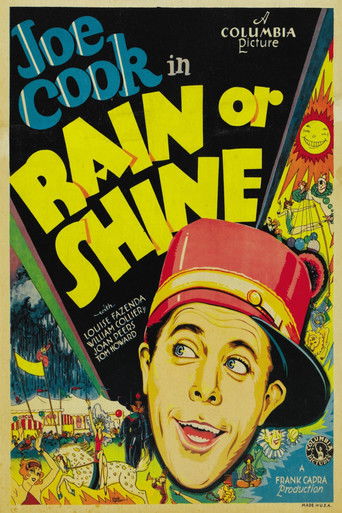
American vaudeville performer, comedian, and actor who was widely celebrated as the 'One-Man Vaudeville Show' during the 1920s and 1930s. Born Joseph Lopez in Evansville, Indiana, he was orphaned at the age of three and adopted by relatives, taking the surname Cook. He began his career in circuses and medicine shows as a teenager, mastering an incredible array of skills including juggling, unicycle riding, wire-walking, and several musical instruments. By the 1920s, he had become one of the highest-paid headliners in vaudeville, famously performing at New York's Palace Theatre and starring in major Broadway hits like 'Rain or Shine' and 'Fine and Dandy.' Although he preferred the live stage to the screen, he starred in the 1930 film adaptation of 'Rain or Shine,' directed by a young Frank Capra, which remains his most significant cinematic contribution. His career was tragically cut short in 1941 when he was diagnosed with Parkinson's disease, forcing him into a long retirement before his death in 1959.
The Craft
On Screen
Cook's acting style was a high-energy blend of physical comedy, surrealist monologues, and 'doubletalk.' He often played an 'average Joe' character who would suddenly engage in absurdly complex tasks or deliver nonsensical, rapid-fire stories. His performances were heavily influenced by his circus background, incorporating juggling and acrobatics into his character work. He excelled in the 'Rube Goldberg' style of comedy, using elaborate, needlessly complicated mechanical props to achieve simple results, creating a sense of whimsical chaos that predated the Marx Brothers' cinematic peak.
Milestones
- Headlined at the prestigious Palace Theatre in New York City
- Starred in the Broadway hit 'Rain or Shine' (1928) and its 1930 film adaptation
- Known as the 'One-Man Vaudeville Show' for his mastery of over a dozen variety skills
- Starred in 'Fine and Dandy' (1930), the first Broadway hit completely scored by a woman (Kay Swift)
- Created the famous 'Four Hawaiians' monologue, a staple of early 20th-century comedy
- Owned the legendary 'Sleepless Hollow' estate, a hub for Golden Age celebrities
Best Known For
Iconic Roles
Must-See Films
Accolades
Special Recognition
- Inducted into the International Jugglers' Association Hall of Fame
- Subject of a permanent exhibition at the Lake Hopatcong Historical Museum
- Called 'the greatest man in the world' by New York Times critic Brooks Atkinson
Working Relationships
Worked Often With
Studios
Why They Matter
Impact on Culture
Bridge between the physical spectacle of the circus and the sophisticated 'nonsense' comedy of early Broadway and talkies. His 'Four Hawaiians' routine became a cultural touchstone, cited by fellow comedians as a masterpiece of the 'tall tale' genre. He was one of the few performers who could legitimately claim to be a 'one-man show,' influencing the variety format of early television. His penchant for absurd mechanical inventions also influenced the visual language of comedy, paving the way for the elaborate prop-based humor seen in later decades.
Lasting Legacy
Though his filmography is small, Cook's legacy is preserved through the restoration of 'Rain or Shine' by Sony Pictures and his enduring reputation among historians of American variety theater. He is remembered as. His stooge, Dave Chasen, went on to found Chasen's, the legendary Hollywood restaurant, ensuring that Cook's name remained a part of industry lore long after his retirement.
Who They Inspired
He directly influenced the comedic timing and 'absurdist' persona of performers like Fred Allen and the Marx Brothers. His use of complex, useless machinery influenced later visual comedians and even the 'gadget' comedy of the mid-20th century.
Off Screen
Joe Cook was orphaned at age three after his father died saving a drowning boy and his mother passed away shortly after. He was raised by his aunt and uncle, Anna and Joseph Cook, in the back of their grocery store. He was married twice, first to Beatrice Helen Reynolds and later to Alice Boulden. He was a devoted family man who famously hosted lavish, prank-filled parties at his New Jersey estate, 'Sleepless Hollow,' which featured a three-hole golf course with 'booby traps' like a camouflaged rock that would bounce balls back at the golfer.
Education
Self-taught through circus and medicine show apprenticeships; no formal higher education.
Family
- Beatrice Helen Reynolds (1913-1934)
- Alice Boulden (1935-1959)
Did You Know?
- He once used a doctored photo of himself juggling 17 balls to get his first major vaudeville booking.
- His estate 'Sleepless Hollow' had a golf course where the first hole was played through a tunnel and the second required hitting a ball into a 20-foot-high funnel.
- He excelled in 'doubletalk,' a technique of speaking in a way that sounds like real language but is actually nonsensical.
- Cook — highly skilled 'five-club' juggler, a rare feat in the early 1900s.
- Despite his Parkinson's diagnosis, he continued to juggle for his family well into his 60s.
- He was one of the highest-paid stars of the 1920s, earning upwards of $3,000 a week at his peak.
In Their Own Words
I will now give an imitation of three Hawaiians. This is one (whistles), this is another (plays ukulele), and this is the third (marks time with his foot). I could imitate four Hawaiians just as easily, but. Why should a man with $350,000 bother to imitate four Hawaiians?
Of course, I don't want to brag, but I'm the only man in the world who can juggle three balls while standing on a rolling globe and playing 'The Rosary' on a violin.
Frequently Asked Questions
Who was Joe Cook?
Premier American vaudeville comedian and Broadway star known as the 'One-Man Vaudeville Show.' He was famous for his incredible versatility, combining juggling, acrobatics, and surreal comedy into a single act.
What films is Joe Cook best known for?
Titles linked here include Rain or Shine (1930), Arizona Mahoney (1936).
When was Joe Cook born and when did he die?
Born March 29, 1890; died May 15, 1959.
What was Joe Cook's 'Four Hawaiians' bit?
It was a famous comedy monologue where Cook would offer to imitate four Hawaiians, perform a few simple sounds for three of them, and then spend several minutes telling a convoluted story about why he was too wealthy to bother imitating the fourth.
Why did Joe Cook retire from show business?
He was forced to retire in 1941 after being diagnosed with Parkinson's disease, which made it impossible for him to perform the complex physical stunts and juggling that were the hallmarks of his act.