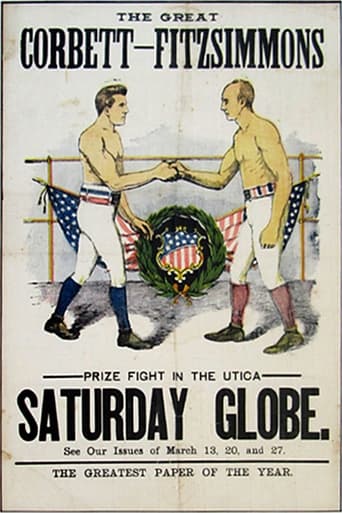
Films
1 film
About Billy Madden
Actor from the earliest days of cinema, appearing during the year of 1897. His sole known film appearance was in 'The Corbett-Fitzsimmons Fight,' a documentary that captured the historic boxing match between James J. Corbett and Bob Fitzsimmons. This film was remarkable for its time as it ran for over 100 minutes, making it one of the first feature-length motion pictures ever produced. Madden was likely involved in the production as either a participant or background figure during the filming of this sporting event. The film was directed by Enoch J. Rector and was shot on a widescreen format called 'Veriscope,' which was revolutionary for its era. Unfortunately, like many performers from cinema's birth, detailed records of Madden's life and career have been lost to time, leaving only this single credit as evidence of his contribution to early film history.
The Craft
Milestones
- Appeared in 'The Corbett-Fitzsimmons Fight' (1897), one of cinema's first feature-length films
Best Known For
Must-See Films
Working Relationships
Worked Often With
Studios
Why They Matter
Impact on Culture
Billy Madden represents the anonymous pioneers who helped launch the film industry during its infancy in the late 1890s. Though his contribution was minimal, his participation in 'The Corbett-Fitzsimmons Fight' connects him to. This film demonstrated that motion pictures could be more than just short novelties and could serve as a medium for documenting major events, paving the way for the narrative films that would follow. Every actor from this period, no matter how obscure, played a role in establishing cinema as a legitimate art form and entertainment medium.
Lasting Legacy
Billy Madden's legacy is tied to the historic significance of 'The Corbett-Fitzsimmons Fight,' which remains an important milestone in film history. While his individual contribution may have been small, he represents the countless unknown performers and workers who helped build the foundation of the film industry during its experimental phase. The film itself was preserved and recognized for its historical importance, ensuring that even the most minor participants like Madden are remembered as part of cinema's generation.
Who They Inspired
As an actor from the very beginning of cinema, Billy Madden's influence on later performers is likely negligible due to his brief career and the primitive state of the art form at the time. However, like all early film participants, he contributed to proving that moving pictures could capture and preserve human performances for future audiences, establishing the basic premise upon which the entire film industry would be built.
Off Screen
Very little is known about Billy Madden's personal life, as is common with actors from cinema's earliest period. Records from the 1890s are sparse, and many early film performers were not documented with the same thoroughness as later Hollywood stars.
Did You Know?
- 'The Corbett-Fitzsimmons Fight' was over 100 minutes long, making it one of the first feature-length films in history
- The film was shot using the Veriscope widescreen process, which was 63mm wide compared to the standard 35mm
- The boxing match it documented took place on March 17, 1897, in Carson City, Nevada
- The film was a massive commercial success, grossing over $100,000 at a time when movie tickets cost just a few cents
- Only fragments of the original film survive today, making any appearance by actors like Billy Madden extremely rare to see
- The film was so successful that it led to a wave of boxing films being produced in the following years
- Early film actors like Madden were often not credited by name in the productions they appeared in
- The film was considered scandalous by some moralists of the time because it showed men in boxing trunks
- Billy Madden was active during the same year that Thomas Edison's Vitascope projector was first demonstrated commercially
Frequently Asked Questions
Who was Billy Madden?
American with credits in this catalog.' He represents the anonymous pioneers who helped establish the film industry during its experimental phase in the late 19th century.
What films is Billy Madden best known for?
Titles linked here include The Corbett-Fitzsimmons Fight (1897).
When was Billy Madden born and when did he die?
Unfortunately, Billy Madden's birth and death dates are unknown, as is common with many performers from cinema's earliest period. The only documented year of his activity is 1897.
What awards did Billy Madden win?
Billy Madden did not receive any awards or nominations, as the formal award systems for cinema would not be established for decades after his brief career in 1897.
What was Billy Madden's acting style?
Billy Madden's acting style is unknown due to the limited documentation of his work. As an actor in 1897, he would have been working during the very birth of cinema when acting techniques for film were still being developed.
Why is Billy Madden significant in film history?
Billy Madden is significant primarily because he participated in 'The Corbett-Fitzsimmons Fight,' one of cinema's first feature-length films. Though his role was minor, he represents the anonymous pioneers who helped establish motion pictures as a viable medium for entertainment and documentation.
Was Billy Madden a boxer or just an actor?
It is unclear whether Billy Madden was actually involved in boxing or was simply an actor who appeared in the documentary. Given the film's nature as a recording of an actual sporting event, he may have been a participant, attendant, or background figure during the match.