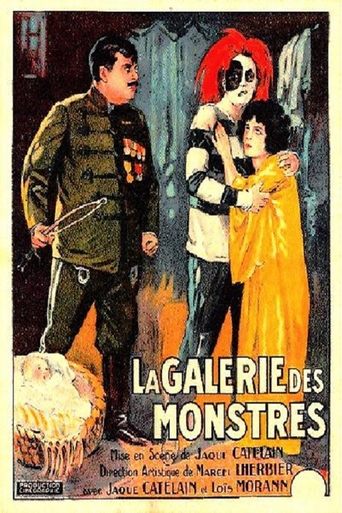
Jean-Paul Le Tarare
Actor
- Active
- 1924-1924
Films 1
About Jean-Paul Le Tarare
Available film-reference sources for classic cinema do not provide a substantive biographical record for Jean-Paul Le Tarare beyond his credited appearance in the 1924 film The Gallery of Monsters. He appears to be an obscure or poorly documented screen performer from the silent era, and no reliable contemporary biographical profile, studio publicity campaign, or later retrospective account has been identified in standard reference material. Because of that, details such as birth date, birthplace, education, personal life, and later career remain unverified. His surviving screen credit indicates that he worked as an actor in at least one silent-era production, but the record is too sparse to determine whether this was a stage name, a European performer working in a small role, or a brief screen career under an anglicized or variant spelling. In the absence of corroborated evidence, it is safest to treat him as a documented but highly obscure screen credit rather than a fully profiled figure in film history. Further confirmation would likely require archival trade papers, studio records, or original film program materials from the period.
More about Jean-Paul Le Tarare
In film history
Jean-Paul Le Tarare's cultural impact is limited by the extremely small surviving documentary footprint of his career. His name persists primarily because silent-era film credits and cast lists preserve many performers who otherwise vanished from mainstream historical memory. In that sense, he represents the broader issue of lost or partially lost film histories, where thousands of working actors participated in early cinema yet left behind little more than a line in a cast sheet. For researchers and database curators, such figures are important because they help reconstruct the personnel networks of silent-era production and exhibition. Even without a substantial biography, his credit contributes to a more complete understanding of the labor and cast composition behind lesser-known 1920s films.
Later reputation
Le Tarare's legacy is archival rather than star-driven: he is remembered, if at all, through the filmography record attached to The Gallery of Monsters. His case illustrates how many silent-era performers remain under-documented, with their careers recoverable only through fragmentary evidence. In film history, these obscure credits matter because they can point to international casting practices, studio transcription habits, and the movement of performers between stage and screen. While no broad influence can be confidently attributed to him individually, his surviving record is still valuable as part of the historical fabric of early cinema. For modern databases, preserving his name accurately helps prevent the erasure of minor participants in classic film production.
Influence
No direct influence on later actors or directors can be verified from the current record. His significance lies in the historical presence of his credit, which may be of use to archivists, film historians, and restoration researchers studying silent-era casting. Without corroborated information on additional performances, teaching, or public career activity, any claims of artistic influence would be speculative.
Off screen
No reliable personal biographical information has been located for Jean-Paul Le Tarare in standard classic-cinema reference sources. Marital status, family background, residence, and post-film career are not documented in the accessible record. Because the available evidence is limited to a film credit, any additional claims about his private life would be speculative.
Credits
- Credited screen appearance in the silent feature The Gallery of Monsters (1924)
- Documented participation in early 1920s silent cinema
- Presence in surviving cast records for a classic-era production
- An example of an obscure performer whose name survives through film credit documentation
Roles
- Role in The Gallery of Monsters (1924)
Films
- The Gallery of Monsters (1924)
Notes
- His name survives in classic-cinema references despite an otherwise minimal documented biography.
- He is credited with a role in The Gallery of Monsters, a 1924 silent production.
- No standard biographical details such as birth date or birthplace are readily verified in common reference sources.
- He is a good example of how many silent-era performers are known only through partial film credits.
- His record may reflect an alternate spelling, stage name, or incomplete archival cataloging.
- Because his documentation is so limited, he is more easily studied through filmography databases than through biographical sources.
Questions
Who was Jean-Paul Le Tarare?
Jean-Paul Le Tarare is a largely obscure silent-era film actor known from a credited appearance in The Gallery of Monsters (1924). Surviving reference material does not provide a substantial biography, so he is best understood as a documented but poorly preserved figure from early cinema history.
What films is Jean-Paul Le Tarare best known for?
He is currently best known for The Gallery of Monsters (1924), which is the only reliably documented film credit available in the accessible record. No additional confirmed screen appearances are readily verified from standard reference sources.
When was Jean-Paul Le Tarare born and when did he die?
His birth and death dates are not currently verifiable from reliable classic-cinema sources. The available record does not provide confirmed biographical details such as birthplace, lifespan, or later-life information.
What awards did Jean-Paul Le Tarare win?
No awards or nominations are documented in the available reference record for Jean-Paul Le Tarare. This is not unusual for obscure silent-era performers whose careers are known only through partial cast listings.
What was Jean-Paul Le Tarare's acting style?
His acting style cannot be reliably assessed because no critical descriptions, reviews, or performance analyses have been identified. Any characterization of his screen technique would be speculative without surviving reviews or multiple credited performances.
What is Jean-Paul Le Tarare's legacy in film history?
His legacy is primarily archival: he remains part of the historical record for early silent cinema, even though little biographical information survives. Preserving his credit helps film historians and database editors maintain a more complete picture of the personnel involved in 1920s productions.