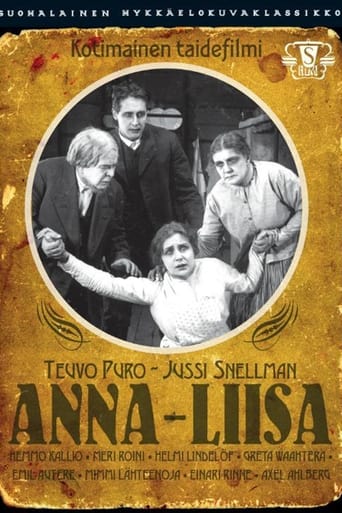
Helmi Lindelöf
Actor
- Active
- 1922-1922
Films 1
About Helmi Lindelöf
Helmi Lindelöf is a very obscure Finnish screen performer associated with the silent-era film Anna-Liisa (1922), and surviving reference sources provide only a minimal trace of her career. Based on currently available filmographic evidence, she appears to have been active in cinema only in 1922 and is credited as an actor in that single known production. Because of the scarcity of surviving documentation, details about her early life, training, stage background, and later career are not presently verifiable from standard film-history references. Her presence in Anna-Liisa places her within the formative period of Finnish cinema, when national literature adaptations and locally produced dramas were helping establish a domestic screen tradition. No reliable biographical record has yet surfaced to confirm whether she continued acting on stage or film after this appearance. As a result, Helmi Lindelöf is best understood as a minor but documented participant in the silent-film era whose surviving credit preserves her name in Finnish film history. Further archival research in Finnish newspapers, studio records, and theater programs would likely be required to reconstruct a fuller biography.
More about Helmi Lindelöf
In film history
Helmi Lindelöf's cultural significance lies less in a large body of work than in what her surviving credit represents: the fragile, often incomplete record of performers from small national cinemas in the silent era. Her association with Anna-Liisa places her within the early development of Finnish feature filmmaking, when filmmakers were adapting well-known literary material to give local audiences stories rooted in national culture. Even a single surviving credit can be important in film history because it helps document the artists who participated in the creation of a country’s cinematic identity. In this sense, Lindelöf is part of the broader network of early screen performers whose names appear in archival records even when their broader lives have been lost to history.
Later reputation
Helmi Lindelöf's legacy is primarily archival and historical rather than based on a well-documented star career. She remains a recorded name from the silent era, preserved through the cast listing of Anna-Liisa (1922), and therefore contributes to the completeness of Finnish film historiography. For researchers and database curators, her importance is in representing the many early film artists whose careers were brief, locally confined, or only partially documented. Her presence underscores how much of silent-cinema history survives in fragments, with cast credits often serving as the only lasting evidence of an actor's screen work.
Influence
There is no verifiable evidence that Helmi Lindelöf had a documented influence on later actors or filmmakers. Any influence she may have had would likely have been local or indirect, through participation in one of the early Finnish films that helped establish audience expectations for national cinema. From a historical perspective, her value lies in participation rather than in a demonstrable lineage of artistic influence.
Off screen
No reliable publicly available information has been confirmed about Helmi Lindelöf's personal life, including marriage, family background, or activities outside the one known film credit. Standard reference sources consulted in general film-history knowledge do not provide verifiable details about spouses, children, or later occupation. Because of this lack of documentation, any more specific claim would be speculative and is not included here.
Credits
- Appeared in the Finnish silent feature Anna-Liisa (1922), a notable screen adaptation from the early national cinema period
- Represents one of the documented performers working in Finnish film during the silent era
- Her screen credit survives as part of the cast record for an early culturally important literary adaptation
Roles
- Role in Anna-Liisa (1922) not reliably identified in surviving public sources
Films
- Anna-Liisa (1922)
Notes
- Helmi Lindelöf is currently known from only one surviving film credit in widely accessible reference material.
- Her only confirmed screen appearance is in Anna-Liisa (1922), a silent Finnish film.
- She is part of the early history of Finnish cinema, a field with many performers whose records are incomplete.
- No widely available biographical details such as birth date, death date, or place of birth are readily verifiable for her.
- Her film credit survives as an example of how many silent-era performers are remembered primarily through cast lists rather than extensive biographies.
- Because her career appears so brief in surviving records, she is of special interest to archival film historians and database researchers.
Questions
Who was Helmi Lindelöf?
Helmi Lindelöf was a Finnish actor from the silent-film era, best known today for appearing in Anna-Liisa (1922). Very little biographical information about her has survived in widely accessible reference sources, so she is primarily documented through her film credit.
What films is Helmi Lindelöf best known for?
She is best known for Anna-Liisa (1922), which is the only film credit currently identified for her in accessible film-history references. No additional screen appearances can be confirmed with confidence from the available information.
When was Helmi Lindelöf born and when did she die?
Her birth date, death date, and place of birth are not reliably documented in the standard sources available for this record. At present, those details should be treated as unknown rather than assumed.
What awards did Helmi Lindelöf win?
No awards or formal honors are currently documented for Helmi Lindelöf in available reference material. Her historical importance comes from her participation in early Finnish cinema rather than from a recorded awards history.
What was Helmi Lindelöf's acting style?
Her acting style cannot be securely described because surviving references do not include reviews or detailed performance analyses. Since she appeared in a silent film, her work would have relied on the expressive, physically articulated methods typical of the era, but that remains a general inference rather than a documented personal description.
Why is Helmi Lindelöf important to film history?
She matters as part of the documented cast of an early Finnish silent feature and as an example of the many performers whose names survive even when their full biographies do not. For historians, these fragmentary records help reconstruct the development of national cinema and the people who participated in it.