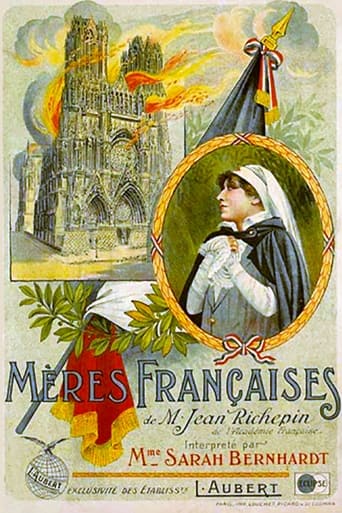
Berthe Jalabert
Actor
- Active
- 1917-1917
Films 2
About Berthe Jalabert
Berthe Jalabert was a French stage and screen actress active during the silent era, remembered today chiefly for her appearance in the 1917 film Mothers of France. Her surviving film record is very limited, which suggests that her career was rooted primarily in the theater, as was common for many French performers of her generation who moved between the stage and early cinema. Because documentation about her life is sparse, many personal details such as her birth and death dates, family background, and training are not readily verifiable from standard film references. What can be established with confidence is that she was part of the generation of classical French performers who brought theatrical discipline and expressive physical acting to silent film roles. Her screen work places her within the important wartime and immediate pre-1920 period of French cinema, when melodrama, patriotic themes, and literary adaptations were especially prominent. Although not a widely documented star, she remains a traceable part of silent-film history through her credited participation in Mothers of France and related archival filmographies. Her legacy is therefore less about celebrity than about representing the many experienced character actors whose work helped shape early French screen acting.
More about Berthe Jalabert
On screen
Specific contemporary descriptions of Berthe Jalabert's acting style are not readily available, but as a French silent-era performer she likely relied on the expressive physicality, precise gesture, and stage-trained facial emphasis common to early screen acting. Performers of her background typically balanced theatrical clarity with the more intimate demands of the camera, especially in melodramatic or domestic roles. Her work would have been shaped by the conventions of wartime French cinema, where emotional legibility and moral seriousness were central.
In film history
Berthe Jalabert's cultural impact lies primarily in her presence within early French silent cinema rather than in a large surviving body of work. Even a single credited appearance in a 1917 film places her within a crucial historical moment when French filmmakers were defining cinematic performance under the pressures of wartime production and changing audience expectations. Her career is representative of the many stage-trained actors who helped legitimize film acting as a serious dramatic craft in Europe. For historians, names like hers are important because they preserve the fuller texture of silent-era production beyond the few internationally famous stars. Although she does not appear to have achieved broad celebrity, her inclusion in film records helps document the collaborative nature of early cinema, where supporting performers often carried significant emotional and narrative weight. In this sense, her legacy is archival as much as artistic: she stands as evidence of a working actress whose contribution survives in credits even when biographical detail does not. That survival matters because it allows modern databases and historians to reconstruct the personnel of lost or partially lost film cultures. Her name also underscores the role of women performers in shaping French screen melodrama during the 1910s, a field often dominated in memory by directors and leading stars.
Later reputation
Berthe Jalabert's legacy is that of a documented silent-era actress whose surviving record contributes to the historical map of French cinema. While she is not known to have left behind a large filmography or a widely recognized star persona, her credited work in Mothers of France gives her a place in the history of wartime French filmmaking. For scholars and film databases, figures like Jalabert are essential because they fill in the cast lists, production networks, and performance traditions that made early cinema possible. Her legacy is therefore quiet but meaningful: she remains part of the broader body of classical screen performers whose work supports the study of silent film culture. In the absence of extensive biography, her film credit itself becomes her most enduring historical trace.
Influence
There is no documented evidence that Berthe Jalabert directly influenced later named performers in a traceable, personal sense. Her broader influence is indirect, stemming from the example of stage-trained actors who helped establish the performance vocabulary of French silent cinema. By participating in films of the 1910s, she belonged to a generation whose work informed the evolution from theatrical declamation to more naturalistic screen acting. Her presence in the historical record assists later researchers in understanding the working conditions and casting practices of early French film production.
Off screen
Reliable information about Berthe Jalabert's personal life is not readily available in standard film references. No verified details concerning her marriages, children, education, or family background could be confidently established from accessible historical records. Like many performers of the silent era who were not major international stars, she left a very limited biographical paper trail in popular reference sources. As a result, her life outside the screen remains largely undocumented in the public record.
Credits
- Appeared in the 1917 silent film Mothers of France, her best-documented screen credit
- Worked as part of the generation of French performers who bridged stage traditions and early cinema
- Contributed to the wartime French film culture of the 1910s, a period marked by patriotic and melodramatic storytelling
- Represents the many lesser-documented but historically important character performers of the silent era
Roles
- Unnamed role in Mothers of France (1917)
Films
- Mothers of France (1917)
Notes
- Her most secure and best-known screen credit is Mothers of France (1917).
- She was active in the silent-film era, when many performers came from the theater rather than from a dedicated film industry.
- Very little personal information about her survives in mainstream reference sources, making her a relatively obscure historical figure.
- Her surviving record highlights the importance of cast lists in reconstructing early French cinema history.
- She is associated with a wartime period of filmmaking in France, when patriotic and domestic dramas were especially common.
- Because her filmography appears to be extremely short in available sources, she may have worked primarily on stage or in productions that were not widely archived.
- Her name is preserved in film history largely through database and archival documentation rather than through widespread popular remembrance.
Questions
Who was Berthe Jalabert?
Berthe Jalabert was a French actress from the silent-film era, best known for her credited appearance in Mothers of France (1917). Surviving information about her life is limited, so she is remembered primarily through film records rather than a detailed biographical profile.
What films is Berthe Jalabert best known for?
She is best known for Mothers of France (1917), which is the principal screen credit associated with her in accessible film histories and databases. No broader filmography is securely documented in the available record.
When was Berthe Jalabert born and when did she die?
Her birth date and death date are not readily verifiable from accessible standard references. As a result, the surviving public record does not currently provide confirmed dates or places for her birth and death.
What awards did Berthe Jalabert win?
No awards or formal honors are documented for Berthe Jalabert in the available historical record. This is not unusual for early silent-era performers whose careers were only partially recorded in later reference sources.
What was Berthe Jalabert's acting style?
Her specific style is not described in surviving contemporary reviews, but as a silent-era French actress she likely used expressive gesture, clear physical storytelling, and stage-trained facial emphasis. Those techniques were typical of performers working in French cinema during the 1910s.
What is Berthe Jalabert's legacy in film history?
Her legacy is archival and historical: she represents the many lesser-known but important performers who populated early French cinema. Even with limited surviving biographical detail, her credited work helps historians reconstruct silent-era production and performance practices.