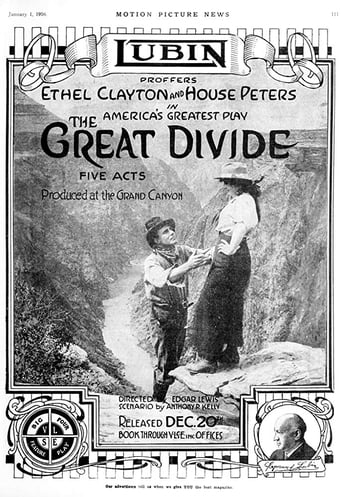

Edgar Lewis
Director
- Active
- 1915-1915
Films directed 1
About Edgar Lewis
Edgar Lewis was an early American film director active during the silent era, best known today for directing The Great Divide (1915), an adaptation of the popular stage play. He belongs to the first generation of filmmakers who helped establish the language of feature-length narrative cinema in the United States, when directors were still defining visual continuity, performance style, and screen storytelling for a growing audience. Surviving documentation on Lewis is limited, and his career is most clearly visible through trade references and filmographies rather than through a large body of widely preserved films. He appears to have worked in the formative years of the feature film industry, when many directors moved between short subjects, literary adaptations, and stage-derived dramas. Because his known filmography is brief in modern records, he is often encountered by film historians as a representative of the many early directors whose contributions were important to silent-era development but whose personal histories were not always thoroughly preserved. His name remains associated with The Great Divide, a title that reflects the industry's early interest in prestige material and dramatized frontier or stage narratives. Beyond that, detailed information about his later life, personal background, and full career arc is scarce in standard surviving reference sources.
More about Edgar Lewis
Behind the camera
Based on the limited surviving record, Edgar Lewis appears to have worked in the straightforward, theatrical-to-cinematic directorial mode common in 1910s silent drama. Directors of this period typically emphasized clear staging, readable gesture, and faithful adaptation of established material, especially for literary or stage-based productions like The Great Divide. His work likely reflected early feature-film conventions: static or lightly mobile cameras, carefully arranged compositions, and performance styles calibrated for silent-screen clarity rather than later naturalism. Because so few detailed production notes survive, any more specific characterization would be speculative; however, he can be placed among the directors who helped translate stage drama into an emerging film language.
In film history
Edgar Lewis's cultural impact is best understood in the context of the early feature-film era rather than through a large surviving canon of work. His association with The Great Divide places him among the directors helping to legitimize film as a medium for serious dramatic material, particularly adaptations of successful stage properties. During the 1910s, directors like Lewis were instrumental in proving that cinema could handle longer-form storytelling, emotional nuance, and commercially viable prestige subjects. Even when their names did not remain as prominent as those of major studio-era auteurs, these filmmakers contributed to the industrial and artistic foundations upon which later American cinema was built.
Later reputation
Lewis's legacy lies primarily in historical significance: he is part of the generation of silent-film directors whose work helped establish the transition from short-form entertainment to feature-length narrative cinema. His surviving footprint in film history is modest, but that modesty itself is instructive, reflecting how many early directors played essential roles without leaving a large accessible record. For researchers of silent cinema, names like Edgar Lewis are valuable because they map the broader ecosystem of the early industry, including the many artists whose labor shaped the medium before star-director branding became dominant. The preservation of his name in filmographies and database records ensures that his contribution to early American cinema is not entirely lost.
Influence
There is no well-documented record of Edgar Lewis exerting a direct, traceable influence on later major directors, at least not in the way more extensively documented silent-era figures did. However, by participating in the early practice of adapting stage works for film and working within the evolving feature format, he contributed to conventions that later directors inherited and refined. His influence is therefore indirect and historical: he belongs to the cohort of craftsmen and early auteurs whose collective work established norms of cinematic storytelling, blocking, and adaptation. In that broader sense, his work helped create the conditions for the later maturity of American narrative film.
Off screen
Reliable biographical information about Edgar Lewis's personal life is not readily available in standard surviving film references. No confirmed details about marriages, children, household, or later career circumstances are widely documented in accessible classic-cinema sources. Like many early silent-era filmmakers, his private life appears to have left only a faint archival trace compared with better-known contemporaries. As a result, any attempt to describe his family background in detail would be speculative.
Credits
- Directed The Great Divide (1915), his best-documented credit in surviving film reference sources
- Worked during the silent-era transition toward feature-length dramatic storytelling
- Contributed to the early adaptation of stage plays for the screen, a major trend in 1910s American cinema
- Represents one of the many formative directors whose work helped shape the grammar of narrative film in the pre-Hollywood and early Hollywood period
Films
- The Great Divide (1915)
Notes
- Edgar Lewis is most readily identified today with The Great Divide (1915), his best-known surviving credit in standard film references.
- He worked during a period when many directors were making the transition from short films to feature-length productions.
- His name appears in silent-era records even though detailed personal biography is scarce, which is common for many early filmmakers.
- The Great Divide was part of a broader 1910s trend of adapting popular stage material for motion pictures.
- Lewis is an example of a filmmaker whose historical importance is larger than the surviving detail about his life.
- Because so little is documented about him, historians must often rely on filmographies and trade listings rather than extensive archival interviews or memoirs.
Questions
Who was Edgar Lewis?
Edgar Lewis was an American silent-era film director best known for directing The Great Divide (1915). He worked during the early development of feature filmmaking, when the grammar of screen storytelling was still being established. Surviving information about his life is limited, so he is primarily remembered through his film credit.
What films is Edgar Lewis best known for?
He is best known for The Great Divide (1915), which is the most clearly documented title associated with him in surviving classic-cinema references. Because his filmography is sparsely preserved in modern sources, other credits are not as securely and widely recorded. His reputation today rests mainly on this early directorial work.
When was Edgar Lewis born and when did he die?
Reliable birth and death dates for Edgar Lewis are not readily available in the surviving standard reference material commonly used for classic cinema research. His biographical record is fragmentary, which is not unusual for silent-era filmmakers whose careers were documented less thoroughly than later studio-era figures. As a result, both dates are currently unknown in this dataset.
What awards did Edgar Lewis win?
No major awards or formal honors are currently documented for Edgar Lewis in the surviving reference sources available for his career. This does not necessarily mean he received none; rather, the early film industry often lacked the awards culture that later became standard. His historical importance is based more on his role in early filmmaking than on decorated recognition.
What was Edgar Lewis's directing style?
His directing style is best understood as typical of early 1910s silent drama: clear, stage-influenced, and focused on readable storytelling. Directors of this era emphasized visual clarity, expressive performance, and faithful adaptation of source material, especially in feature-length dramas. Without more surviving evidence, it is safest to describe his style in these broad historical terms rather than claim precise personal techniques.
What is Edgar Lewis's legacy in film history?
Edgar Lewis's legacy lies in his place among the early directors who helped establish American feature filmmaking. Even though detailed biographical information is scarce, his work on The Great Divide places him within the important 1910s movement toward longer, more ambitious screen dramas. He remains historically significant as part of the foundation on which later silent cinema and studio-era filmmaking were built.