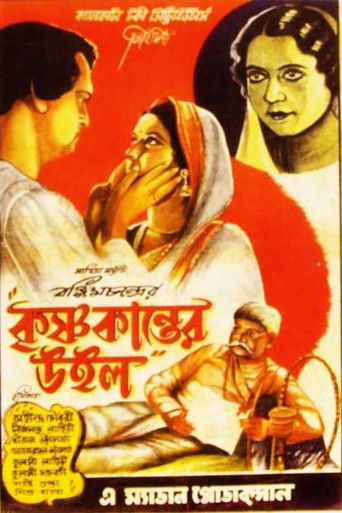

Films
1 film
About Manoranjan Bhattacharya
This archive lists one role for Manoranjan Bhattacharya: Krishnakanter Will (1932). His career was notably brief, with his only known film appearance being in the 1932 production 'Krishnakanter Will.' This film was an adaptation of Bankim Chandra Chattopadhyay's celebrated novel and was one of the early sound films produced in Bengal. As an actor in the early 1930s, Bhattacharya would have been part of the transition from silent films to talkies in Indian cinema. His performance in this literary adaptation demonstrated the growing sophistication of Bengali cinema during this period. Unfortunately, like many actors from this very early era of Indian cinema, detailed records of his life and career are scarce, and he appears to have had a very limited filmography before disappearing from the cinematic landscape.
The Craft
Milestones
- Appeared in 'Krishnakanter Will' (1932), one of the early Bengali talkie films
Best Known For
Must-See Films
Why They Matter
Impact on Culture
Manoranjan Bhattacharya represents the generation of actors who helped establish Bengali cinema during its transition to sound. His participation in 'Krishnakanter Will' (1932) places him among the early performers who brought literary adaptations to the screen, helping to create a tradition of literary cinema in Bengal that would flourish in subsequent decades. Though his individual contribution was limited, actors like him were essential in establishing the foundation for what would become one of India's most important regional film industries.
Lasting Legacy
The legacy of Manoranjan Bhattacharya is primarily historical, serving as proof of the early days of Bengali cinema. His appearance in a significant early talkie film makes him part of the foundational generation of Indian film actors. While he may not have achieved lasting fame, his contribution to the early development of Bengali cinema is historically valuable, representing the many actors who participated in cinema's formative years in India.
Who They Inspired
Due to the brevity of his career and the limited documentation of his work, there is little evidence of direct influence on subsequent generations of actors. However, like all early cinema pioneers, his participation in the medium helped pave the way for the more sophisticated acting styles and techniques that would develop in Bengali and Indian cinema in the following decades.
Off Screen
Very little is known about Manoranjan Bhattacharya's personal life, which is typical for actors from the very early era of Indian cinema where documentation was limited and many performers came from theater backgrounds with little recorded personal history.
Did You Know?
- Appeared in only one known film during his career
- His only film 'Krishnakanter Will' was based on a famous Bengali novel by Bankim Chandra Chattopadhyay
- The film was released during the early years of sound cinema in India
- Very little documentation exists about actors from this early period of Bengali cinema
- His career coincided with the transition from silent films to talkies in Indian cinema
- The film he appeared in was part of the early tradition of literary adaptations in Bengali cinema
Frequently Asked Questions
Who was Manoranjan Bhattacharya?
Screen credits include Bengali films. He is known primarily for his role in the 1932 film 'Krishnakanter Will,' which was one of the early talkie productions in Bengali cinema.
What films is Manoranjan Bhattacharya best known for?
Titles linked here include Krishnakanter Will (1932).
When was Manoranjan Bhattacharya active in cinema?
Manoranjan Bhattacharya was active only in 1932, making him part of the very early generation of talkie actors in Indian cinema. His career appears to have been extremely brief, with only one documented film appearance.
What was the significance of 'Krishnakanter Will' (1932)?
'Krishnakanter Will' was significant as it was one of the early Bengali talkie films and was based on a celebrated literary work. It represented the growing sophistication of Bengali cinema during the transition from silent films to sound.
Why is there so little information about Manoranjan Bhattacharya?
The scarcity of information about Manoranjan Bhattacharya is typical for actors from the very early era of Indian cinema (1930s), when documentation was limited, many performers came from theater backgrounds, and the film industry was still establishing its practices and record-keeping systems.