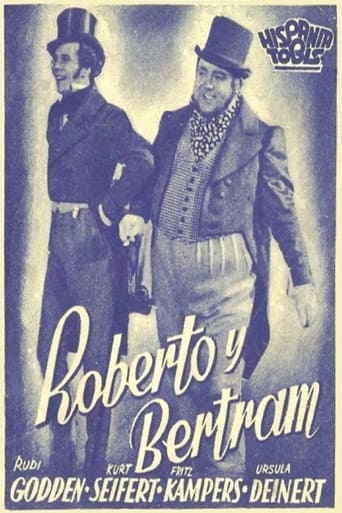
Kurt Seifert
Actor
- Born
- July 4, 1903, Essen, German Empire
- Died
- December 3, 1950
- Active
- 1919-1950
- Birth name
- Kurt Max Karl Seifert
Films 1
About Kurt Seifert
Kurt Seifert was a versatile German performer whose career spanned the stage, screen, and musical theater during the mid-20th century. Born in Essen as Kurt Max Karl Seifert, he began his professional journey at the age of 16, debuting in the play 'Alt-Heidelberg' before establishing himself as a prominent lyre baritone and comedian in regional theaters across Luxembourg and Germany. In 1932, he moved to Berlin, where he became a fixture of the prestigious Metropol-Theater, often starring in lavish operettas and revues. His film career took off in 1934, and he quickly became known for portraying 'earthy' and often humorous characters, such as butchers, bakers, and bumbling philistines. While he primarily played supporting roles, he achieved significant notoriety as the lead in the 1939 musical comedy 'Robert and Bertram,' a film now historically scrutinized for its antisemitic propaganda. Despite the political complexities of the era, Seifert remained a popular figure in German entertainment, appearing in over forty films until his untimely death in 1950. In his final years, he transitioned into theater direction and management, briefly leading the Theater Neukölln in post-war Berlin.
More about Kurt Seifert
On screen
Seifert was celebrated for his 'quirlige Lebendigkeit' (lively energy) and a comedic style that often utilized his large, heavy physical presence—frequently compared to later American comedian Jackie Gleason. He specialized in 'kauzig-originelle' (quirky and original) character types, bringing a sense of down-to-earth realism to roles of everyday tradesmen and middle-class citizens. His background as an operetta singer allowed him to blend musical performance seamlessly with physical comedy, making him a favorite for musical comedies and revues.
Impact on culture
Kurt Seifert was a significant figure in the 'entertainment as enchantment' strategy of the Third Reich, providing a familiar, comedic face that helped normalize the era's cinema. His involvement in 'Robert and Bertram' remains a point of intense study for film historians examining how musical comedy was used as a vehicle for state-sponsored antisemitism. Despite this, his popularity as a 'Volksschauspieler' (people's actor) allowed him to bridge the gap between the pre-war, wartime, and post-war German entertainment landscapes, maintaining a connection with audiences through periods of extreme political upheaval.
Lasting legacy
Seifert's legacy is twofold: he is remembered as one of the great character comedians of the Berlin stage and early sound cinema, but his career is also inextricably linked to the propaganda of the Nazi era. His films, particularly the 'Vorbehaltsfilme' (reserved films) like 'Robert and Bertram,' continue to be shown in educational contexts to illustrate the complexities of film history. In the world of music, his shellack recordings for Telefunken and Odeon remain artifacts of the 1930s Berlin operetta scene.
Who they inspired
His 'heavyweight' comedic persona influenced the archetype of the lovable but bumbling German burgher in later German 'Heimatfilms' and comedies. His ability to transition from a musical star to a character actor provided a template for versatile performers in the German studio system.
Off screen
Seifert was the son of a merchant and received a formal education at a Realschule before pursuing arts. He was married to Irma Seifert (née Fust), a singer and dancer from Hamburg who gave up her own career to support his. The couple was described as an 'incongruous' but devoted pair due to their differing physical statures. Seifert was also known privately as a 'bibliophile' and a man of high conversational culture with a deep love for literature.
Education
Attended Realschule in Germany; received formal vocal training as a baritone and studied acting.
Career milestones
- Professional stage debut at age 16 in 'Alt-Heidelberg'
- Became a leading star of the Berlin Metropol-Theater in the 1930s
- Transitioned to feature films in 1934 with 'The Island'
- Starred as Bertram in the high-profile musical 'Robert and Bertram' (1939)
- Included in the 'Gottbegnadeten-Liste' (God-gifted list) of essential artists in 1944
- Appointed Director of the Theater Neukölln in Berlin after World War II
Iconic roles
- Bertram in 'Robert and Bertram' (1939)
- Hugo Bratzberger in 'Wir machen Musik' (1942)
- Otto Lauschke in the operetta 'Frauen im Metropol'
- Stallmeister Paul in 'Der Mann im Sattel' (1945/2000)
- Karl Brummer in 'Maharadscha wider Willen' (1950)
Must-see films
- Robert and Bertram (1939)
- Wir machen Musik (1942)
- Glückskinder (1936)
- Tango Notturno (1937)
- The Gasman (1941)
- The Black Forest Girl (1950)
Special recognition
- Member of the 'Gottbegnadeten-Liste' (1944), exempting him from military service due to his cultural importance
- Recognized as a leading 'Metropol-Star' during the Golden Age of Berlin Operetta
Worked often with
- Rudi Godden (Actor)
- Hans H. Zerlett (Director)
- Grethe Weiser (Actress)
- Heinz Hentschke (Theater Director)
- Fred Raymond (Composer)
Studios
- Tobis Film
- Terra Film
- UFA
- CCC-Film
Family
- Irma Seifert (née Fust) (married until his death in 1950)
Did you know?
- He was often compared to the American comedian Jackie Gleason due to his large build and expressive comedic face.
- Seifert was a dedicated book collector and bibliophile, known for his extensive personal library.
- He recorded several successful shellac records between 1935 and 1940, including songs from the operetta 'Ball der Nationen'.
- His final film, 'The Black Forest Girl' (1950), was one of the first major color hits of the post-war West German cinema.
- He died at the age of 47 in the Westend Hospital in Berlin; the exact cause of his early death is not widely documented.
- His wife, Irma, lived to be 91 years old and was buried alongside him in the Waldfriedhof Dahlem.
In their own words
He who wants to conquer the world without thunder, must be on his guard and damn canny. (Sung as a character in a Metropol-Theater production, reflecting the 'sly' nature of his stage persona)
Questions and answers
Who was Kurt Seifert?
Kurt Seifert was a prominent German actor, singer, and comedian active from the late 1910s until 1950. He was a major star of the Berlin Metropol-Theater and appeared in over 40 films, known for his comedic character roles.
What is Kurt Seifert's most famous film?
He is best known for the 1939 musical comedy 'Robert and Bertram,' where he played the lead role of Bertram. He is also remembered for 'Wir machen Musik' (1942) and 'The Black Forest Girl' (1950).
Was Kurt Seifert involved in propaganda?
Yes, Seifert starred in 'Robert and Bertram' (1939), which is historically recognized as an antisemitic propaganda film. Because of this, some of his work is still subject to screening restrictions in Germany today.
What was Kurt Seifert's acting style?
He was known for a lively, energetic comedic style, often playing 'common man' characters like tradesmen. His large physical presence and background in operetta singing made him a unique 'heavyweight' comedian of his time.
When did Kurt Seifert die?
Kurt Seifert died on December 3, 1950, in Berlin at the young age of 47. He is buried in the Waldfriedhof Dahlem in Berlin.
Did Kurt Seifert have a musical career?
Yes, before and during his film career, he was a celebrated operetta singer (baritone) and recorded several records for labels like Telefunken and Odeon.