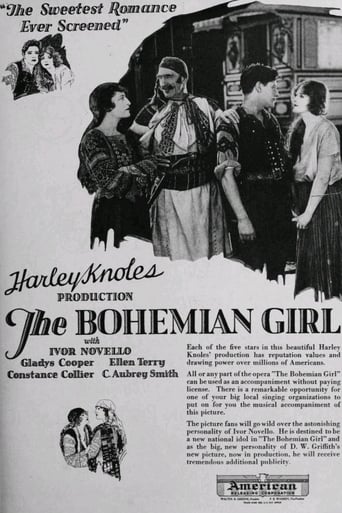
Harley Knoles
Director
- Active
- 1922-1922
Films directed 1
About Harley Knoles
Harley Knoles was an early American film director whose work belongs to the silent era, though detailed biographical documentation about his life remains scarce. He is best remembered for directing The Bohemian Girl (1922), a silent adaptation associated with the era’s frequent practice of turning popular stage works and literary properties into feature films. Knoles appears to have been active in cinema only briefly, with surviving filmography evidence placing him at least in the early 1920s. Because he worked during the transitional, lightly documented years of silent filmmaking, comparatively little is known about his personal background, training, or later career. His surviving credit suggests he was part of the broad class of studio-era craftsmen who contributed to the development of feature-length narrative cinema without becoming a major public celebrity. No reliable mainstream source confirms extensive later-life activity, suggesting that he either left the film industry early or worked in capacities that were not widely recorded. In film history terms, Knoles is primarily significant as a representative of the many directors whose work helped shape silent-era production even when the historical record preserves only fragments of their careers.
More about Harley Knoles
Behind the camera
Knoles’ directing style cannot be reconstructed in detail from the surviving record, but as a silent-era director he would have relied on visual storytelling, expressive blocking, and clear dramatic staging to communicate narrative without synchronized dialogue. His known credit, The Bohemian Girl, suggests experience with adaptation and with translating well-known material into screen form, a task that required emphasis on pictorial composition, gesture, and tempo. Because there are no widely cited contemporary reviews or detailed production studies tied to his name, any more specific stylistic description would be speculative. He is best understood as a practical silent-era filmmaker working within the conventions of early feature production rather than as a highly documented auteur.
In film history
Harley Knoles’ cultural impact is best understood as archival and historical rather than celebrity-driven. Directors like Knoles formed the working backbone of silent-era production, helping establish the grammar of feature filmmaking through studio systems, adaptation practices, and visual narrative techniques. Even when their names do not survive in popular memory, their films contributed to the expanding audience for motion pictures in the early 1920s. His association with The Bohemian Girl places him within the broader history of adapting established stories and stage properties for the screen, a central practice in early film culture. In that sense, Knoles is part of the foundational generation whose labor supported the transition from short-form cinema to more ambitious feature storytelling.
Later reputation
Harley Knoles’ legacy lies mainly in the historical record of silent cinema, where many directors are known today only through isolated credits. His name endures because film databases and archival references preserve his contribution to The Bohemian Girl (1922), allowing researchers to trace the broader network of early filmmakers. Although he does not appear to have left behind a large, celebrated body of work, his career reflects the indispensable role of lesser-known directors in the development of classic Hollywood and silent-era production. For historians, figures like Knoles are valuable because they illuminate how film history was built not only by famous auteurs, but also by a much larger group of craftsmen whose work shaped the industry’s early decades.
Influence
No documented evidence identifies Harley Knoles as a major influence on later directors in the way that more prominent silent-era filmmakers were. His influence is therefore indirect, residing in the films he helped create and in the broader silent-era production practices he participated in. If his work on literary or stage adaptation followed common silent-era methods, then he contributed to conventions that later directors continued to use, especially in visual storytelling and adaptation structure. Because the surviving record is thin, it is most accurate to regard his influence as part of the cumulative influence of early studio filmmaking rather than as a uniquely traceable personal school of directing.
Off screen
No reliable, widely available biographical documentation has been found for Harley Knoles’ personal life, including details about marriage, family, education, or post-film career. He appears in historical film references primarily as a director credit rather than as a well-documented public figure. As a result, any attempt to describe his private life in detail would be speculative. The surviving record does not provide confirmed information about spouses, children, or later personal activities.
Credits
- Directed The Bohemian Girl (1922), his best-documented surviving screen credit
- Worked during the silent era, when feature-length film production was consolidating into a major commercial art form
- Represents the early studio-era directors whose names survive primarily through surviving film credits rather than extensive biographical records
Films
- The Bohemian Girl (1922)
Notes
- Harley Knoles is chiefly remembered today for a single surviving or readily traceable directing credit: The Bohemian Girl (1922).
- His career falls squarely within the silent era, when many directors were documented far less thoroughly than major stars.
- The scarcity of biographical information about him is typical of many early film craftsmen whose work survives better than their personal histories.
- His association with The Bohemian Girl connects him to the era’s strong interest in adapting stage or literary properties for film.
- He is an example of a director whose historical importance is recognized by film databases and archives more than by mainstream popular memory.
- Available sources do not clearly establish his birth date, death date, or family background.
- Because his active period is only documented as 1922 in the supplied filmography, he may have had a very limited film career or a poorly preserved one.
- He is not known as a star system personality; his significance is primarily behind the camera.
Questions
Who was Harley Knoles?
Harley Knoles was a silent-era film director best known for directing The Bohemian Girl (1922). He is not a widely documented celebrity figure, but rather one of the early cinema craftsmen whose work survives in film credits and archival references.
What films is Harley Knoles best known for?
His best-known and most readily documented film credit is The Bohemian Girl (1922). Beyond that, the surviving public record about his filmography is limited, and he does not appear to have a large body of widely cited work.
When was Harley Knoles born and when did he die?
Reliable mainstream sources available in the historical record do not clearly document Harley Knoles’ birth or death dates. His biographical details remain largely unknown, which is common for many early silent-era filmmakers.
What awards did Harley Knoles win?
No awards, nominations, or honors are currently documented for Harley Knoles in the readily available record. His historical significance comes from his place in early film production rather than from formal awards recognition.
What was Harley Knoles’s directing style?
His exact directing style is difficult to reconstruct because so little detailed critical writing survives about him. As a silent-era director, he would have relied on visual storytelling, staged action, and expressive composition to carry the narrative without dialogue.
What is Harley Knoles’ legacy in film history?
His legacy is that of a working silent-era director whose name survives through archival film records. He represents the many early filmmakers who helped build the feature-film industry even if their personal histories were not extensively preserved.