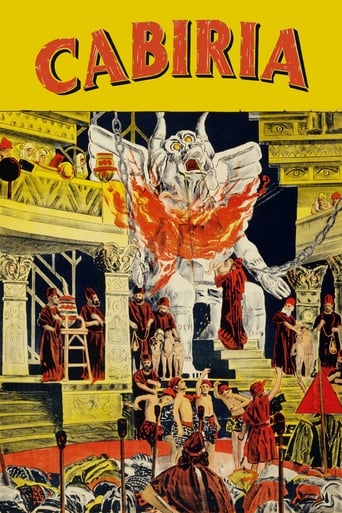
Films
1 film
About Edoardo Davesnes
The 1914 film Cabiria is the only title linked here for Edoardo Davesnes. Best known for his role in the 1914 epic film 'Cabiria.' His career was notably brief, with his only documented film work occurring in 1914 during the height of Italian cinema's golden age. Davesnes was part of the ensemble cast assembled by director Giovanni Pastrone for what would become films of the silent era. 'Cabiria' was renowned for its massive scale, innovative cinematography, and epic storytelling, setting new standards for cinematic spectacle. While his specific role in the film is not well-documented in surviving records, his participation placed him among the early pioneers of feature filmmaking. Like many actors of this period, Davesnes' career appears to have been limited to the early years of Italian cinema before the industry underwent significant changes during and after World War I.
The Craft
Milestones
- Appeared in the landmark silent epic 'Cabiria' (1914)
- Participated in
- Worked with director Giovanni Pastrone
Best Known For
Iconic Roles
Must-See Films
Working Relationships
Worked Often With
Studios
Why They Matter
Impact on Culture
Edoardo Davesnes' contribution to cinema, while limited to a single known film, places him within the context of early Italian cinema's revolutionary period. 'Cabiria' was instrumental in establishing many cinematic conventions that would influence filmmakers worldwide, including D.W. Griffith's 'Intolerance.' The film's massive sets, elaborate costumes, and camera movements set new standards for what cinema could achieve as an art form. As a participant in this landmark production, Davesnes was part of a creative endeavor that helped establish the epic film genre and demonstrated cinema's potential for grand storytelling.
Lasting Legacy
Edoardo Davesnes represents the countless supporting actors and performers who contributed to early cinema's development but whose individual stories have been largely lost to history. His legacy is tied to 'Cabiria,' which remains. While his personal contributions may be difficult to trace in detail, his participation in this groundbreaking film places him among the pioneers who helped shape the language of cinema during its formative years.
Who They Inspired
Due to the limited documentation of his career and the brief nature of his film work, Edoardo Davesnes' direct influence on other performers or filmmakers cannot be specifically traced. However, as part of the cast of 'Cabiria,' he contributed to a film that profoundly influenced generations of filmmakers, including Cecil B. DeMille and Fritz Lang. The techniques and narrative approaches pioneered in 'Cabiria' would become standard elements of epic filmmaking throughout the 20th century.
Off Screen
Very little is documented about Edoardo Davesnes' personal life, which was common for many supporting actors in the early silent film era. Records from this period are often incomplete, especially for performers who had brief careers or worked primarily in supporting roles. Like many actors of his generation, his life story remains largely undocumented in film history archives.
Did You Know?
- Cabiria was one of the first feature-length films ever made, running over two hours
- The film's budget was enormous for its time, equivalent to millions in today's currency
- Cabiria featured some of the earliest examples of camera movement in cinema
- The film was shot on location in Tunisia, Sicily, and the Italian Alps
- Cabiria introduced the character Maciste, who would become one of cinema's first recurring characters
- The film was a massive international success and helped establish Italian cinema's reputation
- Davesnes worked alongside other actors like Lidia Quaranta and Umberto Mozzato
- The film's sets included a full-scale reconstruction of ancient Carthage
- Cabiria's influence can be seen in later epics like Ben-Hur and Cleopatra
- The film was restored and preserved by the Cineteca Italiana and is considered a masterpiece of world cinema
Frequently Asked Questions
Who was Edoardo Davesnes?
Italian with credits in this catalog.' His career appears to have been brief, with documented work limited to 1914 during the peak of Italian cinema's golden age.
What films is Edoardo Davesnes best known for?
Titles linked here include Cabiria (1914).
When was Edoardo Davesnes born and when did he die?
Specific birth and death dates for Edoardo Davesnes are not documented in available historical records, which is common for many supporting actors from the early silent film period. He is known to have been active as an actor in 1914.
What awards did Edoardo Davesnes win?
There are no documented awards or nominations for Edoardo Davesnes, as the major film award systems were not established during his brief career in 1914. The Academy Awards would not be founded until 1929.
What was Edoardo Davesnes' acting style?
Specific details about Edoardo Davesnes' acting style are not documented in surviving records. However, as an actor in 'Cabiria,' he would have worked within the theatrical, exaggerated style common to silent film performance of the era, which emphasized broad gestures and facial expressions to convey emotion without dialogue.
Why is Cabiria considered important in film history?
Cabiria is considered. It pioneered camera movement, epic storytelling, and set design standards that would influence generations of filmmakers worldwide.