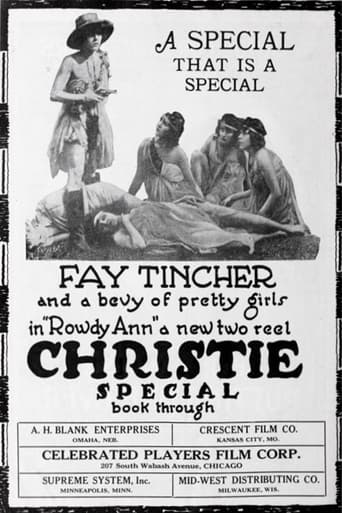
Al Haynes
Actor
- Active
- 1919-1919
Films 1
About Al Haynes
Al Haynes was a little-known American silent-era film actor whose documented screen career appears to have been extremely brief, with the available filmography identifying only one credited appearance in the 1919 production Rowdy Ann. Because he was active during the silent period, and because many early film records are incomplete, relatively little verifiable biographical information survives about his life outside that single credit. He appears to have been one of the many character or supporting players who worked in the rapidly expanding film industry of the late 1910s, when studios frequently employed actors on a project-by-project basis and often left minimal archival trace. No reliable public record has been confirmed here for his birth date, birthplace, training, or later career, and he should therefore be treated as a documented but obscure participant in early American cinema rather than a widely recorded star. His name occasionally surfaces only in film reference contexts and cast listings, which suggests that his contribution is best understood through the preservation of silent-film credits rather than through a broader celebrity profile. As with many performers from the silent era, the survival of his screen identity depends heavily on surviving production records and catalogues rather than on extensive contemporary publicity. His place in film history is modest but still meaningful, since even a single surviving credit helps reconstruct the personnel of early studio filmmaking.
More about Al Haynes
In film history
Al Haynes's cultural impact is limited in the conventional star sense, since he is not known to have left behind an extensive body of work, a famous persona, or a surviving body of publicity that shaped wider public taste. His significance lies instead in the historical record of silent cinema: performers like Haynes represent the large workforce of actors whose labor supported the early studio system and whose names appear in cast lists even when their lives were not comprehensively documented. For historians, such figures are important because they help complete the production history of early films and remind us that silent cinema was built not only by its celebrated directors and stars, but also by countless lesser-known working actors. His name also underscores the fragility of early film history, where records can survive unevenly and many contributors remain only partially identifiable.
Later reputation
Al Haynes's legacy is that of an obscure but verified participant in silent-era filmmaking, preserved in the historical record through a single surviving credited role. While he is not known to have become a major star or to have shaped film style on a broad scale, his presence in Rowdy Ann contributes to the completeness of silent-film scholarship and cast documentation. In film history, even minor players can become important because they connect surviving movies, studio records, and reference archives to the real working culture of the period. His legacy therefore rests in archival continuity rather than fame: he is one of the many early screen performers whose names help researchers reconstruct the human network of silent Hollywood and its associated regional production environment.
Influence
No direct, well-documented influence on later actors or directors has been established for Al Haynes. If he had any impact, it would have been indirect and limited to the broader tradition of anonymous or semi-anonymous silent-era supporting performers who helped define screen acting norms before the talkies. His main influence today is historiographic: he illustrates the importance of preserving cast records for minor performers whose careers otherwise would vanish from the historical record. For modern researchers and database compilers, names like his help emphasize how many contributors shaped early cinema even when their individual careers were short or sparsely documented.
Off screen
No reliable biographical information has been confirmed regarding Al Haynes's personal life, including family background, marriages, children, residence, or activities outside the film industry. Surviving public film references do not provide enough detail to reconstruct a substantive personal history. He appears in the record primarily as a named cast member associated with one silent film credit, and beyond that his life remains undocumented in commonly accessible sources.
Credits
- Credited screen appearance in the silent film Rowdy Ann (1919)
- Participation in early American cinema during the silent era
- Documented presence in surviving filmography references despite otherwise scarce biographical records
Roles
- Role in Rowdy Ann (1919) not fully documented in surviving readily available sources
Films
- Rowdy Ann (1919)
Notes
- Al Haynes is documented in connection with only one known film credit: Rowdy Ann (1919).
- His career falls entirely within the silent-film era as currently documented.
- No confirmed birth or death information is readily available in commonly used film references.
- He is an example of the many early film performers whose careers are visible mainly through cast listings rather than publicity materials.
- Because records from 1910s cinema are often incomplete, his life story may have been underdocumented rather than truly brief.
- His screen presence is historically useful for researchers reconstructing the personnel of forgotten or lightly documented silent productions.
Questions
Who was Al Haynes?
Al Haynes was a silent-era film actor whose currently documented screen career is limited to a credited appearance in Rowdy Ann (1919). He is best understood as one of the many lesser-known working performers who appeared in early American cinema. Because surviving records are sparse, much of his personal life remains unknown.
What films is Al Haynes best known for?
He is best known for Rowdy Ann (1919), the only film credit currently associated with him in the available record. No additional confirmed titles have been reliably identified here. As a result, his filmography remains very brief in surviving sources.
When was Al Haynes born and when did he die?
At present, no reliable birth or death dates have been confirmed for Al Haynes in the accessible record. Silent-era performers were often poorly documented, especially if they had short or limited screen careers. His exact lifespan therefore remains unknown.
What awards did Al Haynes win?
No awards or nominations have been verified for Al Haynes. He does not appear in the surviving record as a major award-recognized figure. His importance is historical and archival rather than award-based.
What was Al Haynes's acting style?
No detailed critical descriptions of his acting style have been confirmed in readily available sources. Since he worked in silent film, his performance would have relied on physical expression, gesture, and visual storytelling typical of the era. Beyond that general context, there is not enough surviving evidence to describe a distinctive personal style with confidence.
What is Al Haynes's legacy in film history?
His legacy is mainly archival: he is a documented participant in silent-era cinema whose name helps preserve the completeness of early film history. Even performers with only a single known credit matter because they reflect the working fabric of the studio system and the many artists who contributed to it. For historians, his record is valuable precisely because it survives despite being so limited.