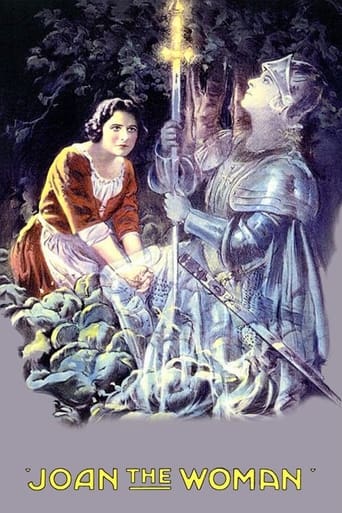
Films
1 film
About Lawrence Peyton
Lawrence Peyton appears once in this catalog: Joan the Woman (1916). His career, though brief, is marked by his participation in one of Cecil B. DeMille's ambitious early epics, 'Joan the Woman' (1916). Peyton was part of a large ensemble cast assembled by the famous director to bring the story of Joan of Arc to life, a production that was for its scale and historical scope. While his role was a supporting one, appearing in a DeMille production of this magnitude in 1916 would have been a notable achievement for any actor of the period. His active years are recorded exclusively as 1916, suggesting his time in the film industry was either very short or his other works have been lost to history. Like many actors from the earliest days of Hollywood, detailed records of his life and career are scarce, leaving 'Joan the Woman' as his primary legacy. He represents the countless performers who contributed to the foundation of cinema during its formative years, even if their names did not achieve lasting fame.
The Craft
Milestones
- Appeared in Cecil B. DeMille's historical epic 'Joan the Woman' (1916)
Best Known For
Must-See Films
Working Relationships
Worked Often With
Studios
Why They Matter
Impact on Culture
Lawrence Peyton's cultural impact is not as an individual but as a component part of a landmark film in early Hollywood history. His participation in 'Joan the Woman' places him within the context of Cecil B. DeMille's efforts to establish the historical epic as a major American film genre. The film itself was a massive undertaking that pushed the boundaries of cinematic storytelling, production design, and scale in 1916. By contributing to this project, Peyton, along with hundreds of other cast and crew members, helped lay the groundwork for the grand Hollywood spectacles that would follow. His legacy is intrinsically tied to the film's place in cinematic history, serving as a reminder of the collaborative nature of filmmaking and the many unsung artists who made these early classics possible.
Lasting Legacy
The legacy of Lawrence Peyton is that of a silent-era ghost, a name preserved only through a film credit. He exemplifies the transient nature of fame for early film actors, many of whom worked for a short time before fading into obscurity. His primary legacy is his name in the cast list of a historically significant film, making him a point of reference for film historians and silent cinema enthusiasts studying the work of Cecil B. DeMille or the production of 'Joan the Woman'. While his individual contribution may have been small, he remains a tangible link to the very early days of the Hollywood studio system and the army of performers it employed.
Who They Inspired
Given his extremely brief and sparse filmography, there is no documented evidence that Lawrence Peyton directly influenced other actors or filmmakers. His influence is indirect, existing only as part of the collective effort that created 'Joan the Woman'. The film itself, with its grand scale and historical subject matter, influenced countless subsequent epics, and as a participant, Peyton is a footnote in that broader chain of cinematic influence.
Off Screen
Very little is known about the personal life of Lawrence Peyton. As a minor actor from the silent era who appeared in only one credited film, detailed biographical information such as family life, marriages, or personal interests has not been preserved in historical records. He is a representative figure of the many anonymous faces who populated early films.
Did You Know?
- His entire known filmography consists of a single film, 'Joan the Woman' (1916).
- He worked under the direction of one of Hollywood's most iconic founding fathers, Cecil B. DeMille.
- 'Joan the Woman' was one of the first feature films to use the Handschiegl Color Process for certain scenes, a very early form of color cinematography.
- The film's production was massive for its time, reportedly involving over 2,000 extras and costing over $300,000, a huge sum in 1916.
- He is listed in the film's credits simply as 'Lawrence Peyton,' with no specific character name attributed to him in most surviving records.
- Like many silent films, the original 1917 version of 'Joan the Woman' is considered lost, though a re-edited version from 1928 survives.
- His co-star, opera diva Geraldine Farrar, was one of the highest-paid actresses in the world at the time, highlighting the prestigious nature of the production he was part of.
Frequently Asked Questions
Who was Lawrence Peyton?
American with credits in this catalog. DeMille's 1916 historical epic, 'Joan the Woman'. His career in film appears to have been very brief, with no other credited roles to his name.
What films is Lawrence Peyton best known for?
Titles linked here include Joan the Woman (1916).
When was Lawrence Peyton born and when did he die?
Unfortunately, the birth and death dates for Lawrence Peyton are not recorded in available film archives or historical databases, a common issue for minor actors from the silent era.
What awards did Lawrence Peyton win?
There are no records of Lawrence Peyton receiving any major awards or nominations for his work in film.
What was Lawrence Peyton's acting style?
Due to the lack of surviving information about his career and the loss of many films from that era, it is not possible to definitively describe Lawrence Peyton's specific acting style. As a supporting actor in a DeMille epic, he likely employed the dramatic, theatrical gestures typical of silent film performance.
What was 'Joan the Woman' and why was it significant?
'Joan the Woman' was a 1916 silent historical epic directed by Cecil B. DeMille, starring Geraldine Farrar. It was significant for its massive scale, high budget, and early use of color effects, helping to establish DeMille excelled in the cinematic spectacle.