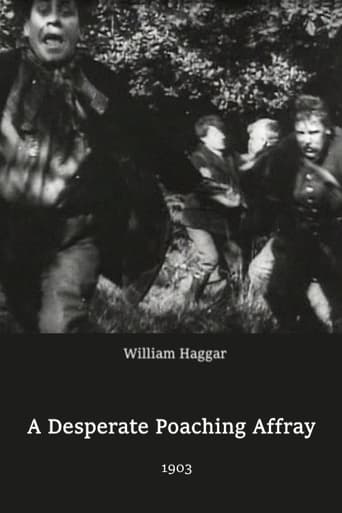
Will Haggar Jr.
Actor
- Active
- 1903-1903
Films 1
About Will Haggar Jr.
Will Haggar Jr. is a very obscure early British screen performer whose surviving record is extremely limited, and he is primarily identified today through his appearance in the 1903 short film Desperate Poaching Affray. He belonged to the formative years of cinema, when many performers came from theatrical, family, or local amateur backgrounds and were recorded in only a handful of surviving credits, if any, by name. Because of the scarcity of documentation, his broader life story, training, and later career are not well preserved in standard film reference sources, and he should be treated as a little-documented figure rather than a well-established star. His credited work places him within the earliest phase of narrative filmmaking in Britain, an era when films were short, highly kinetic, and often centered on melodramatic action or comic incident. Desperate Poaching Affray is the key surviving title associated with him, and it anchors his place in film history as part of the transition from stage-derived performance to cinema-specific acting. No reliable evidence currently confirms a longer film career, later prominence, or a substantial body of surviving roles under this exact name. As a result, Will Haggar Jr. is best understood as a minor but historically interesting participant in the first years of screen acting, especially within early British film production.
More about Will Haggar Jr.
On screen
No detailed contemporary acting analysis survives for Will Haggar Jr. specifically. Given the film style of 1903, his performance would have relied on broad, readable physical expression, clear gesture, and exaggerated action suitable for silent storytelling and short-form exhibition. Actors in this period typically performed in a stage-influenced manner, with emphasis on visual clarity rather than subtle facial nuance, especially in chase or melodramatic subjects.
In film history
Will Haggar Jr.'s cultural impact lies less in personal stardom than in his place within the earliest history of screen performance. His presence in a 1903 film connects him to the period when cinema was still defining its grammar, and when British filmmakers were experimenting with location shooting, pursuit narratives, and dynamic visual storytelling. Even when individual performers from this period are not widely remembered, they form part of the foundation on which later screen acting developed. His credit in Desperate Poaching Affray helps document the participation of early, often uncelebrated performers in the creation of a distinctive national film culture in Britain.
Later reputation
His legacy is primarily archival and historical rather than celebrity-based. Will Haggar Jr. stands as a representative of the many early silent-era performers whose names survive only in connection with a small number of early films. For historians of early British cinema, such figures are valuable because they help reconstruct production practices, family film enterprises, and the evolution of acting before the consolidation of the studio system. In that sense, his surviving credit contributes to the broader narrative of how motion pictures moved from novelty attraction to a recognizable dramatic medium. His name remains relevant chiefly to scholars, archivists, and enthusiasts tracing the origins of British cinema.
Influence
There is no evidence of a traceable influence on later actors or directors under the name Will Haggar Jr., but his performance environment influenced the development of silent acting norms in general. By appearing in an early action-oriented film, he participated in a mode of performance that helped establish the relationship between body movement, camera framing, and narrative clarity. That broader early screen tradition influenced generations of performers who learned to communicate without dialogue and to adjust stage habits for the camera. His historical value is therefore indirect: he is part of the pool of early practitioners whose work collectively shaped cinematic acting conventions.
Off screen
No reliable public record has been found that clearly documents Will Haggar Jr.'s personal life, family circumstances, marriages, or later biography. Because early film credits were often incomplete and many contributors were not extensively profiled in trade papers or studio publicity, even basic biographical information such as date of birth, death, or education may remain unverified. He may have been connected to the Haggar family associated with early film work, but precise family relationships should not be asserted without stronger documentation. At present, any further detail would be speculative rather than archival fact.
Credits
- Appeared in the early British short film Desperate Poaching Affray (1903)
- Participated in one of the earliest surviving narrative action films associated with British cinema
- Represents the type of unheralded performer whose work helped establish screen acting in the silent era
Roles
- Performer in Desperate Poaching Affray (1903)
Films
- Desperate Poaching Affray (1903)
Collaborators
Notes
- He is best known today for a single confirmed screen credit rather than a long surviving filmography.
- Desperate Poaching Affray (1903) is one of the early British films that helped define the chase film and action short.
- His surname suggests a connection to the Haggar family associated with early filmmaking in Britain, though exact relationships are not securely documented here.
- Like many performers from cinema's first decade, he may have worked in a context where credits were irregular and documentation was sparse.
- His career, as currently documented, falls entirely within the earliest years of narrative silent film production.
- He is an example of how many early film participants survive in history primarily through individual title records rather than biographical archives.
Questions
Who was Will Haggar Jr.?
Will Haggar Jr. was an early British silent-film actor known primarily for appearing in Desperate Poaching Affray (1903). He is not a widely documented star, but rather one of the many pioneering performers whose work helped establish the first years of cinema.
What films is Will Haggar Jr. best known for?
He is best known for Desperate Poaching Affray (1903), which is the main surviving or reliably recorded credit associated with his name. No additional major titles can be confidently confirmed from the available record.
When was Will Haggar Jr. born and when did he die?
His birth and death dates are not currently verified in accessible standard film references. The available record identifies him through a very early 1903 screen credit, but not through secure biographical vital statistics.
What awards did Will Haggar Jr. win?
No awards or formal honors are documented for Will Haggar Jr. in the surviving record. This is not unusual for early silent-era performers, many of whom worked before modern film award systems existed.
What was Will Haggar Jr.'s acting style?
No direct critical commentary on his style survives, but as a performer in a 1903 silent film, his acting would have been shaped by broad physical expressiveness and clear visual storytelling. Early cinema required gestures and movement that could read instantly without spoken dialogue.
What is Will Haggar Jr.'s legacy in film history?
His legacy is mainly historical and archival: he represents the many uncelebrated performers who appear in the earliest surviving films. By being attached to Desperate Poaching Affray, he remains part of the record of Britain’s first narrative film experiments.