Salvador de Alberich
Director
Born: 1896 in Móra d'Ebre, Tarragona, Spain Died: 1963 Active: 1925-1960 Birth Name: Salvador de Alberich i Coronas
Films
1 film
About Salvador de Alberich
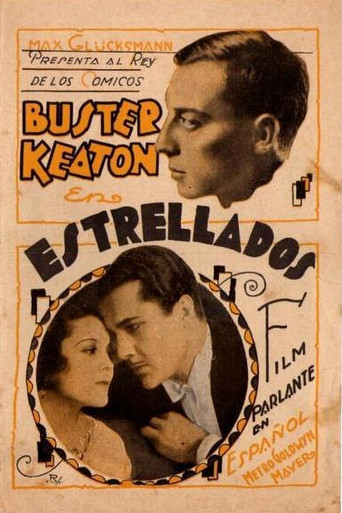
Pivotal figure in the early sound era of Hollywood, serving as a primary architect for Spanish-language cinema produced by major American studios. Born in Móra d'Ebre, Spain, in 1896, he moved to the United States in the late 1920s and quickly became a key supervisor and director for Metro-Goldwyn-Mayer's (MGM) Spanish department. He is most famous for co-directing and writing the Spanish versions of Buster Keaton's early talkies, such as 'Estrellados' (1930) and 'De frente, marchen' (1930), where he notably adapted Keaton's physical comedy for Hispanic audiences. Beyond directing, Alberich — prolific screenwriter and translator, responsible for the linguistic and cultural adaptation of numerous Hollywood scripts during the 'parallel production' era. Following the decline of multi-language versions in Hollywood, he returned to Spain to continue his career but eventually went into exile in the United States following the Spanish Civil War. He spent his later years in New York, where he remained active in the film industry, particularly in dubbing and short film production, until his death in 1963.
The Craft
Behind the Camera
Alberich — specialist in linguistic and cultural translation, focusing on adapting American humor and narrative structures for Spanish-speaking audiences. His directing style was characterized by a meticulous attention to dialogue and phonetic performance, especially when working with non-Spanish speaking stars like Buster Keaton. He often collaborated with American directors like Edward Sedgwick to ensure that the technical quality of the Spanish versions matched the high standards of the English originals while maintaining a distinct Hispanic cultural flavor.
Milestones
- Supervised the Spanish-language department at Metro-Goldwyn-Mayer (MGM) during the transition to sound.
- Co-directed Buster Keaton's first Spanish-language sound film, 'Estrellados' (1930).
- Adapted and wrote the screenplay for 'De frente, marchen' (1930), the Spanish version of 'Doughboys'.
- Directed the Spanish production 'El secreto de Ana María' (1935) in Barcelona.
- Pioneered the 'parallel production' technique, where films were shot simultaneously in different languages with different casts.
- Worked as a key translator and dialogue director for Universal and MGM's Hispanic market initiatives.
Best Known For
Must-See Films
Accolades
Special Recognition
- Recognized as a pioneer of the 'Hispanic Hollywood' movement by film historians.
- Subject of academic study regarding Spanish-language film production in the early 1930s.
Working Relationships
Worked Often With
Studios
Why They Matter
Impact on Culture
Salvador de Alberich played a crucial role in the brief but fascinating era of 'Multi-Language Versions' (MLVs). Before dubbing became the industry standard, Alberich ensured that Spanish-speaking audiences could enjoy Hollywood's biggest stars in their own language. His work on the Buster Keaton films is particularly significant, as it represents a unique moment where a silent film icon attempted to bridge the language gap through phonetic performance and culturally specific dialogue written by Alberich.
Lasting Legacy
Alberich's legacy resides in the preservation of the 'Hispanic Hollywood' history. While many of the Spanish-language versions he worked on were lost for decades, recent restoration efforts by the Warner Archive and film historians have brought his contributions back to light. He is remembered as a bridge between the Spanish literary world and the Hollywood studio system, helping to define the aesthetic of Spanish-language cinema in its infancy.
Who They Inspired
He influenced the development of film translation and adaptation techniques that would later evolve into modern dubbing and subtitling practices. His ability to translate American 'slapstick' into a Spanish context influenced other Spanish writers working in Hollywood, such as Enrique Jardiel Poncela and Tono.
Off Screen
Salvador de Alberich was part of a small but influential community of Spanish intellectuals and artists in Hollywood during the 1930s, which included figures like Edgar Neville and José López Rubio. He lived in Los Angeles during his peak years at MGM before returning to Spain in the mid-1930s. Following the Spanish Civil War, he lived in exile in New York City. He occasionally used the pseudonym 'Joan de Móra' for his creative work.
Education
Educated in Spain; details of specific university or film training are not widely documented, though he was known for his literary and linguistic expertise.
Did You Know?
- He often wrote the Spanish dialogue for Buster Keaton phonetically so the actor could deliver lines without knowing the language.
- He used the pseudonym 'Joan de Móra' for some of his later work in New York.
- Alberich was the supervisor of the Hispanic department at MGM, making him.
- He was responsible for naming Buster Keaton's character 'Canuto Cuadratín' in the Spanish versions.
- His film 'Estrellados' is a direct Spanish-language remake of Keaton's 'Free and Easy'.
- He was one of the few directors of that era to successfully transition from the Hollywood studio system back to the Spanish film industry and then to the New York production scene.
In Their Own Words
The challenge was not just to translate the words, but to translate the laughter. (Reflecting on his work adapting American comedies for Spanish audiences)
Frequently Asked Questions
Who was Salvador de Alberich?
Spanish on YTB.my. He specialized in creating Spanish-language versions of American films for Metro-Goldwyn-Mayer and Universal.
What films is Salvador de Alberich best known for?
Titles linked here include Estrellados (1930), De frente, marchen (1930).
Did Salvador de Alberich work with Buster Keaton?
Yes, he was Keaton's primary collaborator for his Spanish-language films. Alberich not only co-directed him but also wrote the dialogue and coached Keaton on his Spanish delivery.
What was Salvador de Alberich's role at MGM?
He served as the supervisor and head of the Spanish-language department, overseeing the adaptation of scripts and the production of films intended for the Spanish and Latin American markets.
When did Salvador de Alberich die?
He passed away in 1963 in New York City, where he had been living in exile following the Spanish Civil War.
What is a 'parallel production' in the context of Alberich's career?
It refers to the practice of filming a movie in multiple languages simultaneously. Alberich would often work on the Spanish set immediately after the English-language crew finished a scene, sometimes using the same sets and the same lead actors.