Films
1 film
About James Keane
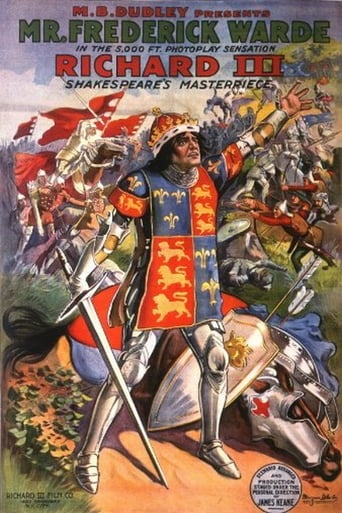
American playwright, director, and actor of the early silent era, best known for his monumental contribution to the birth of the feature-length film. In 1912, he co-directed and wrote the screenplay for 'The Life and Death of King Richard III,' which is historically recognized as the oldest surviving complete American feature film. Keane collaborated with the renowned stage tragedian Frederick Warde to bring Shakespearean prestige to the fledgling motion picture medium, aiming to elevate cinema's status among high-culture audiences. Beyond his directorial duties, Keane also appeared in the film as the Earl of Richmond, the heroic figure who ultimately overthrows the titular tyrant. His work on this production was remarkably ambitious for the time, utilizing over a thousand extras, hundreds of horses, and elaborate location shooting in Westchester County and City Island, New York. Although his filmography is sparse, Keane's role in establishing narrative complexity and feature-length runtimes helped pave the way for the Golden Age of Hollywood. His legacy was revitalized in 1996 when a long-lost print of his masterpiece was rediscovered and restored by the American Film Institute.
The Craft
On Screen
Keane's acting, as seen in his portrayal of the Earl of Richmond, reflected the theatrical 'histrionic' style prevalent in the early 1910s, characterized by broad, expressive gestures intended to convey emotion without the aid of synchronized sound.
Milestones
- Directed 'The Life and Death of King Richard III' (1912), the oldest surviving American feature film.
- Authored one of the first feature-length screenplays adapted from William Shakespeare.
- Pioneered large-scale spectacle in early cinema with a production budget of $30,000 (a massive sum in 1912).
- Collaborated with French director André Calmettes and the Film d'Art movement to bring European artistic sensibilities to American film.
- Successfully transitioned the legendary stage actor Frederick Warde from the theater to the screen.
Best Known For
Iconic Roles
Must-See Films
Accolades
Special Recognition
- Posthumous recognition by the American Film Institute (AFI) during the 1996 restoration of his work.
- Subject of the 2001 Kino International DVD release featuring a score by Ennio Morricone.
Working Relationships
Worked Often With
Studios
Why They Matter
Impact on Culture
James Keane played a crucial role in the 'Feature Film Revolution.' By adapting Shakespeare, he helped legitimize cinema as a respectable art form for the middle and upper classes, who previously viewed movies as low-brow nickelodeon entertainment. His work demonstrated that audiences had the patience for narratives exceeding the standard one-reel (15-minute) format, directly influencing the industry's shift toward the 60-minute feature standard.
Lasting Legacy
Keane's legacy is inextricably linked to the survival of 'Richard III.' For decades, it was believed that no American features from 1912 survived, but the rediscovery of Keane's film provided historians with a 'missing link' in the evolution of cinematic language. It remains a primary text for studying early Shakespearean adaptation and the technical capabilities of pre-World War I independent production.
Who They Inspired
He influenced the early development of the 'prestige picture,' a genre that would later be perfected by directors like D.W. Griffith and Cecil B. DeMille. His emphasis on historical accuracy in costumes and sets set a high bar for the production values of future historical epics.
Off Screen
Little is recorded of Keane's personal life outside of his professional identity as a playwright and filmmaker in the New York area during the early 1910s. He was part of a circle of artists attempting to bridge the gap between the legitimate stage and the 'flickers.'
Education
Described in contemporary trade journals as a playwright, suggesting a background in theatrical writing and stage production.
Did You Know?
- His film 'Richard III' was rediscovered in 1996 in the private collection of a former projectionist named William Buffum.
- The film features five distinct battle scenes and a specially built three-masted warship.
- Keane's production employed over 1,000 extras and 200 horses, making it.
- The 1996 restoration of his film was honored with a new orchestral score composed by the legendary Ennio Morricone.
- The film was shot on location in Westchester County and City Island, New York, rather than in a studio.
- In 1912, the film was marketed as the 'Sensation of the Century' due to its unprecedented length and scale.
Frequently Asked Questions
Who was James Keane?
American playwright and on YTB.my.' He is a pivotal figure in silent film history for creating the oldest surviving American feature-length movie.
What is James Keane's most famous work?
He is best known for 'The Life and Death of King Richard III' (1912), which he co-directed with André Calmettes and in which he also acted as the Earl of Richmond.
Why is James Keane important to film history?
Keane is important because he helped pioneer the feature-length film format in the United States. His 1912 Shakespearean adaptation proved that long-form storytelling was commercially and artistically viable.
Did James Keane win any awards?
While he did not win awards during his lifetime, his work received significant posthumous honors when the American Film Institute restored his 1912 masterpiece in the late 1990s.
What was James Keane's directing style?
Keane focused on grand spectacle, historical accuracy, and large-scale outdoor sequences. He moved away from the static, stage-like presentation of early shorts to create a more dynamic and epic cinematic experience.