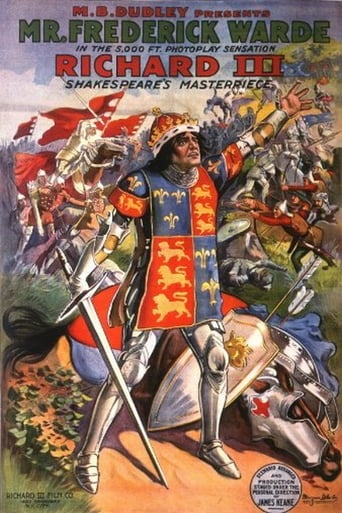
Films
1 film
About Howard Stuart
American child actor of the silent era, primarily remembered for his pivotal role in the 1912 production of 'The Life and Death of King Richard III'. In this historic film, he portrayed King Edward V, one of the ill-fated 'Princes in the Tower', appearing alongside his likely relative Violet Stuart. The production was a monumental undertaking for its time, co-directed by James Keane and André Calmettes, and served as a vehicle for the renowned stage tragedian Frederick Warde. Stuart's performance captured the vulnerability of the young monarch, a role that required a delicate balance of regal poise and youthful innocence. Although his film career appears to have been brief and centered around this single landmark production, his contribution is immortalized in what is now recognized as the oldest surviving American feature-length film. The rediscovery of the film in 1996 brought Stuart's work back into the scholarly spotlight, providing a rare glimpse into early 20th-century acting styles for children. His presence in the film reflects the era's transition from stage-bound traditions to the emerging visual language of narrative cinema.
The Craft
On Screen
As a child actor in the early silent era, Stuart's style was characterized by the pantomimic clarity required for the medium before the advent of close-ups. His portrayal of Edward V involved stylized gestures to convey royal status and the tragic pathos of a doomed child king. He worked under the direction of James Keane, who emphasized a theatrical but earnest approach to Shakespearean drama.
Milestones
- Cast as King Edward V in the first feature-length Shakespearean adaptation in cinema history (1912).
- Performed in the oldest surviving American feature-length film, 'The Life and Death of King Richard III'.
- Collaborated with the legendary stage actor Frederick Warde during his transition to the screen.
- Participated in an international co-production between the United States and France's Film d'Art.
- Featured in a film that was thought lost for over 70 years before its historic 1996 rediscovery.
Best Known For
Iconic Roles
Must-See Films
Accolades
Special Recognition
- The film he starred in was added to the National Film Registry for its cultural and historical significance.
Working Relationships
Worked Often With
Studios
Why They Matter
Impact on Culture
Howard Stuart's role in 'The Life and Death of King Richard III' places him at the very beginning of feature-length narrative cinema in America. At a time when most films were short one-reelers, his participation in a 55-minute epic helped prove that audiences had the appetite for complex, long-form storytelling. The film's status as a 'Film d'Art' production also contributed to the elevation of cinema from a carnival attraction to a respected art form capable of interpreting high literature.
Lasting Legacy
Stuart's legacy is inextricably tied to the 1996 rediscovery of his only known film. When a print of 'Richard III' was found in the collection of a former projectionist, it became a sensation in the film preservation community. As the actor portraying.
Who They Inspired
While Stuart did not have a long career to influence others directly, his performance served as a prototype for the 'tragic child' archetype in early historical epics. His work helped establish the visual iconography of the Princes in the Tower that would be echoed in later versions of Richard III, including the 1955 Laurence Olivier version.
Off Screen
Little is documented regarding Howard Stuart's life outside of his 1912 film appearance. He appeared in the film alongside Violet Stuart, who played Lady Anne, suggesting they may have been siblings or members of a theatrical family. Like many child actors of the early 1910s, he likely returned to a private life or the stage after his brief foray into the burgeoning film industry.
Did You Know?
- The film Stuart starred in was lost for 84 years until a nitrate print was found in Portland, Oregon.
- He was part of the first American film to feature a complete five-act structure similar to a stage play.
- The 1912 film was shot on location in Westchester, New York, and City Island.
- Stuart's co-star, Frederick Warde, used the film to tour the country, giving live lectures during the screenings.
- The film was.
- He is one of the earliest actors to ever portray King Edward V on film.
Frequently Asked Questions
Who was Howard Stuart?
Early American silent film with credits in this catalog. He is a significant figure in film history because he appeared in the oldest surviving American feature-length movie.
What is Howard Stuart's most famous film?
His most famous and only known film is 'The Life and Death of King Richard III' (1912), which is a landmark adaptation of William Shakespeare's play.
Was Howard Stuart a child actor?
Yes, Howard Stuart — child actor during the production of 'Richard III', portraying the young Prince Edward (later Edward V) who is famously imprisoned in the Tower of London.
Why is Howard Stuart's work considered historically important?
His work is important because it represents the birth of the feature film in the United States. The film's rediscovery in 1996 allowed historians to see one of the earliest examples of professional acting for a feature-length narrative.
Who did Howard Stuart work with in 1912?
He worked with the legendary Shakespearean stage actor Frederick Warde and was directed by James Keane and the French filmmaker André Calmettes.