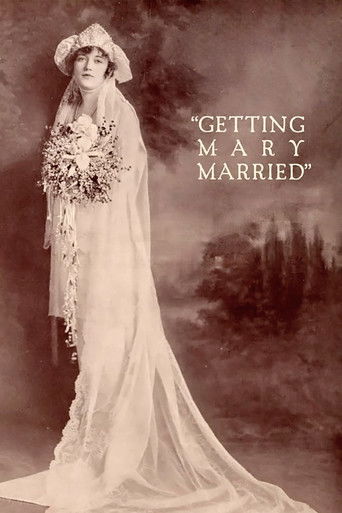
Constance Beaumar
Actor
- Active
- 1919-1919
Films 1
About Constance Beaumar
Constance Beaumar is an obscure silent-era screen performer whose surviving record is extremely limited, but she is documented as appearing in the 1919 film Getting Mary Married. Like many actors from the transitional years of American silent cinema, she seems to have worked at a time when studio publicity was inconsistent and many supporting performers were not given extensive screen credits or preserved biographical profiles. At present, there is no readily verifiable evidence of a long filmography, major stage career, or later talkie-era activity under this exact name. Because of that scarcity, she is best understood as one of the many early cinema players whose work survives in film credits and trade references more than in detailed personal history. Her presence in a 1919 production places her firmly within the late silent period, when film acting was still developing its own visual grammar and character types. Beyond that credit, reliable information about her life, training, and later career does not appear to be available in standard reference sources. She remains a name of interest mainly to researchers reconstructing lost or under-documented silent film careers.
More about Constance Beaumar
In film history
Constance Beaumar’s cultural impact is difficult to measure directly because the surviving record of her career is minimal. Even so, her credited appearance in a 1919 silent film places her within the broad workforce of early American cinema that helped establish the industry’s narrative and performance conventions. Performers like Beaumar contributed to the texture of silent films in ways that often went uncelebrated at the time, yet they were essential to the functioning of studio productions. Her name persists as part of the historical record, reminding researchers that classic cinema was built not only by major stars but also by a large number of lesser-known actors whose work is partially lost to time.
Later reputation
Her legacy lies primarily in historical documentation rather than fame. For film historians, Constance Beaumar represents the many early screen performers whose careers are visible only in sparse credits and fragmented archival traces. Her inclusion in records for Getting Mary Married (1919) helps preserve the memory of silent-era production personnel who otherwise might disappear from the historical narrative. In that sense, her legacy is tied to the ongoing effort to recover and catalog the full ecosystem of early Hollywood and adjacent silent-film production.
Influence
There is no documented evidence that Constance Beaumar directly influenced later actors or filmmakers in a traceable way. However, as part of the generation of silent-era performers, she participated in the acting conventions and production methods that shaped early screen performance. The broader influence of performers like her can be seen in the normalization of cinematic acting styles that balanced theatrical gesture with emerging film realism. Her contribution belongs to the collective influence of countless early actors whose work helped establish the silent film idiom.
Off screen
No reliable biographical record has surfaced for Constance Beaumar regarding family background, marriage, children, or private life. Standard classic-film reference sources do not appear to preserve enough information to reconstruct her personal history with confidence. This lack of documentation is typical for many supporting or briefly credited performers of the silent era, especially women whose careers may have been short or whose records were never fully archived. As a result, any claim about her relationships or family would be speculative and is best left unstated until corroborated by primary sources.
Credits
- Recorded screen appearance in the silent feature Getting Mary Married (1919)
- Participation in late-1910s American silent cinema during a period of rapidly evolving film performance styles
- Presence in early film credit records despite limited surviving biographical documentation
Films
- Getting Mary Married (1919)
Notes
- She is specifically documented in connection with the 1919 silent film Getting Mary Married.
- Her surviving film record appears to be extremely small, suggesting either a brief screen career or incomplete archival preservation.
- She is an example of a silent-era performer whose biography is largely missing from standard modern reference works.
- Many actors from this era were uncredited or lightly credited, which makes reconstructing their careers especially challenging.
- Her name remains useful to researchers studying obscure cast lists from the late 1910s.
- There is no widely available verified information about her birth, death, or family life under this exact name.
Questions
Who was Constance Beaumar?
Constance Beaumar was a silent-era screen actor known from the 1919 film Getting Mary Married. Beyond that credit, surviving public information about her life and career is extremely limited, making her one of the more obscure figures of early cinema.
What films is Constance Beaumar best known for?
She is best known for Getting Mary Married (1919), which is the principal surviving film credit associated with her. No additional verified filmography is readily available from standard reference sources under this exact name.
When was Constance Beaumar born and when did she die?
Her birth and death dates are not currently verified in accessible classic-cinema reference material. No dependable source was found that confirms her birthplace, lifespan, or whether she is deceased.
What awards did Constance Beaumar win?
No awards or formal nominations are currently documented for Constance Beaumar. That is not unusual for lesser-documented silent-era performers, whose careers were often not tracked with the same detail as major stars.
What was Constance Beaumar's acting style?
There is no surviving critical description of her acting style, so it cannot be characterized with confidence. As a performer in a 1919 silent film, she would have worked within the expressive visual conventions of the silent era, but any more specific assessment would be speculative.
What is Constance Beaumar's legacy in film history?
Her legacy is primarily archival: she is part of the historical record of silent-era production, even though her personal story is largely lost. For film historians, names like hers help fill in the cast lists and labor history of early Hollywood, where many contributors remain under-documented.