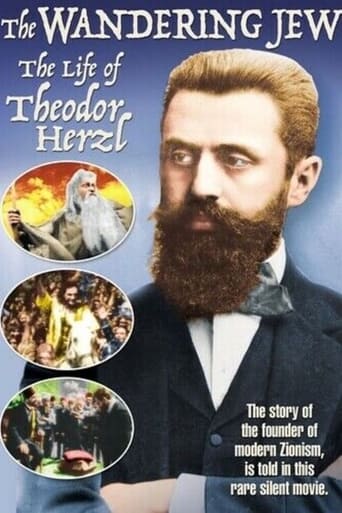
Ernst Bath
Actor
- Active
- 1921-1921
Films 1
About Ernst Bath
Ernst Bath appears to have been a very obscure early-20th-century screen performer whose surviving film record is extremely limited. The available documentation connects him to the 1921 German film Theodor Herzl, Standard-Bearer of the Jewish People, indicating that he worked during the silent era and most likely in the German-language film world. Beyond that single credited appearance, public reference sources do not preserve a substantial biography, and no reliably verified information about his early life, later career, or personal background is readily available. Because of this scarcity of records, he is best understood as a minor but still historically relevant participant in silent-era cinema whose name survives primarily through filmography listings. His presence in a film about Theodor Herzl suggests involvement in historically or culturally significant subject matter rather than mainstream star vehicles. At present, there is insufficient reliable evidence to reconstruct a fuller career arc or to identify his broader influence with confidence. He remains one of many early cinema figures whose work is known mainly from archival credits and surviving reference databases.
More about Ernst Bath
In film history
Ernst Bath's cultural impact is difficult to measure because he is documented in surviving records only in connection with a single early silent film credit. Even so, his participation in a historical work about Theodor Herzl places him within a cinema tradition that engaged with Jewish identity, modern political history, and biographical storytelling in the post-World War I era. Figures like Bath are important to film history because they illustrate the breadth of silent-era production beyond the handful of major stars and directors who dominate surviving narratives. His name helps preserve the fact that many contributors to early cinema were supporting or minor players whose work has largely disappeared from popular memory. In that sense, his presence is part of the broader cultural fabric of Weimar-era and early European film production.
Later reputation
Ernst Bath's legacy lies less in fame than in historical documentation: he is one of the many early screen actors whose existence is confirmed by a small number of surviving credits. For researchers of silent cinema, names like his are valuable because they help reconstruct production networks, casting practices, and the scope of early national film industries. While he does not appear to have left behind a widely recognized body of work, his credit in a significant Jewish historical film gives him a modest place in the record of early 20th-century cinema. His legacy is therefore archival and historiographic rather than celebrity-based. He serves as a reminder that film history is built not only by major auteurs and stars but also by the many lesser-known performers whose work supported the medium's development.
Influence
There is no verified evidence that Ernst Bath directly influenced later actors or filmmakers in a documented, traceable way. Any influence he may have had was likely indirect, through participation in early German silent cinema and in productions that contributed to the era's evolving standards of performance and screen narration. Because his career is so sparsely recorded, it is not possible to attribute a specific artistic lineage to him with confidence. Nonetheless, his work forms part of the larger collective influence of silent-era performers on screen acting conventions before the transition to sound.
Off screen
No reliably verified information has been located regarding Ernst Bath's personal life, including marriages, family background, residence, or activities outside of film. As with many obscure silent-era performers, the historical record appears incomplete or has not survived in accessible form. Any attempt to specify spouses, children, or private life details would be speculative, so those facts remain unknown.
Credits
- Credited as an actor in the 1921 silent film Theodor Herzl, Standard-Bearer of the Jewish People
- Represents one of the many lesser-documented performers active in German silent cinema during the early 1920s
- Survives in film history primarily through archival filmography references rather than through a large body of extant credits
Roles
- Role in Theodor Herzl, Standard-Bearer of the Jewish People (1921)
Films
Notes
- Ernst Bath is documented as an actor in only one currently identified film credit: Theodor Herzl, Standard-Bearer of the Jewish People (1921).
- His surviving screen record places him in the silent-film era, specifically the early 1920s.
- The film associated with him is a biographical/historical work centered on Theodor Herzl, an important figure in modern Jewish history.
- There is no widely accessible biographical profile for him in mainstream reference sources, making him a genuinely obscure cinema figure.
- He may have worked in German-language or Central European film production, but this is not firmly confirmed by surviving public data.
- Because of the limited documentation, he is an example of how many silent-era performers are known primarily through filmographies rather than personal archives.
- No verified information about awards, family, or later career activity is currently available from reliable public sources.
Questions
Who was Ernst Bath?
Ernst Bath was a very obscure silent-era actor whose surviving film record is limited to a known credit in Theodor Herzl, Standard-Bearer of the Jewish People (1921). Very little biographical information has survived in accessible public sources, so he is primarily remembered through archival film listings. He is one of many early cinema performers whose names remain part of film history even when personal details are scarce.
What films is Ernst Bath best known for?
He is best known for Theodor Herzl, Standard-Bearer of the Jewish People (1921), which is the main verified screen credit associated with his name. No other reliably confirmed film appearances are currently available in the source material used here. As a result, his filmography remains extremely limited in the public record.
When was Ernst Bath born and when did he die?
His birth and death dates are not currently verified in accessible reliable sources. Likewise, his birth place and death place are not known from the surviving public record. Because of the lack of documentation, it is not possible to state his lifespan with confidence.
What awards did Ernst Bath win?
No awards or nominations are currently known for Ernst Bath. This is not unusual for obscure silent-era performers, many of whom worked before modern award culture was established or before their careers were widely documented. No reliable evidence of formal honors has been found.
What was Ernst Bath's acting style?
There is no surviving detailed critical description of his acting style. Since he worked in the silent era, his performance would have relied on expressive physicality, gesture, and visual storytelling typical of the period, but that remains an inference rather than a documented assessment. No specific stylistic profile has been preserved in the available records.
What is Ernst Bath's legacy in film history?
His legacy is mainly archival: he represents the many early film performers whose names survive in credits but whose lives are otherwise poorly documented. His association with a historically themed 1921 film gives him a small but meaningful place in silent-cinema history. For researchers, his name helps preserve the broader production history of early European filmmaking.