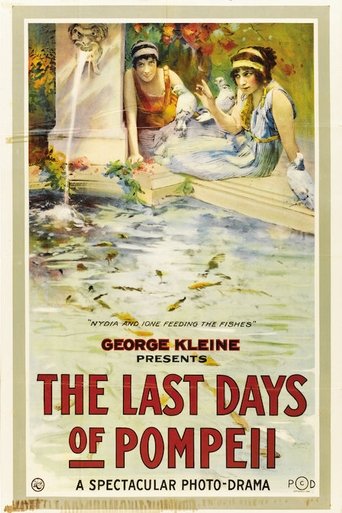
Giovanni Ciusa
Actor
- Active
- 1913-1913
Films 1
About Giovanni Ciusa
Giovanni Ciusa is an obscure early Italian silent-film performer whose surviving screen credit places him in the 1913 historical spectacle The Last Days of Pompeii. Beyond that documented appearance, very little reliable biographical information survives in widely accessible film reference sources, which is not unusual for minor participants in the earliest years of European cinema. His known screen activity falls entirely within 1913, suggesting either a very brief acting career or one that has not been fully preserved in extant records. Because the available evidence is so limited, his life outside this single known credit cannot be reconstructed with confidence without risking speculation. Ciusa remains of interest to film historians primarily as part of the large ensemble of early Italian players who helped establish the scale and visual ambition of pre-World War I historical cinema. His presence in The Last Days of Pompeii links him to one of the landmark productions of the silent era, a film associated with the development of the peplum and the internationally exported Italian spectacle. In the absence of more documentation, he should be understood as a little-documented silent-era actor whose name survives mainly through surviving cast records.
More about Giovanni Ciusa
In film history
Giovanni Ciusa's cultural importance lies less in an individually documented career than in what his name represents: the many early film performers whose contributions to silent cinema were substantial at the production level but lightly preserved in surviving archives. His credited participation in The Last Days of Pompeii places him within the rapidly developing Italian historical-film tradition that became one of the country's most influential exports before the First World War. Films of this type helped establish the visual language of spectacle, crowd scenes, monumental sets, and literary adaptation that would later influence international epic filmmaking. Even when the performers are obscure, their work forms part of the foundation upon which silent-era cinematic culture was built.
Later reputation
Ciusa's legacy is archival and historical rather than celebrity-based. He survives in film history as a name attached to an important silent-era production, reminding researchers how incomplete early cinema documentation can be, especially for ensemble cast members. His recorded presence in a landmark 1913 film makes him a small but genuine part of the Italian silent cinema record. For databases and scholars, figures like Ciusa are valuable because they help preserve a fuller account of the people who participated in cinema's formative decade. In that sense, his legacy is the survival of a name, a credit, and a place in the broader story of early screen acting.
Influence
There is no evidence that Giovanni Ciusa had a documented influence on later actors or filmmakers in the conventional sense. His influence is indirect and historical, embodied in his participation in early Italian production culture rather than in a traceable artistic school or public career. As part of the cast of a major silent epic, he contributed to the ensemble model and production practices that other filmmakers would expand upon in later historical spectacles. His main significance for influence studies is as a representative of the many unheralded performers whose work supported the growth of narrative feature filmmaking.
Off screen
No dependable biographical record has been found regarding Giovanni Ciusa's personal life. Information about his family, marriages, residence, education, and later life is not currently documented in standard film-history reference material available from his surviving screen credit. Because the historical record is sparse, any specific claims about his private life would be speculative and are therefore omitted. He should be treated as a poorly documented early silent-era performer whose personal history remains largely unknown.
Credits
- Appeared in the 1913 Italian silent historical film The Last Days of Pompeii
- Represents one of the early screen performers documented in the formative years of Italian cinema
- Associated with a major pre-World War I spectacle production that helped define the international reputation of Italian silent films
Roles
- Role in The Last Days of Pompeii (1913)
Films
- The Last Days of Pompeii (1913)
Notes
- Giovanni Ciusa is primarily identified today through a single surviving film credit.
- His known screen appearance is in The Last Days of Pompeii from 1913, one of the early Italian historical epics.
- His active period in surviving filmography appears to be only one year, 1913.
- No widely cited birth or death details are readily available in standard reference sources.
- He is an example of the many silent-era performers whose careers were not extensively documented at the time.
- His film credit connects him to the early international reputation of Italian spectacle cinema.
- Because records are sparse, his exact role in The Last Days of Pompeii is not reliably preserved in readily accessible sources.
Questions
Who was Giovanni Ciusa?
Giovanni Ciusa was an early Italian silent-film actor known from a surviving credit in The Last Days of Pompeii (1913). Very little else about his life or career is currently documented in widely accessible film references. He is best understood as one of the many obscure performers who appeared in early European cinema.
What films is Giovanni Ciusa best known for?
He is best known for The Last Days of Pompeii (1913), the only film credit currently associated with him in surviving records. That film was a significant Italian silent historical epic and remains his principal claim to film history.
When was Giovanni Ciusa born and when did he die?
His birth and death dates are not currently documented in the accessible historical record. Likewise, his place of birth and death are not reliably established from the surviving evidence.
What awards did Giovanni Ciusa win?
No awards or formal honors are documented for Giovanni Ciusa. Given the fragmentary nature of his surviving biography, there is no verified record of nominations or industry recognition.
What was Giovanni Ciusa's acting style?
There is no surviving critical description of his acting style. Because his career is known from a very limited record, any detailed assessment of his technique would be speculative. He should be regarded as an early silent performer whose work has not been preserved well enough for stylistic analysis.
Why is Giovanni Ciusa important to film history?
He is important because he is part of the documented cast history of an early Italian silent epic. Even when performers are obscure, their credits help historians reconstruct the development of feature-length storytelling, ensemble production, and historical spectacle in the silent era.