
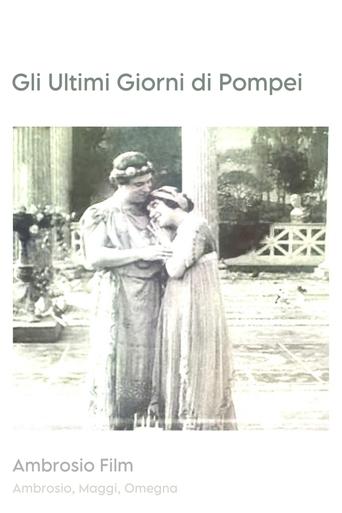
The Last Days of Pompeii
"Love and jealousy in Pompeii on the eve of Vesuvius."
Keys: Space play/pause · ←/→ 10s · F fullscreen · M mute · </> speed
About this film
Pompeii lovers Glaucus of Pompeii the young Glaucus loves beautiful Jone, although he's courted by Giulia and secretly loved by his blind slave Nidia. One day Glaucus is wrongly accused of murder by a priest of Isis, Arbace, who wants to marry Jone and please Giulia. Glauco is condemned to be devoured by lions in the arena of the city, on that very day the erupting Vesuvius. Jone ovvero gli ultimi giorni di Pompei (1913) was one of two major Italian productions of The Last Days of Pompeii done in 1913, and not to be confused by the more famous Gli ultimi giorni di Pompei (1913).
Cast & crew
More films like this
More from Ubaldo Maria Del Colle
View all →
More about this film
About the production
Release date1913
ProductionCines
Filmed inItaly
This is one of two major Italian 1913 screen versions of The Last Days of Pompeii, and it is the less frequently discussed of the pair, often overshadowed by the more famous Gli ultimi giorni di Pompei (1913). Produced at a time when Italian historical films were setting international standards for spectacle, the picture adapted the familiar Pompeii story into a compact silent melodrama centered on romance, jealousy, religious manipulation, and disaster. Precise budget, box-office, and surviving production records are not widely documented in modern reference sources, which is typical for many early silent productions. The film’s cast included Cristina Ruspoli, Luigi Mele, and Giovanni Enrico Vidali, but complete production personnel details beyond director Ubaldo Maria Del Colle are not consistently preserved in accessible archives.
Themes
Love and rivalryFalse accusation and injusticeReligious manipulation and pagan intrigueThe fragility of civilizationCatastrophe and divine or natural judgment
Themes & topics
Historical background
Production circa 1913 situates The Last Days of Pompeii within the technical limits of its era—intertitles, fixed cameras, and studio-bound sets shaped every creative choice.
Why this film matters
Collectors prize surviving prints of The Last Days of Pompeii as evidence of how 1913-era filmmakers solved storytelling problems with limited means.
Making of
Very little detailed behind-the-scenes documentation survives in widely accessible sources for this specific 1913 production, which is common for silent-era Italian films. What can be said with confidence is that the production emerged from the vigorous Italian historical-film tradition of the early 1910s, when companies like Cines were investing in literary adaptations, ancient-world settings, and spectacular disaster tableaux. The film likely relied on studio-built interiors and painted or practical scenic effects to represent Pompeii, the temple settings, and the arena, since location shooting and complex effects work were still constrained by the technology and production methods of the time. The presence of a relatively concise cast and the film’s melodramatic structure suggest a production designed to capitalize on a familiar story while keeping the storytelling visually direct for silent audiences.
What critics said
Audience surveys from 1913 are scarce; reception for The Last Days of Pompeii must be inferred from reissue patterns and how often programmers still book it.
Did you know?
- This 1913 film should not be confused with the more famous Italian production Gli ultimi giorni di Pompei, also released in 1913.
- It is one of several early cinematic adaptations of Edward Bulwer-Lytton’s hugely popular 1834 novel The Last Days of Pompeii.
- The story’s mixture of romance, pagan intrigue, and volcanic catastrophe made it an ideal subject for early Italian historical cinema.
- Ubaldo Maria Del Colle was active in Italian silent filmmaking during a period when Italy was a major exporter of prestige historical spectacles.
- The film’s plot includes the same core characters found in many adaptations of the Pompeii story, including Glaucus, Jone, Nidia, and the antagonist Arbace.
- Because many silent-era Italian films survive only fragmentarily or in incomplete documentation, exact runtime and preservation details are often difficult to verify.
- The film reflects the early 1910s Italian tendency to mount large-scale literary and historical adaptations that combined moral conflict with visual spectacle.
- Its dramatic destruction by Vesuvius fits the era’s fascination with disaster imagery and the cinematic possibilities of apocalyptic endings.
- The presence of an actress playing Jone in a 1913 Italian production underscores the popularity of this material across stage, novel, and screen adaptations.
- The title form Jone ovvero gli ultimi giorni di Pompei is a reminder that Italian films of the period often circulated under alternate or expanded titles.
Visual style
The cinematography is characteristic of early Italian historical cinema, emphasizing tableau composition, legible staging, and clear presentation of action within carefully arranged sets. As a silent production, the film would have depended on visual clarity, expressive performance, and dramatic blocking to convey the relationships among Glaucus, Jone, Nidia, Giulia, and Arbace. Historical epics of this period often used frontal staging and theatrical depth to present costumes, architecture, and crowd scenes, while still striving for cinematic dynamism during key moments of conflict and catastrophe. The eruption sequence would have been the visual centerpiece, likely relying on practical effects, painted backdrops, smoke, and intercut spectacle to communicate the scale of the disaster.
Innovations
The film’s primary achievement lies in its participation in the early development of cinematic spectacle in Italy, particularly the recreation of antiquity and the staging of large-scale catastrophe for silent audiences. Even if it did not introduce a uniquely documented technical innovation, it represents the industry’s growing confidence in presenting historical worlds through set design, crowd staging, and dramatic special effects. The eruption of Vesuvius would have required creative illusion-making within the technical limits of 1913 filmmaking, making the sequence a notable example of early disaster cinema. Its existence alongside another Pompeii film from the same year also shows how quickly studios were testing the commercial and artistic potential of big historical subjects.
Music
As a 1913 silent film, it did not have an original synchronized soundtrack. Like most films of the era, it would have been accompanied in exhibition by live music selected or improvised by local theater musicians, often using dramatic cues to underscore romance, tension, trial, and catastrophe. No verified original score has been widely documented for this specific production. Any modern presentations would typically use reconstructed or newly commissioned accompaniment if the film survives in a form suitable for screening.
Memorable scenes
- Glaucus is condemned to be devoured by lions in the arena, turning public spectacle into a moment of extreme personal peril.
- The eruption of Vesuvius destroys Pompeii, transforming the romantic and political drama into an apocalyptic finale.
- Arbace’s scheming against Glaucus and his attempts to secure Jone drive the story’s central intrigue.
- The contrast between tender romance and public violence gives the film its characteristic melodramatic tension.
What audiences thought
Specific audience-response records are not readily available, but the film would have been playing to spectators already familiar with the Pompeii legend and drawn to the promise of romance, betrayal, and volcanic disaster. Early 1910s audiences were especially receptive to historical spectacle films, and the story of Pompeii had a proven appeal across novels, theater, and cinema. The disaster climax and the moralized melodrama likely made it an accessible crowd-pleaser for silent audiences, particularly in urban exhibition settings. Its long-term audience legacy, however, is limited by its obscurity and the uneven survival of early Italian cinema documentation.
Film connections
Influenced by
- Edward Bulwer-Lytton's novel The Last Days of Pompeii (1834)
- Stage adaptations of The Last Days of Pompeii popular in the late 19th and early 20th centuries
- Early Italian historical spectacle films
- Biblical and antiquity epics from the silent era
This film influenced
- Later cinematic adaptations of The Last Days of Pompeii
- Subsequent Italian peplum and antiquity spectacles
- Early disaster films centered on ancient-world destruction
Film restoration
Preservation status is uncertain in readily available modern references. The film is not widely known to survive in complete, easily accessible form, and it is often treated as an obscure or poorly documented silent-era title. If extant, it appears to be rare and difficult to view; if not lost, it is at minimum not commonly circulating in major public archives or commercial restorations.
Where to watch
- No widely known commercial streaming availability
- Check specialist silent-film archives and national film collections
- Possible access through curated archival screenings or scholarly research repositories