Films
1 film
About Nina Chernova
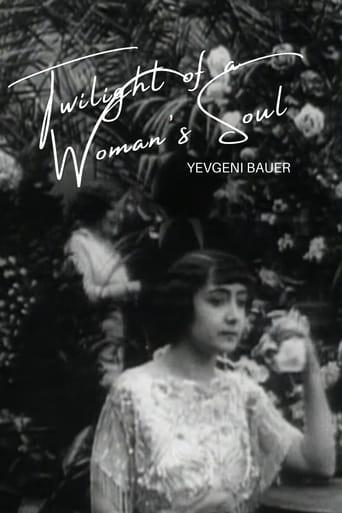
This archive lists one role for Nina Chernova: Twilight of a Woman's Soul (1913). Her career was remarkably brief, spanning only the year 1913, during which she participated in the film 'Twilight of a Woman's Soul.' This film, directed by the innovative Yevgeni Bauer, was sophisticated psychological dramas of its era, showcasing the artistic potential of Russian cinema before the Revolution. Chernova's performance demonstrated the emotional depth and subtlety that characterized Bauer's approach to filmmaking, which was ahead of its time in terms of psychological complexity and visual storytelling. Like many actors from this very early period of Russian cinema, detailed records of her life and career are scarce, as the film industry was still in its infancy and documentation was limited. Her contribution to Russian film history, while brief, represents the important work of actresses who helped establish the dramatic conventions of silent cinema in Russia before the upheavals of 1917 would transform the country and its film industry.
The Craft
On Screen
Based on her appearance in a Bauer film, likely employed the subtle, psychologically nuanced style characteristic of the director's approach to performance, emphasizing emotional depth over melodramatic gestures
Milestones
- Starred in 'Twilight of a Woman's Soul' (1913),
Best Known For
Iconic Roles
Must-See Films
Working Relationships
Worked Often With
Studios
Why They Matter
Impact on Culture
Nina Chernova's contribution to cinema, while brief, is part of the important foundation of Russian silent film. Her appearance in 'Twilight of a Woman's Soul' places her within the context of. The film itself was remarkable for its time, dealing with complex themes of morality, redemption, and social class, and Chernova's performance contributed to this groundbreaking artistic achievement.
Lasting Legacy
As an actress from the very dawn of Russian cinema, Nina Chernova represents the performers who helped establish the dramatic language of silent film in Russia. While her career was extremely brief, her work in 'Twilight of a Woman's Soul' ensures her place in film history as part of an important artistic movement that prefigured the golden age of Russian cinema. The survival of this film allows modern audiences to appreciate the sophistication of early Russian filmmaking and the contributions of actors like Chernova to this artistic heritage.
Who They Inspired
Due to the extremely brief nature of her career and the scarcity of documentation, it's difficult to trace specific influences that Nina Chernova may have had on subsequent performers. However, her work in an early Bauer film places her within the tradition of psychologically nuanced acting that would become characteristic of Russian cinema's approach to performance.
Off Screen
Very little is documented about Nina Chernova's personal life, which is typical for actors from this very early period of Russian cinema. Records from the early 1910s Russian film industry are scarce, and many performers from this era remain largely anonymous in historical accounts.
Did You Know?
- Appeared in only one known film during her entire career
- Worked with director Yevgeni Bauer, who was one of Russia's most innovative early filmmakers
- Her film 'Twilight of a Woman's Soul' was remarkably progressive for its time, featuring complex psychological themes
- The film she appeared in was one of the earliest Russian films to explore female psychology and moral complexity
- Like many early Russian film actors, virtually no biographical information about her survives in historical records
- Her entire known active years covered just one year, making her one of cinema's briefest working actors
- The film she appeared in has survived to the present day, allowing modern scholars to study early Russian cinema
Frequently Asked Questions
Who was Nina Chernova?
Early Russian silent film actress active in 1913, known primarily for her role in 'Twilight of a Woman's Soul,'.
What films is Nina Chernova best known for?
Titles linked here include Twilight of a Woman's Soul (1913).
When was Nina Chernova born and when did she die?
Unfortunately, no biographical information about Nina Chernova's birth or death dates has survived in historical records, which is common for actors from this very early period of Russian cinema.
What awards did Nina Chernova win?
No awards or honors have been documented for Nina Chernova, as she worked during the very early years of cinema before formal award systems were established.
What was Nina Chernova's acting style?
Based on her appearance in a Yevgeni Bauer film, she likely employed the subtle, psychologically nuanced style characteristic of Bauer's direction, which emphasized emotional depth and complexity over the melodramatic gestures common in early silent cinema.
Why is so little known about Nina Chernova?
The scarcity of information about Nina Chernova is typical for actors from the very early period of Russian cinema (1910s), when the industry was still developing and documentation was limited. Many performers from this era remain largely anonymous in historical records.