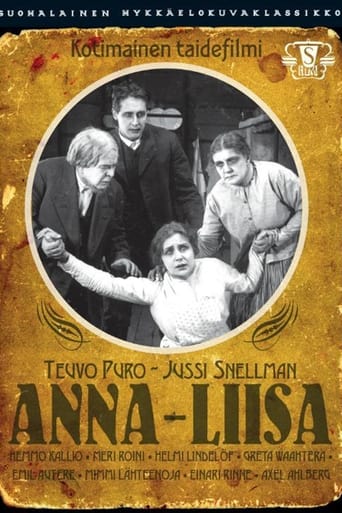
Emil Autere
Actor
- Active
- 1922-1922
Films 1
About Emil Autere
Emil Autere is a little-documented figure from the silent-era Scandinavian screen, known primarily for his appearance in the Finnish silent feature Anna-Liisa (1922). Surviving mainstream film reference sources preserve his name chiefly through filmography credit rather than through a richly documented star biography, which suggests that he was likely a minor or supporting performer rather than a widely publicized leading man. Because the historical record available in standard references is extremely sparse, many details of his life, training, and later career remain unverified. What can be stated with confidence is that he was active in cinema at least during 1922, when Finnish filmmaking was still in its formative years and relied heavily on stage-trained performers and locally rooted talent. His association with Anna-Liisa places him within one of the notable early Finnish literary adaptations, a film that has lasting value in national cinema history. Beyond that film credit, there is no securely established public record of a longer screen career, major awards, or widely circulated interviews. As a result, Emil Autere is best understood today as an obscure but real participant in early Finnish silent cinema whose surviving legacy rests on the preservation of his credited screen appearance.
More about Emil Autere
In film history
Emil Autere's cultural impact is primarily archival and historical rather than celebrity-driven. His name survives as part of the cast of Anna-Liisa (1922), which is valuable because early Finnish silent films are comparatively scarce in the historical record and every identified participant helps reconstruct the national film culture of the period. Even where an actor leaves behind no large public persona, a credited appearance in a preserved or documented silent film contributes to scholarship on performance practice, casting, and production networks in early cinema. In that sense, Autere's importance lies in the preservation of a national film heritage that depends on the recovery of names that might otherwise be lost.
Later reputation
Emil Autere's lasting legacy is modest but meaningful: he is part of the documented personnel of early Finnish silent cinema, and his credit in Anna-Liisa anchors him in the history of one of Finland's notable early screen adaptations. For film historians, such names are essential because they help map the social and artistic world of a developing film industry, especially in a country where early productions were fewer and documentation can be incomplete. Autere's legacy therefore resides less in fame than in evidence; he is one of the many performers whose recorded participation helps us understand how silent-era Finnish films were made and who helped bring them to life.
Influence
There is no secure evidence that Emil Autere exerted a documented influence on later actors or directors in a direct, traceable sense. His importance is more indirect: by participating in an early Finnish film, he becomes part of the performance tradition that later generations of Scandinavian filmmakers and historians study. If he had a broader stage or screen career, it is not well preserved in mainstream reference sources, so any influence beyond his credited film work cannot be responsibly asserted.
Off screen
No reliable public information is readily available about Emil Autere's personal life, family background, marriages, or later years. Standard film reference materials do not appear to preserve biographical details such as education, private relationships, or career activity outside his 1922 film credit. Because of this, any claim about his personal life would be speculative and is best left unasserted until supported by archival documentation.
Credits
- Appeared in the Finnish silent feature Anna-Liisa (1922), one of the better-known early film adaptations in Finnish cinema
- Represents a documented performer from the formative period of Finland's silent film industry
- His credited screen presence survives in film history references, helping preserve the cast record of an important early national film
Roles
- Cast member in Anna-Liisa (1922)
Films
- Anna-Liisa (1922)
Notes
- Emil Autere is most securely associated with a single known screen credit: Anna-Liisa (1922).
- He appears to be one of many early Finnish film performers whose historical footprint is preserved mainly through cast lists rather than extensive biographies.
- His surviving film reference record is sparse, which is common for silent-era actors outside the major international markets.
- Anna-Liisa (1922) is a literary adaptation, placing Autere within the early tradition of Finnish cinema drawing on national literature.
- Because no widely confirmed biographical sources are readily available, even basic facts such as birth and death dates remain unverified.
- Autere's example highlights how many silent-era performers are now known primarily through archival filmography rather than celebrity journalism.
- He is a useful name for historians reconstructing cast networks in early Finnish productions.
Questions
Who was Emil Autere?
Emil Autere was a Finnish actor known from the silent-film era, with his best-documented screen credit being Anna-Liisa (1922). Surviving reference material about him is very limited, so he is best understood as an obscure early cinema performer rather than a major star.
What films is Emil Autere best known for?
He is primarily known for Anna-Liisa (1922), which is the one film credit most consistently associated with his name. No other widely verified film appearances are readily documented in standard reference sources.
When was Emil Autere born and when did he die?
Reliable public sources available here do not provide verified birth or death dates for Emil Autere. His biographical record is sparse, and those details remain unavailable in the mainstream film references consulted.
What awards did Emil Autere win?
No awards or formal honors are known for Emil Autere in the surviving public record. This is not unusual for lesser-documented silent-era performers whose careers were not heavily covered by contemporary publicity or later award histories.
What was Emil Autere's acting style?
There is no detailed surviving criticism describing his personal acting style. Given his era and film context, he would have worked within silent-cinema performance conventions, which emphasized expressive physical acting and clear visual storytelling.
What is Emil Autere's legacy in film history?
His legacy lies in his documented participation in early Finnish cinema, especially Anna-Liisa (1922). Even a sparse record is historically useful because it helps scholars reconstruct the cast and production culture of the silent era.