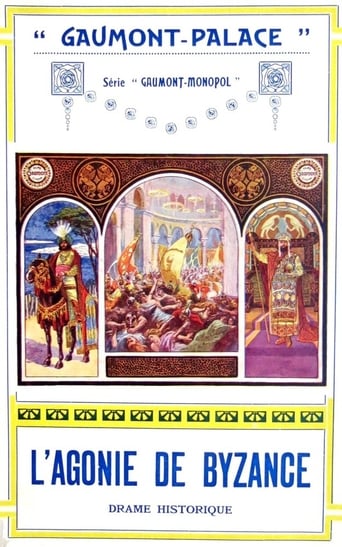
Albert Reusy
Actor
- Active
- 1913-1913
Films 1
About Albert Reusy
Albert Reusy is an obscure early French screen performer whose surviving film record places him in the silent era at the very beginning of the 1910s. He is documented in connection with the 1913 production The Agony of Byzantium, which suggests participation in the formative years of European historical cinema, when filmmakers were experimenting with large-scale period dramatization and stylized acting. Beyond that film credit, reliable biographical information about his life, training, and later career is extremely limited in the available reference record, and he does not appear to have maintained a sustained, well-documented screen presence after 1913. Because of this scarcity, his surviving significance rests primarily on the fact that he was part of the generation of actors who helped populate early narrative cinema before star systems and comprehensive studio documentation became standard. As with many silent-era performers of minor or isolated credits, his work is preserved more in cast lists and film histories than in detailed personal archives. No verified evidence currently confirms major later film activity, and he should therefore be regarded as a little-documented contributor to early silent film history rather than a widely known screen personality.
More about Albert Reusy
On screen
No detailed critical descriptions of Albert Reusy's acting style have survived in the accessible reference record. Given the period and the kind of historical drama in which he is known to have appeared, his work would most likely have relied on the restrained but still expressive conventions typical of early silent cinema, including clear physical gesture, facial expressiveness, and tableau-based staging. Any assessment beyond that would be speculative, as there are no known reviews or performance analyses that securely describe his screen technique.
In film history
Albert Reusy's cultural impact lies less in celebrity than in representation: he is part of the broad, often under-credited workforce of early cinema that made the silent historical epic possible. Performers like Reusy helped populate the films of the 1910s, when European productions were building ambitious screen depictions of history, empire, religion, and spectacle. Even when individual careers are poorly documented, these actors contributed to the evolving language of performance on film, bridging stage-derived gesture and the more nuanced screen acting that followed.
Later reputation
Reusy's legacy is chiefly archival and historical. He survives as a name attached to The Agony of Byzantium, which allows researchers to trace the personnel involved in early silent historical filmmaking. In the absence of extensive filmography, awards, or personal records, his importance is as a verified example of the many early performers whose work formed the foundation of narrative cinema but whose lives were not preserved in the same depth as later stars. For film historians, such names are valuable because they help reconstruct production networks, casting practices, and the largely anonymous texture of early European film history.
Influence
There is no evidence that Albert Reusy directly influenced later actors or filmmakers in a documented, traceable way. His broader influence is indirect: as one of many early silent-era performers, he contributed to the performance norms that shaped the development of screen acting in the 1910s. The cumulative work of actors like Reusy helped establish the visual grammar of historical drama and the standards by which later performers would calibrate movement, expression, and presence for the camera.
Off screen
No reliable public information has been found regarding Albert Reusy's personal life, including marriages, family background, residence, or post-film career. He appears in the historical record primarily as a credited or identified performer in a single early film, leaving little verifiable material about his off-screen life. This level of documentation is common for many silent-era bit players and short-lived screen participants whose careers were not tracked by the trade press in detail.
Credits
- Appeared in the 1913 silent historical production The Agony of Byzantium
- Represents the early generation of European screen performers active during cinema's formative narrative period
- Documented in film history primarily through a surviving early film credit rather than extensive later studio records
Roles
- Performer in The Agony of Byzantium (1913)
Films
- The Agony of Byzantium (1913)
Notes
- Albert Reusy is known from surviving film history primarily for a single confirmed 1913 credit.
- He is associated with The Agony of Byzantium, an early silent historical production.
- His career appears to have been extremely brief or at least extremely under-documented.
- There is no widely available biographical record confirming his birth date, death date, or family background.
- He is representative of many early cinema performers whose names survive even when their personal histories do not.
- Because of the limited documentation, he is more often discussed by film archivists than by mainstream film reference works.
- His surviving credit places him in the formative years of French and European silent cinema.
Questions
Who was Albert Reusy?
Albert Reusy was an early silent-era actor, likely French, who is documented in connection with the 1913 film The Agony of Byzantium. Beyond that film credit, very little verified biographical information about him survives. He is best understood as a little-documented contributor to the earliest years of narrative cinema.
What films is Albert Reusy best known for?
He is best known for The Agony of Byzantium (1913), which is the principal surviving credit associated with his name. No other firmly verified film appearances were identified in the available reference record. As a result, his reputation rests on that single historical screen appearance.
When was Albert Reusy born and when did he die?
His birth and death dates are not currently verified in the accessible record. The same is true of his birth place and death place. Many minor silent-era performers were not documented in the same detail as major stars, which appears to be the case here.
What awards did Albert Reusy win?
No awards or formal honors are known for Albert Reusy from the available historical record. Early film performers of his level of documentation were often not tracked through modern award systems, especially during the silent era. Any claim of awards would be unverified.
What was Albert Reusy's acting style?
There are no surviving critiques that precisely describe his performance style. Based on the era and the kind of film in which he appeared, his acting would likely have followed early silent-cinema conventions, using expressive gesture and facial emphasis to communicate character. Beyond that, any detailed stylistic assessment would be speculative.
What is Albert Reusy's legacy in film history?
His legacy is primarily historical and archival rather than star-driven. He stands as one of the many early performers who helped shape silent historical cinema but whose careers were not extensively recorded. For film historians, his name helps preserve the cast history of early 20th-century European film production.