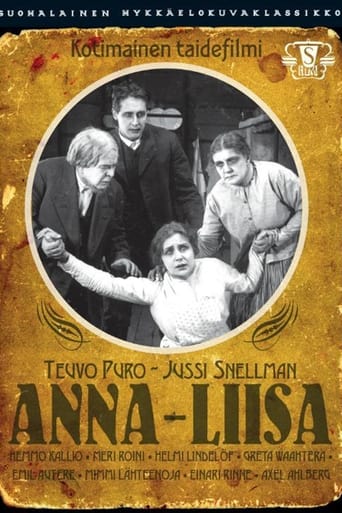
Glory Leppänen
Actor
- Active
- 1922-1922
Films 1
About Glory Leppänen
Glory Leppänen was a Finnish stage and screen actress, director, and writer associated with the earliest years of Finnish cinema and theatre. She is credited in the silent film Anna-Liisa (1922), one of the key early Finnish literary adaptations brought to the screen, and her film work places her among the small group of performers who helped establish a native screen culture in Finland during the silent era. Although her surviving filmography is limited, she was better known in broader Finnish cultural life as a theatrical figure and artistic personality rather than as a long-running film star. Her career belongs to the formative period when Finnish cinema was still defining its artistic identity, and performers often moved fluidly between stage, writing, and screen. Information about her life and screen roles is comparatively sparse in widely accessible English-language sources, which is typical for many Nordic silent-era artists. Even so, her association with Anna-Liisa gives her a permanent place in the history of Finnish film as part of the generation that translated important national literature into cinema. Her name remains of interest to historians tracing women’s participation in early Scandinavian and Finnish screen culture.
More about Glory Leppänen
On screen
Specific documented descriptions of Glory Leppänen's screen acting style are not readily available in surviving mainstream references. As a silent-era performer, her work would have relied on expressive physical presence, gesture, and facial expressivity rather than dialogue. Given the era and the literary nature of Anna-Liisa, her performance likely aligned with the restrained yet emotionally legible style common to Nordic silent cinema. Because her available film record is extremely limited, any further characterization would be speculative.
In film history
Glory Leppänen's cultural importance lies less in a large surviving screen corpus than in what her presence signifies about the early development of Finnish cinema. Her appearance in Anna-Liisa connects her to one of the period's efforts to build a distinctly national film tradition by adapting respected Finnish literature for the screen. Women performers like Leppänen were essential to the legitimacy and emotional texture of silent-era national cinema, even when the historical record preserves only fragments of their careers. She is part of the early cultural infrastructure that helped establish Finnish film as a serious artistic medium rather than a novelty imported from abroad. For historians, figures such as Leppänen are valuable because they illuminate the relationship between theatre-trained performers and the silent screen in a small national film industry.
Later reputation
Her legacy rests on her place among the earliest named Finnish screen performers documented in surviving film history. While she does not appear to have left behind a large body of extant film work, her credit in Anna-Liisa ensures that she remains connected to a landmark phase in Finland's cinematic development. The preservation of her name in film archives and databases helps restore visibility to women whose contributions to early cinema were often under-recorded. She stands as a representative of silent-era artists whose influence is measured not only by star status but by participation in culturally significant productions. In this sense, her legacy is archival, historical, and representative of the broader women’s contribution to Scandinavian silent film.
Influence
Any direct influence on later performers is difficult to document specifically, but her presence in early Finnish cinema contributed to the normalization of women as central screen figures in national film production. By participating in literary adaptation during the silent era, she helped demonstrate how theatre and screen performance could intersect in Finnish cultural life. Her work belongs to a tradition that later Finnish actresses and filmmakers could look back on as part of their industry’s origins. More broadly, performers from her era influenced the visual language and emotional style of Nordic silent acting through disciplined, character-centered performance.
Off screen
Publicly accessible information about Glory Leppänen's personal life is limited in widely available reference sources. She is known primarily through her artistic association with early Finnish theatre and cinema rather than through extensive biographical coverage. Details regarding marriages, family relationships, and later life are not consistently documented in commonly used film references. Because of this, it is not possible to provide a fuller verified personal biography without risking inaccuracy.
Credits
- Appeared in Anna-Liisa (1922), a significant early Finnish silent film adaptation of a major national literary work
- Represents one of the early women associated with Finnish silent-era screen performance
- Part of the generation of artists whose work bridged theatre, literature, and early cinema in Finland
- Her credit in Anna-Liisa places her within the foundational period of Finnish feature filmmaking
Roles
- Role in Anna-Liisa (1922)
Films
- Anna-Liisa (1922)
Notes
- Glory Leppänen is credited in Anna-Liisa (1922), one of the important early Finnish silent films.
- Her surviving mainstream filmography is extremely small, which is common for many early silent-era performers.
- She is associated with the formative period of Finnish national cinema rather than with the later studio era.
- Her name is preserved in film reference sources despite limited public biographical detail.
- Because her career straddles the era of stage and silent film, she is of particular interest to historians of Finnish theatre-film crossover.
- She is an example of a performer whose importance is historical and cultural even when star biography is sparse.
- Her documented screen presence comes from a literary adaptation, a common prestige format in early Nordic cinema.
Questions
Who was Glory Leppänen?
Glory Leppänen was a Finnish actress associated with the silent era and early Finnish cinema. She is best known for appearing in Anna-Liisa (1922), an important early Finnish film adaptation. Surviving biographical information is limited, but she remains a notable figure in the history of Finland's early screen culture.
What films is Glory Leppänen best known for?
She is best known for Anna-Liisa (1922). That film is the key surviving reference point for her screen career and links her to one of the significant early Finnish literary adaptations.
When was Glory Leppänen born and when did she die?
Reliable public sources commonly used for film reference do not consistently provide verified birth and death details for Glory Leppänen. Because of that, it is safest to treat those dates as unavailable unless confirmed by specialized archival sources.
What awards did Glory Leppänen win?
No widely documented awards or major nominations are readily associated with Glory Leppänen in standard film references. Her importance is primarily historical rather than award-based, especially in relation to early Finnish silent cinema.
What was Glory Leppänen's acting style?
As a silent-era performer, her acting would have depended on gesture, movement, and expressive facial performance rather than spoken dialogue. Beyond that general context, specific contemporary descriptions of her style are not widely preserved in accessible sources.
What is Glory Leppänen's legacy in film history?
Her legacy lies in her participation in the earliest phase of Finnish cinema and in a film that helped define national screen identity. Even with a limited surviving film record, she represents the women who helped shape silent-era Nordic film culture.