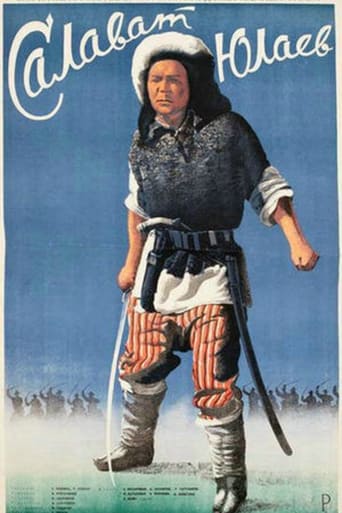
Films
1 film
About Mikhail Bolduman
Mikhail Bolduman is credited on a single production — Salavat Yulayev (1941). His most notable and possibly only significant film role was in the 1941 historical epic 'Salavat Yulayev,' which depicted the life of the Bashkir national hero. The film was directed by Yakov Protazanov, one of the figures of Russian and Soviet cinema. Bolduman's participation in this production placed him within the context of Soviet wartime cinema, which often emphasized heroic narratives and national pride. The film itself was significant as it represented one of the major cinematic treatments of non-Russian national heroes within the Soviet Union. Unfortunately, detailed records of Bolduman's broader career and life remain scarce, suggesting he may have been a character actor or someone whose film career was brief or interrupted by historical circumstances. His work exemplifies the many actors who contributed to Soviet cinema's development during this critical period but whose stories remain largely undocumented in Western film histories.
The Craft
Milestones
- Appeared in 'Salavat Yulayev' (1941), a significant Soviet historical film
- Worked with director Yakov Protazanov
- Participated in Soviet wartime cinema
Best Known For
Iconic Roles
Must-See Films
Working Relationships
Worked Often With
Studios
Why They Matter
Impact on Culture
Mikhail Bolduman's contribution to cinema, while documented through his role in 'Salavat Yulayev,' represents the broader tapestry of Soviet filmmaking during the World War II era. The film itself was significant in Soviet cinema as it highlighted the contributions of non-Russian peoples within the Soviet Union, aligning with the state's policy of promoting unity while celebrating diverse national cultures. Actors like Bolduman, though not widely known internationally, were essential in bringing these national narratives to life and helping to shape the cultural identity of the Soviet republics through cinema.
Lasting Legacy
Mikhail Bolduman's legacy is primarily preserved through his participation in 'Salavat Yulayev,' a film that remains an important document of Soviet cinematic history and the representation of Bashkir culture. While his individual contributions may not be extensively documented, he represents the countless actors who formed the foundation of Soviet cinema's golden age. The film itself continues to be studied by film historians interested in how Soviet cinema handled questions of national identity and historical representation during the Stalin era.
Who They Inspired
Due to limited documentation of Bolduman's career and influence, it's difficult to trace his specific impact on other actors or filmmakers. However, his work in a major historical production during this period would have contributed to the development of acting styles and approaches to historical characterization in Soviet cinema.
Off Screen
Very limited information is available about Mikhail Bolduman's personal life, which is not uncommon for Soviet character actors of this era whose contributions were not extensively documented in accessible archives.
Did You Know?
- 'Salavat Yulayev' (1941) was released just before the Soviet Union entered World War II
- The film depicted the life of Salavat Yulayev, a national hero of Bashkortostan
- Director Yakov Protazanov was
- The film was produced by Mosfilm, one of the Soviet Union's largest film studios
- Historical films were particularly important in Soviet cinema as vehicles for ideological education
- The film's release in 1941 coincided with a critical period in Soviet history
- Very little documentation exists about many Soviet character actors from this period
Frequently Asked Questions
Who was Mikhail Bolduman?
Soviet with credits in this catalog. He appears to have had a brief film career during the early golden age of Soviet cinema.
What films is Mikhail Bolduman best known for?
Titles linked here include Salavat Yulayev (1941).
When was Mikhail Bolduman born and when did he die?
Specific birth and death dates for Mikhail Bolduman are not readily available in accessible film archives, which is not uncommon for Soviet character actors of this era whose complete biographical information may be limited or undocumented in English-language sources.
What awards did Mikhail Bolduman win?
There are no documented awards or nominations for Mikhail Bolduman in available film archives, which was not unusual for character actors in Soviet cinema of this period unless they achieved prominent recognition.
What was Mikhail Bolduman's acting style?
Specific details about Mikhail Bolduman's acting style are not extensively documented, but actors in Soviet historical films of this era typically employed dramatic, theatrical approaches suitable for epic narratives and character archetypes.
Why is so little known about Mikhail Bolduman?
Limited documentation about Mikhail Bolduman is common for many Soviet character actors of the 1940s, whose careers may have been brief, interrupted by historical events like World War II, or simply not extensively preserved in accessible international film archives.