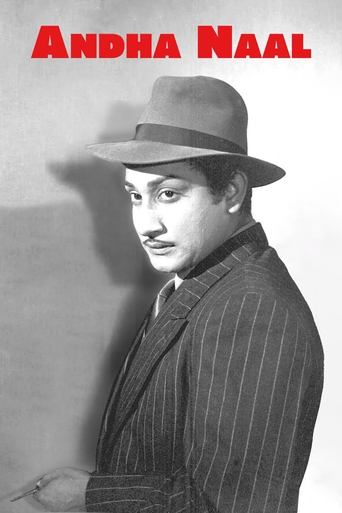

Films
1 film
About K. Sooryakala
Made her mark in the 1950s, most notably appearing in the 1954 film 'Andha Naal'. While her filmography appears to be brief, her contribution to this classic thriller has secured her place in Indian cinema history. 'Andha Naal' was revolutionary as the first Tamil film without songs and the first Tamil film to be shot entirely indoors. Sooryakala's performance, though in a supporting capacity, contributed to the film's realistic and intense atmosphere that set it apart from conventional cinema of its time. Her career seems to have been concentrated primarily around 1954, with 'Andha Naal' being her most documented work. The film itself was a critical success and is now considered a milestone in Tamil cinema, though detailed information about Sooryakala's subsequent career or other film appearances remains limited in historical records.
The Craft
On Screen
Based on her appearance in 'Andha Naal', Sooryakala appeared to employ a realistic, naturalistic acting style that aligned with the film's innovative approach to cinema, moving away from the theatrical performances common in Indian films of the era
Milestones
- Appeared in the Tamil thriller 'Andha Naal' (1954)
- Part of the cast of the first Tamil film without songs
- Contributed to India's first film shot entirely indoors
Best Known For
Iconic Roles
Must-See Films
Working Relationships
Worked Often With
Why They Matter
Impact on Culture
K. Sooryakala's cultural impact, while modest in scope, is tied to her participation in 'Andha Naal', a film that revolutionized Tamil cinema. The film broke numerous conventions - being the first Tamil film without songs, the first shot entirely indoors, and featuring a non-linear narrative structure. By being part of this groundbreaking production, Sooryakala contributed to a pivotal moment in Indian film history that demonstrated the viability of songless, realistic cinema in an industry dominated by musical formats.
Lasting Legacy
K. Sooryakala's legacy is preserved through her association with 'Andha Naal', which remains a cult classic and is frequently cited in film studies as a milestone in Indian cinema. While she may not have achieved widespread fame, her contribution to this innovative film ensures her place in cinema history. The film continues to be studied for its technical innovations and narrative techniques, and all cast members, including Sooryakala, are remembered as part of this revolutionary production.
Who They Inspired
As a supporting actress in a film, K. Sooryakala's direct influence on other actors is difficult to trace. However, her participation in 'Andha Naal' contributed to the film's success in demonstrating that realistic, songless cinema could work in the Tamil industry, thereby influencing subsequent generations of filmmakers and actors who sought to create more naturalistic cinema in India.
Off Screen
Very limited information is available about K. Sooryakala's personal life, as was common for supporting actors in 1950s Indian cinema. Historical records from this era often focused primarily on lead actors and directors, leaving many details about supporting cast members undocumented.
Did You Know?
- 'Andha Naal' was the first Tamil film without any songs, which was revolutionary for its time
- The film was shot entirely indoors, making it the first Indian film with this distinction
- 'Andha Naal' featured a non-linear narrative structure, influenced by Japanese cinema
- The film was directed by S. Balachander, who was also a renowned veena player
- Despite its innovations, 'Andha Naal' was not a commercial success initially but gained cult status over time
- The film's title translates to 'That Day' in English
- K. Sooryakala was part of a relatively small cast for a 1950s Tamil film
- The film's noir-style thriller approach was completely new to Tamil cinema audiences
Frequently Asked Questions
Who was K. Sooryakala?
Tamil cinema actress active in 1954, best known for her role in the groundbreaking film 'Andha Naal'. While her filmography appears limited, her contribution to this innovative thriller has secured her place in Indian cinema history as part of a production that revolutionized Tamil filmmaking.
What films is K. Sooryakala best known for?
Titles linked here include Andha Naal (1954).
When was K. Sooryakala born and when did she die?
Specific birth and death dates for K. Sooryakala are not readily available in historical records, which is common for supporting actors from 1950s Indian cinema. Documentation from this era often focused primarily on lead actors and directors.
What awards did K. Sooryakala win?
There are no documented awards or nominations for K. Sooryakala in available historical records. During the 1950s, recognition for supporting actors in regional Indian cinema was limited, and formal award systems were not as established as they are today.
What was K. Sooryakala's acting style?
Based on her appearance in 'Andha Naal', K. Sooryakala employed a realistic, naturalistic acting style that aligned with the film's innovative approach. This was notably different from the theatrical performances common in Indian films of the era, contributing to the film's groundbreaking realistic atmosphere.
Why is 'Andha Naal' significant in cinema history?
'Andha Naal' is historically significant as the first Tamil film without songs, the first Indian film shot entirely indoors, and one of the earliest Indian films to use a non-linear narrative. These innovations made it a milestone in Indian cinema that demonstrated new possibilities for realistic filmmaking in the country.