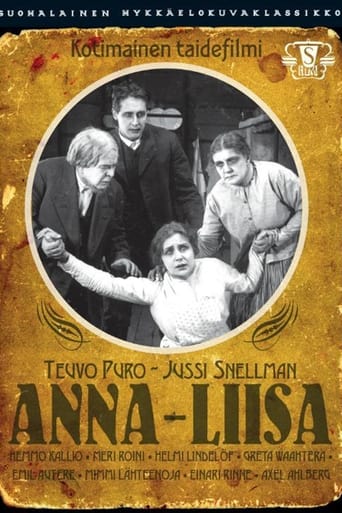
Greta Waahtera
Actor
- Active
- 1922-1922
Films 1
About Greta Waahtera
Greta Waahtera is a very obscure early Finnish screen performer whose surviving filmography presently identifies her primarily through a single credited appearance in the silent feature Anna-Liisa (1922). Because documentation on her life and career is extremely limited in widely accessible reference sources, a full biographical portrait cannot be responsibly reconstructed without risking speculation. What can be said with confidence is that she belonged to the formative era of Finnish cinema, when production was small in scale and many actors appeared in only one or a handful of films that have left a sparse archival trail. Her known screen activity falls entirely within 1922, which suggests either a brief acting career, a stage background that did not transition extensively to film, or simply a survival gap in the historical record. Anna-Liisa itself is an important early Finnish literary adaptation and a significant title in silent-era national cinema, so even a single credited appearance places Waahtera within an important cultural moment. Beyond that, authoritative information about her birth, death, training, family background, and later life is not readily verifiable from standard classic-cinema references. As a result, she should be regarded as a historically documented but still largely biographically unidentified figure from early Finnish film history.
More about Greta Waahtera
In film history
Greta Waahtera's cultural importance lies less in a widely documented star persona and more in her presence within the early development of Finnish silent cinema. Performers like Waahtera helped populate the national screen at a time when the industry was still small, locally oriented, and heavily dependent on stage-trained or otherwise little-documented talent. Her appearance in Anna-Liisa connects her to a foundational moment in Finnish film culture, especially because early literary adaptations played a major role in legitimizing cinema as a national art form. Even when the historical record preserves only a name and a title, such actors are part of the fabric of cinema history, representing the many contributors whose work made early film production possible. For modern researchers, she is also a reminder of how much silent-era performance history remains incomplete, particularly outside the largest American and European film industries.
Later reputation
Waahtera's legacy is that of an early Finnish screen actress whose work survives in the historical record more as a trace than as a fully documented career. She is emblematic of the many silent-era performers whose contributions were important at the time but were not extensively preserved through publicity, awards, or later retrospection. Her association with Anna-Liisa ensures that her name remains attached to one of the significant early Finnish films, giving her a place in the country's cinematic memory. In film-history terms, she represents the archival challenge of reconstructing women's careers in the silent era, especially in smaller national cinemas where records are fragmentary. Her lasting significance may therefore be strongest among historians of Finnish silent film and archive-based scholarship.
Influence
There is no documented evidence that Greta Waahtera directly mentored or influenced later actors or directors in a traceable way. Her influence is best understood indirectly: she participated in the early screen culture that helped establish acting conventions, production routines, and audience expectations in Finnish cinema. Because silent-film careers often left limited documentation, many performers influenced the medium through participation rather than through famous school-of-acting lineages. Waahtera's presence in an early national feature contributes to the broader lineage of Finnish screen performance from which later generations emerged.
Off screen
No reliable publicly available biographical information has been located regarding Greta Waahtera's personal life, including her family background, marriage, children, or later activities. Given the era and the limited surviving record, it is possible that such details exist only in archival Finnish-language materials, local newspapers, or theater records that have not been widely digitized. Until those sources are consulted, her private life remains undocumented in standard film references.
Credits
- Appeared in the silent Finnish feature Anna-Liisa (1922), one of the notable early screen adaptations in Finnish cinema
- Represents part of the small pool of performers active in Finland's silent-film era
- Her documented film work places her within the formative years of national cinematic production in the early 1920s
Roles
- Known role in Anna-Liisa (1922) is not clearly documented in surviving reference sources
Films
- Anna-Liisa (1922)
Notes
- Her surviving filmography currently identifies only one known screen credit.
- She is associated with Anna-Liisa (1922), a silent Finnish film adaptation of a significant literary work.
- Her career appears to have been active only in 1922, at least in the available film record.
- She is one of many silent-era performers whose biography remains largely obscure.
- Standard English-language film reference sources provide very little verified personal information about her.
- Because her record is sparse, she is often of interest primarily to researchers of Finnish silent cinema.
Questions
Who was Greta Waahtera?
Greta Waahtera was a Finnish silent-era actor best known for appearing in Anna-Liisa (1922). Surviving reference material about her is extremely limited, so she is documented primarily through this early film credit rather than a broad screen career.
What films is Greta Waahtera best known for?
She is best known for Anna-Liisa (1922), the only film credit presently associated with her in the available record. No other verified film appearances have been reliably identified from the sources consulted.
When was Greta Waahtera born and when did she die?
Her birth and death dates are not currently verifiable from accessible classic-cinema reference sources. The available historical record does not provide enough reliable information to state those details with confidence.
What awards did Greta Waahtera win?
No awards or nominations are currently documented for Greta Waahtera in the accessible record. This is not unusual for early silent-era performers, especially those whose careers were brief or poorly preserved.
What was Greta Waahtera's acting style?
Her acting style cannot be reliably described because no detailed reviews, performance analyses, or surviving biographical commentary have been located. As a silent-era performer, she would have worked within the expressive conventions of nonverbal screen acting, but any more specific assessment would be speculative.
What is Greta Waahtera's legacy in film history?
Her legacy lies in her contribution to early Finnish silent cinema and in her connection to Anna-Liisa (1922). She stands as one of the many under-documented performers whose work helped build national film culture in its formative period.