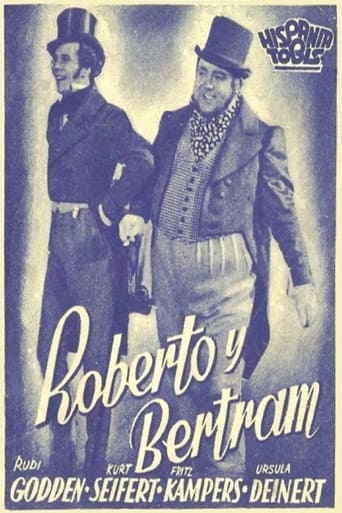

Rudi Godden
Actor
- Born
- April 18, 1907, Berlin, German Empire
- Died
- January 4, 1941
- Active
- 1937-1941
- Birth name
- Rudi Lißbauer
Films 1
About Rudi Godden
Rudi Godden was a prominent German singer and film actor whose career flourished during the late 1930s before being tragically cut short. Born Rudi Lißbauer in Berlin, he was the son of an Austrian café owner and was later adopted by his stepfather, a cinema owner, which likely sparked his early interest in the performing arts. Initially aspiring to be an opera singer, he trained at the Hamburg Opera School but eventually transitioned into cabaret and musical theater, co-founding the vocal quartet 'Blue Boys' in the late 1920s. His cinematic breakthrough came in 1937 when he signed with Tobis Film, quickly becoming a favorite for his 'boy next door' charm and musical talent. He is perhaps most remembered for his leading role in the 1939 musical comedy 'Robert and Bertram' and for performing the iconic hit song 'Musik, Musik, Musik' in 'Hallo Janine!'. His career was abruptly ended at the age of 33 when he died of sudden blood poisoning in January 1941, just as he was reaching the peak of his popularity.
More about Rudi Godden
On screen
Godden was celebrated for his 'Sonnyboy' persona, characterized by a cheerful, easy-going, and charming demeanor. He often played the 'good-humored boy next door' or the romantic lead in musical revues. His performances were heavily reliant on his vocal abilities and comedic timing, often drawing comparisons to the lighthearted slapstick style of Stan Laurel.
Impact on culture
Rudi Godden represented the 'light entertainment' facet of German cinema during a highly politicized era. His performance of 'Musik, Musik, Musik' (I don't need millions...) became a cultural touchstone, remaining a well-known 'evergreen' song in Germany for decades. While his films were often escapist musical revues, they provided the public with a specific brand of optimistic, rhythmic entertainment that defined the 'revue film' genre of the late 1930s.
Lasting legacy
Godden's legacy is twofold: he is remembered as a talented musical star whose life was cut tragically short, and as a central figure in films that are now studied for their historical and political context. His film 'Robert and Bertram' remains a significant subject for film historians due to its status as the only anti-Semitic musical comedy produced during the Third Reich. Despite the controversy of the era's propaganda, Godden's personal talent as a singer and comedic actor is still recognized in the history of German musical cinema.
Who they inspired
He influenced the 'singing cavalier' archetype in German cinema, bridging the gap between traditional operetta and the more modern, jazz-influenced musical films of the 1940s.
Off screen
Godden was the son of an Austrian café owner who died when Rudi was young. In 1910, his mother married a Berlin cinema owner named Goddeng, whose name Rudi eventually adopted for his stage career. He was married to the cabaret artist Gerti Godden from 1937 until his death in 1941.
Education
Attended schools in Berlin, Rostock, and Hamburg; received formal vocal training at the Hamburg Opera School.
Career milestones
- Signed a major film contract with Tobis Film in 1936
- Starring role as Robert in the musical comedy 'Robert and Bertram' (1939)
- Performed the evergreen hit song 'Musik, Musik, Musik' in the film 'Hallo Janine!' (1939)
- Transitioned from cabaret star to one of Germany's most popular musical film leads
- Cast in 'Das Leben kann so schön sein' (1938), a rare serious role that was initially banned by censors
Iconic roles
- Robert in 'Robert and Bertram' (1939)
- Stage Manager Peters in 'Truxa' (1937)
- The lead singer in 'Hallo Janine!' (1939)
Must-see films
- Robert and Bertram (1939)
- Hallo Janine! (1939)
- Truxa (1937)
- Shoulder Arms (Das Gewehr über!) (1939)
- The Stars Shine (Es leuchten die Sterne) (1938)
Special recognition
- Recognized as a leading star of the Tobis Film studio during the late 1930s
- His grave in the Old Twelve Apostles Churchyard in Berlin-Schöneberg is preserved as a site of historical interest
Worked often with
- Hans H. Zerlett (Director)
- Kurt Seifert (Actor)
- Marika Rökk (Actress)
- Johannes Heesters (Actor/Singer)
Studios
- Tobis Film
- UFA
Family
- Gerti Godden (1937-1941)
Did you know?
- His stepfather was a cinema owner, which allowed him to watch films for free as a child.
- He co-founded a vocal quartet called the 'Blue Boys' before becoming a solo film star.
- He died at the very young age of 33 due to blood poisoning (sepsis).
- One of his films, 'Das Leben kann so schön sein' (1938), was banned by Nazi censors for being too 'pessimistic' and wasn't released until after the war.
- The ending of his film 'Robert and Bertram' was changed in 1942 for propaganda reasons, long after his death.
- He was often compared to Stan Laurel because of his physical comedy and slender build.
In their own words
Ich brauche keine Millionen, mir fehlt kein Pfennig zum Glück... (I don't need millions, I don't lack a penny for happiness...) - Famous lyrics he sang in 'Hallo Janine!'
Questions and answers
Who was Rudi Godden?
Rudi Godden was a popular German singer and actor of the late 1930s, known for his roles in musical comedies and revue films. He was a major star for Tobis Film before his untimely death at age 33.
What films is Rudi Godden best known for?
He is best known for 'Robert and Bertram' (1939), 'Hallo Janine!' (1939), and his debut film 'Truxa' (1937). He is also remembered for singing the hit 'Musik, Musik, Musik'.
When was Rudi Godden born and when did he die?
He was born on April 18, 1907, in Berlin and died on January 4, 1941, also in Berlin, due to blood poisoning.
What was Rudi Godden's acting style?
He was known for a 'Sonnyboy' style—always cheerful, charming, and energetic. He combined physical comedy with his professional singing voice to become a leading man in musical revues.
Why is the film 'Robert and Bertram' controversial?
It is considered the only anti-Semitic musical comedy of the Nazi era. While Godden played a comedic lead, the film used caricatures for propaganda purposes, making it a subject of historical study today.