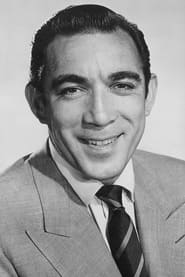
Anthony Quinn
Actor
Born: April 21, 1915 in Chihuahua, Mexico Died: June 3, 2001 Active: 1936-2001 Birth Name: Antonio Rodolfo Quinn Oaxaca
Films
1 film
About Anthony Quinn
Antonio Rodolfo Quinn Oaxaca, known professionally as Anthony Quinn, was a Mexican-American actor whose over six decades in Hollywood. Born in Chihuahua, Mexico, he moved to the United States as a child and grew up in poverty in East Los Angeles. Quinn began his acting career in the early 1930s with small roles, often playing ethnic characters due to his distinctive appearance. His breakthrough came in the 1950s when he won two consecutive Academy Awards for Best Supporting Actor for 'Viva Zapata!' (1952) and 'Lust for Life' (1956). Quinn became known for his powerful, intense performances and his ability to portray a wide range of characters, from historical figures to complex dramatic roles. His international career flourished with collaborations with directors like Federico Fellini and David Lean. Quinn was also a talented painter and sculptor, with his artwork being exhibited in galleries worldwide. He continued acting well into his 80s, leaving behind a legacy as one of Hollywood's most versatile and charismatic character actors.
The Craft
On Screen
Quinn was known for his intense, passionate, and physically commanding presence on screen. His acting style combined raw emotional power with a remarkable ability to transform into diverse characters, often drawing on his Mexican heritage and life experiences. He had a unique capacity to portray both gentle vulnerability and explosive rage, often in the same performance. Quinn's method approach involved deep character study and physical transformation, though he never formally studied at any acting school. His distinctive voice, weathered features, and powerful physique made him particularly effective in roles requiring both physical and emotional intensity.
Milestones
- First Academy Award nomination for 'Viva Zapata!' (1952)
- Won Best Supporting Actor Oscar for 'Viva Zapata!' (1952)
- Won second consecutive Best Supporting Actor Oscar for 'Lust for Life' (1956)
- Starred in Fellini's 'La Strada' (1954)
- Iconic role as Alexis Zorba in 'Zorba the Greek' (1964)
- Played Auda Abu Tayi in 'Lawrence of Arabia' (1962)
- Published autobiography 'The Original Sin' in 1972
- Received Golden Globe Cecil B. DeMille Award (1987)
Best Known For
Iconic Roles
Must-See Films
Accolades
Won
- Academy Award for Best Supporting Actor - Viva Zapata! (1952)
- Academy Award for Best Supporting Actor - Lust for Life (1956)
- Golden Globe Award for Best Actor - Zorba the Greek (1964)
- New York Film Critics Circle Award for Best Actor - Zorba the Greek (1964)
- National Board of Review Award for Best Actor - Zorba the Greek (1964)
Nominated
- Academy Award nomination for Best Actor - Zorba the Greek (1964)
- Academy Award nomination for Best Actor - Wild in the Country (1961)
- Academy Award nomination for Best Actor - Requiem for a Heavyweight (1962)
- Golden Globe nomination for Best Actor - The Guns of Navarone (1961)
- BAFTA nomination for Best Foreign Actor - Lawrence of Arabia (1962)
Special Recognition
- Hollywood Walk of Fame star (1960)
- Golden Globe Cecil B. DeMille Award (1987)
- National Medal of Arts (1990)
- Lifetime Achievement Award from the American Film Institute
- Honorary Doctorate from Fine Arts from the University of California
Working Relationships
Worked Often With
Studios
Why They Matter
Impact on Culture
Anthony Quinn broke significant barriers for Hispanic actors in Hollywood, becoming one of the first Mexican-American actors to achieve international stardom. His success challenged the limited roles available to ethnic actors in the studio system, proving that performers from diverse backgrounds could carry major productions. Quinn's portrayal of complex, non-stereotypical characters helped pave the way for greater diversity in Hollywood casting. His international appeal, particularly in European cinema, helped bridge American and European film industries. Quinn's proud embrace of his Mexican heritage while achieving mainstream success made him a role model for future generations of minority actors. His artistic pursuits beyond acting, particularly his painting and sculpture, demonstrated the multifaceted nature of creative expression.
Lasting Legacy
Anthony Quinn's legacy endures through his iconic film performances that continue to influence actors and filmmakers. His portrayal of Zorba in 'Zorba the Greek' created one of cinema's most memorable characters, embodying a philosophy of life that resonates across cultures. Quinn's two Academy Awards for Best Supporting Actor remain proof of his exceptional talent in character roles. His art collection and personal paintings have been exhibited in major galleries, establishing him as a significant figure in visual arts as well as film. Quinn's large family continues his artistic legacy, with several of his children working in creative fields. His autobiography and numerous interviews provide valuable insights into the Golden Age of Hollywood and the challenges faced by minority actors during that era.
Who They Inspired
Quinn influenced generations of actors through his intense, naturalistic style and his ability to disappear completely into characters. His success proved that ethnic actors could transcend typecasting and achieve leading-man status. Many actors, particularly those from minority backgrounds, cite Quinn as an inspiration for breaking barriers in Hollywood. His collaborations with international directors helped popularize cross-cultural filmmaking. Quinn's method of drawing from personal experience and cultural heritage to inform his performances has been studied by acting students worldwide. His transition from character actor to leading man demonstrated the possibility of career evolution in the film industry.
Off Screen
Anthony Quinn had a complex personal life marked by multiple marriages and numerous children. He was married three times and had 13 children with five different women. His first marriage to actress Katherine DeMille, daughter of director Cecil B. DeMille, lasted from 1937 to 1965 and produced five children. He then married Jolanda Addolori, a costume designer, with whom he had three children. His third marriage was to Katherine Benvin, a former fashion model, who was 30 years his junior. Quinn was known for his passionate relationships and his dedication to his large family. He was also deeply involved in art, painting and sculpting throughout his life, with his work being exhibited internationally. Quinn — polyglot, speaking several languages fluently, and maintained strong connections to his Mexican heritage throughout his life.
Education
Belmont High School, Los Angeles; Polytechnic High School, Long Beach; studied briefly at Santa Barbara State College and UCLA; self-taught in acting through observation and experience
Family
- Katherine DeMille (1937-1965)
- Jolanda Addolori (1966-1997)
- Katherine Benvin (1997-2001)
Did You Know?
- Was originally cast as Stanley Kowalski in 'A Streetcar Named Desire' on Broadway but was replaced by Marlon Brando
- Spoke fluent English, Spanish, French, Italian, and some German
- Was a professional boxer before becoming an actor, with a record of 5 wins and 1 loss
- His first film role was as an extra in the 1936 film 'The Milky Way'
- Was a close friend of painter Pablo Picasso and owned several of his works
- Turned down the role of Don Corleone in 'The Godfather'
- Wrote and directed the film 'The Magnificent Texan' (1965)
- Was a licensed pilot and owned several aircraft
- His net worth at the time of his death was estimated at $20 million
- Was nominated for a Tony Award for his Broadway performance in 'The Great White Hope'
In Their Own Words
I never read a script until I'm offered the part. If I'm not offered the part, I don't read it.
The important thing is to be able at any moment to sacrifice what you are for what you could become.
I've been a Mexican, a Spaniard, a Greek, an Arab, a Frenchman, an Italian, and every other nationality you can think of. I've been a gangster, a priest, a painter, a sculptor, and everything else. I'm an actor.
I'm not a star. I'm an actor. Stars are people who live in Hollywood and have big swimming pools. I don't have a swimming pool.
Tough times don't last, but tough people do.
Frequently Asked Questions
Who was Anthony Quinn?
Mexican-American He won two Academy Awards for Best Supporting Actor and was known for his powerful performances in films like 'Zorba the Greek,' 'Lawrence of Arabia,' and 'La Strada.' His active years covered over 60 years, and he was also a talented painter and sculptor.
What films is Anthony Quinn best known for?
Titles linked here include Zorba the Greek, Lawrence of Arabia.
When was Anthony Quinn born and when did he die?
Born April 21, 1915; died June 3, 2001.
What awards did Anthony Quinn win?
Quinn won two Academy Awards for Best Supporting Actor for 'Viva Zapata!' (1952) and 'Lust for Life' (1956). He also won a Golden Globe for 'Zorba the Greek' and received the Golden Globe Cecil B. DeMille Award for lifetime achievement in 1987. Additionally, he was honored with the National Medal of Arts in 1990.
What was Anthony Quinn's acting style?
Quinn was known for his intense, passionate, and physically commanding presence. His style combined raw emotional power with remarkable versatility, allowing him to transform into diverse characters. He drew on his Mexican heritage and life experiences, creating performances that balanced both vulnerability and explosive intensity.