
Julie Bishop
Actor
- Active
- 1923-1923
Films 1
About Julie Bishop
Julie Bishop was an American silent-era screen actress whose brief known film career falls in the early 1920s, a period when many young performers were being introduced to the screen in supporting and uncredited roles. The filmography information connected to her name indicates an appearance in the 1923 production Maytime, but surviving public records on this specific Julie Bishop are extremely limited, and she should not be confused with the later and much better documented actress Julie Bishop (born Jacqueline Wells), who became a familiar Hollywood leading lady in the 1930s and 1940s. Because this earlier Julie Bishop appears to have worked only briefly, there is no well-established record of a long studio contract, major star vehicles, or a sustained transition into the sound era under this exact name. In the surviving classic-cinema record, she is best understood as one of many early silent-film performers whose names appear in cast listings but whose biographies were not preserved in the same detail as those of major stars. Her presence in Maytime places her within the theater-adaptation tradition that was important to early 1920s studio production, when films often drew on popular stage properties. Beyond that single credited reference, reliable biographical data about her life, training, family background, and later career has not been clearly documented in the standard reference sources commonly used for silent cinema history. As a result, her historical significance lies less in celebrity status than in representing the many working actors whose contributions helped shape the texture of early Hollywood productions.
More about Julie Bishop
In film history
The cultural impact of this specific Julie Bishop is necessarily modest and primarily archival rather than celebrity-driven. Her significance is tied to the preservation of early silent-film personnel records and the way classic cinema history is built not only from stars but also from lesser-known actors who appeared in studio pictures and stage adaptations. By surviving in cast documentation for Maytime, she helps researchers reconstruct the full personnel landscape of the silent era, including performers whose careers were brief or insufficiently publicized. Her example also illustrates a common issue in film historiography: names can recur across different generations of performers, and careful identification is essential to avoid conflating distinct careers. In that sense, she contributes to the broader historical record of Hollywood labor and the often-invisible supporting players of the silent screen.
Later reputation
Her legacy is primarily one of documentary presence in the early silent era rather than a lasting star persona. For film historians, the existence of a Julie Bishop credit in 1923 is a reminder that many early performers remain only partially traced, especially when their work predates more systematic studio publicity and later archival preservation. She stands as part of the larger historical fabric of silent cinema, where even a single surviving credit can be meaningful evidence of participation in the industry. Her name also requires careful disambiguation from the later actress Julie Bishop, whose career was far more extensive and well recorded. As a result, the main legacy of this exact performer is her place in the archival record of early American film production.
Influence
There is no evidence that this exact Julie Bishop exerted a documented influence on later actors or directors in the way major stars did. Her importance is indirect, in that performers like her helped establish the ensemble culture of silent-era filmmaking and contributed to the realism and continuity of studio productions. For historians, such actors influence the field of research by highlighting the need for accurate identification, cast reconstruction, and preservation of ephemeral careers. Her presence in the record is therefore more significant to scholarship than to popular performance history.
Off screen
No dependable biographical record has been located for this exact Julie Bishop in the standard classic-cinema references available from surviving film histories. Details such as marriages, family background, education, later occupation, or post-film life are not securely documented for this performer. Because of the scarcity of evidence, any specific claims about her private life would be speculative and should be avoided in a database entry.
Credits
- Known surviving screen credit connected to the 1923 film Maytime
- Represents an early silent-era performer documented in the cast history of a major studio-era production
- Part of the broad pool of young actors appearing in early 1920s American cinema
Roles
- Role in Maytime (1923)
Films
- Maytime (1923)
Notes
- This Julie Bishop should not be confused with the later actress Julie Bishop, born Jacqueline Wells, who had a much larger Hollywood career.
- Her known film activity is associated with the year 1923 only.
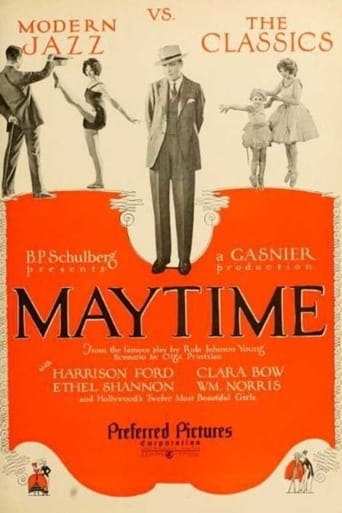
- Maytime was a significant stage-to-screen adaptation, placing her within a popular silent-era production trend.
- Publicly accessible biographical details about her are extremely sparse.
- She is an example of a performer whose name survives more clearly in film credits than in personal history.
- Her record highlights how many silent-era actors remain under-documented in modern databases.
- The scarcity of information makes her a useful case study in film identification and name disambiguation.
Questions
Who was Julie Bishop?
Julie Bishop was a silent-era American film actor known from surviving records for an appearance in Maytime (1923). She is not the same person as the later Hollywood actress Julie Bishop born Jacqueline Wells. Very little biographical information survives about this exact performer.
What films is Julie Bishop best known for?
She is best known, in the surviving record, for Maytime (1923). No other securely documented film credits were located for this exact Julie Bishop in the available classic-cinema references.
When was Julie Bishop born and when did she die?
Her birth and death dates are not securely documented in the surviving sources associated with this exact silent-era performer. Because the records are incomplete, any specific date would be speculative.
What awards did Julie Bishop win?
No awards or nominations are known for this exact Julie Bishop. The historical record available for her is too limited to show the kind of awards profile associated with later, better-documented stars.
What was Julie Bishop's acting style?
There is no detailed critical writing preserved about her acting style. Given her silent-era context, her performance approach would likely have relied on the expressive techniques common to early 1920s screen acting, but that cannot be verified specifically for her.
What is Julie Bishop's legacy in film history?
Her legacy is mainly archival: she represents the many lesser-known performers whose names survive in cast records from the silent era. For researchers, she is important as part of the broader historical fabric of early Hollywood and as a name that requires careful disambiguation from the later actress of the same name.