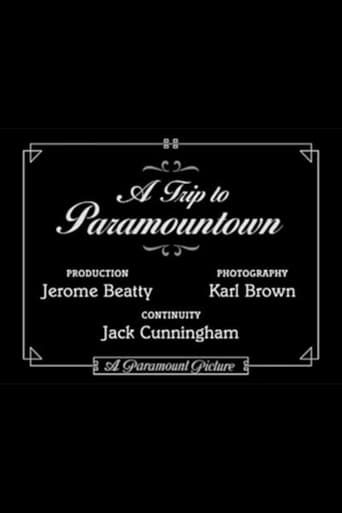
Jack Cunningham
Director
- Active
- 1922-1922
Films directed 1
About Jack Cunningham
Jack Cunningham was a silent-era Hollywood director and screenwriter whose career appears in the records primarily in the early 1920s, including his direction of the short film A Trip to Paramountown (1922). Because the surviving documentation on this specific Jack Cunningham is limited, he is best understood as one of the many craftspeople who helped shape studio-era short subjects and promotional or novelty films during the formative years of American cinema. His known activity falls squarely within the silent period, when directors often worked quickly, efficiently, and with little public fanfare, especially on shorts tied to studio publicity or exhibition programs. Unlike some of his better-documented contemporaries, he does not appear to have left behind a robust biographical trail in mainstream reference sources, making it difficult to establish precise details about his birth, death, or personal life with confidence. What can be said with certainty is that he was part of Paramount's early 1920s production world and contributed to the development of short-form filmmaking at a major studio. His surviving credit on A Trip to Paramountown places him among the working directors who supported the studio system from behind the camera rather than through celebrity. In film-history terms, he represents the many lesser-known practitioners whose labor underpinned the silent-era output of Hollywood's major companies.
More about Jack Cunningham
Behind the camera
No detailed critical description of Jack Cunningham's directing style is readily documented in standard surviving references. Based on the nature of his known credit, his work likely reflected the brisk, economical approach typical of early 1920s studio shorts: efficient staging, clear visual storytelling, and a practical emphasis on delivering material suited to promotional or programmatic exhibition. Because only limited evidence survives, any more specific characterization would be speculative rather than historically secure.
In film history
Jack Cunningham's cultural impact is best understood in the context of the silent-era studio system rather than through a celebrity-driven legacy. Directors like Cunningham helped studios produce the wide range of short subjects, novelty pieces, and supporting program material that formed the everyday cinematic experience for audiences in the 1910s and 1920s. Even when individual names are not widely remembered, these filmmakers contributed to the industrial standardization, pacing, and visual language that defined early Hollywood. His association with Paramount places him within one of the most influential institutions in American film history, and his work is part of the larger body of labor that made the studio era function. In modern film history, his importance lies in representing the often-uncredited or underdocumented creators whose short-form output supported the growth of the business and the culture of cinema.
Later reputation
Jack Cunningham's legacy is primarily archival and historical: he is remembered as one of the many early Hollywood directors whose work survives in credit records even when detailed biographical information does not. The existence of his 1922 Paramount credit is valuable to scholars because it documents the personnel who participated in studio production during a transformative period for American film. His legacy also highlights a common challenge in silent-cinema scholarship, where many working filmmakers contributed meaningfully to the medium but left behind only partial traces. For database and reference purposes, he remains an important name to preserve precisely because such figures are easily lost to history. In that sense, his lasting legacy is as a representative of the silent-era workforce and the collaborative machinery of classic Hollywood.
Influence
There is no strong evidence that Jack Cunningham directly influenced later generations in a documented, personal sense, but his work contributed to the broader professional practices of early studio filmmaking. Directors of his type helped establish the fast, pragmatic production methods that became standard in Hollywood. His work on a Paramount short in 1922 forms part of the cumulative industrial influence that shaped how later filmmakers approached short subjects, studio branding, and visual brevity. Any direct line of mentorship or stylistic influence cannot be confirmed from the available record.
Off screen
Reliable information about Jack Cunningham's personal life is not readily available in surviving classic-cinema reference sources. No confirmed details about marriages, children, family background, or private life could be established with confidence from the available historical record. As with many minor silent-era studio figures, his career documentation is sparse enough that personal biography has largely been lost or remains unverified.
Credits
- Directed A Trip to Paramountown (1922), the principal surviving credit associated with his name
- Worked within the early Paramount studio environment during the silent era
- Contributed to short-form filmmaking at a time when studio publicity and exhibition shorts were an important part of movie culture
- Represents the working directors of the silent period whose output often survives only fragmentarily in modern records
Films
- A Trip to Paramountown (1922)
Studios
- Paramount Pictures
Notes
- His best-known surviving credit is A Trip to Paramountown (1922), a title that strongly suggests a studio-related or promotional subject.
- He appears to have worked during a very narrow documented window, making him a particularly elusive figure in silent-era history.
- Unlike more famous directors of the era, he does not appear to have a substantial public biographical footprint in modern reference sources.
- His career illustrates how many silent-era filmmakers are known today mainly through surviving film credits rather than detailed personal histories.
- The fact that he is associated with Paramount places him within one of the major Hollywood studios of the 1920s.
- Because the available record is sparse, it is important not to confuse him with other people named Jack Cunningham who worked in film or other industries.
- His surviving credit may indicate work on a short film rather than a feature, which was common for studio personnel early in their careers or in specialized production units.
Questions
Who was Jack Cunningham?
Jack Cunningham was a silent-era film director associated with Paramount, best known from the surviving credit for A Trip to Paramountown (1922). He is one of the many early Hollywood craftsmen whose work supported studio production during the formative years of American cinema.
What films is Jack Cunningham best known for?
He is best known for A Trip to Paramountown (1922), which is the principal surviving credit associated with his name. Beyond that, his documented filmography is limited in the available historical record.
When was Jack Cunningham born and when did he die?
His birth and death dates are not readily confirmed in surviving reference sources for this specific silent-era filmmaker. The historical record available today is too sparse to state those details reliably.
What awards did Jack Cunningham win?
No awards or major nominations are currently documented for this Jack Cunningham in the surviving classic-cinema record. Many early studio directors, especially short-subject filmmakers, were never formally recognized with the kinds of awards systems that later became standard.
What was Jack Cunningham's directing style?
A precise stylistic profile cannot be established from the limited surviving evidence. Based on the nature of his known 1922 credit, his work likely followed the efficient, clear, and economical conventions typical of silent-era studio shorts.
What is Jack Cunningham's legacy in film history?
His legacy lies in the historical record of early Hollywood labor and studio production, especially at Paramount. He represents the many working directors whose contributions helped shape the silent-era industry even if their names are not widely remembered today.