Akrobatisches Potpourri
"Eight acrobats, one balancing act"
Keys: Space play/pause · ←/→ 10s · F fullscreen · M mute · </> speed
About this film
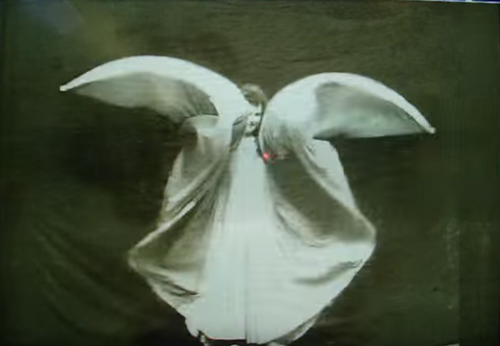
Eight circus performers known as the Grunato family perform their famous balancing act.
Cast & crew
More films like this
More Documentary films
View all →
More from Max Skladanowsky
View all →
More about this film
About the production
Release dateNovember 1, 1895
ProductionSkladanowsky Brothers
Filmed inBerlin, Germany
Filmed using the Bioscop projector/camera system invented by the Skladanowsky brothers. The film was shot in a studio setting specifically constructed for early motion picture production. The performers had to hold their poses longer than usual due to the technical limitations of early cameras. This was one of the first films to capture circus acts on camera, a popular subject in early cinema.
Themes
Circus performanceFamily entertainmentPhysical prowessHuman movementVictorian-era entertainment
Themes & topics
Historical background
Fairground exhibitors screened Akrobatisches Potpourri around 1895, when projected images still traveled as curiosity entertainment.
Why this film matters
Akrobatisches Potpourri belongs to early staged screen fiction, when producers tested camera placement and trick cuts.
Making of
The Skladanowsky brothers, Max and Emil, were optical engineers who had previously worked with magic lanterns and other visual entertainment devices. They developed their Bioscop camera/projector system in their workshop in Berlin. The Grunato family was likely hired specifically for due to their reputation as skilled performers. The filming process was extremely challenging by modern standards - the camera was hand-cranked, lighting was poor, and the performers had to execute their routine while staying within the very limited frame of the camera. The entire production was likely completed in a single day due to the expense and difficulty of the early film process.
What critics said
Press notices for Akrobatisches Potpourri (1895) are sparse in digitized sources; interest today rests on preserved prints and comparison with related titles.
Did you know?
- was part of the first commercial film screening in Germany history, presented by the Skladanowsky brothers
- The Bioscop projector used could only show films for about 6 seconds at a time before needing to be reloaded
- The Grunato family were real circus performers popular in Germany at the time
- predates the famous Lumière brothers' first public screening by nearly two months
- The film was shot on 35mm film, which became the industry standard
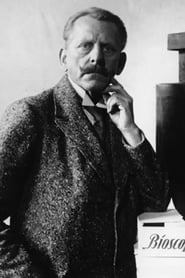
- Max Skladanowsky and his brother Emil were German inventors who developed one of the first movie projectors
- The film was shown at the Wintergarten theatre in Berlin during a variety show
- Unlike many early films that were staged, this captured a genuine circus performance
- The Skladanowsky brothers' Bioscop used two separate film loops to create a more continuous projection
- represents some of the earliest documentation of circus arts on film
Visual style
The cinematography was extremely basic by modern standards, consisting of a single stationary camera position capturing the entire performance from a fixed angle. The camera was hand-cranked, resulting in variable frame rates. The composition was simple, designed to capture the full bodies of all performers within the frame. The lighting was natural or basic studio illumination, creating high contrast images typical of early film. Despite these limitations, the camera successfully captured the dynamic movement of the acrobats, which was the primary technical achievement.
Memorable scenes
- The formation of the human pyramid by the Grunato family, showcasing their remarkable balance and coordination as multiple performers stack themselves in a precarious yet stable configuration, all captured by the primitive camera technology of 1895.
What audiences thought
Audiences at the 1895 Wintergarten screening were reportedly astonished by the lifelike movement captured on screen. The ability to see real people performing actual circus acts was considered miraculous by viewers who had never seen moving images before. The Grunato family's performance was particularly impressive as it showcased the new medium's ability to capture complex human motion. Contemporary newspaper accounts described the screening as a sensation, with viewers marveling at how the performers seemed to come alive on the screen.
Film connections
Influenced by
- Magic lantern shows
- Circus performances
- Vaudeville entertainment
This film influenced
- Other early circus films
- Acrobatic performance films
- German documentary shorts
Film restoration
The film is preserved and held in film archives, particularly at the Bundesarchiv-Filmarchiv in Germany. It has been restored and digitized as part of early cinema preservation efforts. While some deterioration is evident due to the age of the original nitrate film, the content remains viewable and historically significant.
Where to watch
- Available on various early cinema compilation DVDs
- Streaming on some archival film websites
- Viewable at film museums and archives specializing in early cinema
- Included in some online educational resources about film history