
How It Feels to Be Run Over
"Head-on view of impact"
Keys: Space play/pause · ←/→ 10s · F fullscreen · M mute · </> speed
About this film
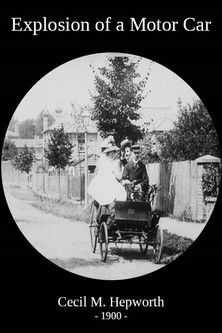
Cecil Hepworth films a horse-drawn carriage and then an automobile rushing toward the camera until the motorcar appears to strike the lens. How It Feels to Be Run Over (1900) is a famous shock gag from British early cinema.
Cast & crew
More films like this
More Horror films
View all →



More from Cecil M. Hepworth
View all →
More about this film
About the production
Release date1900
Box officeUnknown - box office tracking was not standardized in 1900
ProductionHepworth Manufacturing Company
Filmed inWalton-on-Thames, Surrey, England
Filmed in a single continuous take with a stationary camera positioned at ground level to create the subjective perspective. The automobile used was an early motor car, likely owned by Hepworth himself, representing cutting-edge technology of the time. The film was shot outdoors on a rural road, taking advantage of natural lighting which was standard practice for early films. The horse-drawn carriage and automobile were driven by actual drivers, with May Clark and Cecil Hepworth serving as the passengers who wave frantically in the final sequence.
Themes
Technological progress versus traditionThe dangers of modernizationPerspective and subjective experienceClass and social changeThe psychology of fear
Themes & topics
automobilehorrorsuspensecollisionroadfirst person perspectivesubjective camerashockhorse-drawn carriagetechnologydangerphantom ride
Historical background
Hepworth's Walton-on-Thames studio produced many actuality gags; this short exploited the novelty of motor traffic and first-person danger.
Why this film matters
holds immense cultural significance as one of the earliest examples of cinematic horror and suspense techniques. It demonstrates how early filmmakers recognized the power of subjective perspective to create emotional impact on audiences. The film's focus on the automobile as a source of danger reflected genuine public anxiety about new technology, making it a cultural document of the transition from the 19th to the 20th century. Its influence can be traced through horror cinema history, from the psychological tension it creates to its use of perspective shots. The film also represents an early example of the car chase genre, albeit in reverse, and foreshadows the countless automotive action sequences that would become staples of cinema. Additionally, it works as an important artifact documenting the early days of the automobile revolution and society's complex relationship with technological progress.
Making of
The production of 'How It Feels to Be Run Over' exemplifies the innovative spirit of early British cinema. Cecil Hepworth, a pioneer of the British film industry, established his studio in Walton-on-Thames in 1899 and quickly began producing inventive short films. The concept of placing the camera in the path of an oncoming vehicle was both technically challenging and psychologically daring for its time. The filming required precise coordination between the driver of the automobile and the camera operator to create the illusion of impending collision while ensuring actual safety. The rural location was chosen both for practical reasons and to emphasize the contrast between traditional rural life (represented by the horse-drawn carriage) and modern industrial progress (represented by the automobile). The film's brevity was typical of the era, when films were often limited to one or two minutes due to technical constraints and audience expectations for short attractions.
What critics said
Often anthologized in early-cinema courses, the film is discussed for spectator reflex rather than narrative content.
Did you know?
- This is considered one of the earliest examples of the horror genre in cinema history, predating what many consider the first horror film 'Le Manoir du Diable' (1896) by only a few years
- The film's title was originally 'How It Feels to Be Run Over' but was sometimes exhibited as 'How It Feels to Be Run Over by an Automobile' to emphasize the new technology aspect
- Cecil M. Hepworth both directed and appeared in the film as one of the passengers waving frantically, making him one of the earliest directors to also act in his own work
- The automobile featured was likely a Benz Velo or similar early motor car, which would have been a rare and impressive sight for British audiences in 1900
- The film was part of a series of 'phantom ride' films popular in early cinema, where the camera was mounted on moving vehicles to create subjective perspectives
- May Clark, who appears as one of the passengers, was one of Britain's first film stars and had previously starred in Hepworth's 1899 adaptation of 'Alice in Wonderland'
- The film was shot on 35mm film at approximately 16 frames per second, the standard speed for early cinema
- The abrupt ending was revolutionary for its time, leaving audiences shocked and creating a lasting impact that made the film memorable
- represents the transition from horse-drawn to motorized transport, capturing a pivotal moment in technological history
- The film was sometimes screened with live narration or sound effects provided by theater musicians to enhance the suspense
Visual style
The cinematography of 'How It Feels to Be Run Over' is remarkably sophisticated for its time, featuring a stationary low-angle shot that creates a powerful subjective perspective. The camera was positioned at approximately eye level for a person standing or sitting on the road, enhancing the illusion that the viewer is actually in danger. The use of depth of field is notable, with both the approaching vehicles and the surrounding landscape remaining in focus throughout the sequence. The natural lighting creates realistic shadows and highlights as the vehicles move through different positions relative to the sun. The framing is deliberate, with the road serving as a natural leading line that draws the viewer's attention toward the approaching danger. The single continuous take demonstrates technical confidence and planning, as any mistake would have required starting over entirely.
Innovations
The film's primary technical achievement lies in its innovative use of perspective to create a subjective viewing experience that was revolutionary for 1900. The successful execution of the shot required precise timing and coordination between the camera operator and the automobile driver to create the illusion of danger while ensuring actual safety. The film demonstrates early mastery of continuity editing through its single, uninterrupted take. The capture of motion, particularly the relatively fast movement of the automobile, presents the improving technical capabilities of early film equipment. The film's effective use of depth and spatial relationships within a single shot shows sophisticated understanding of cinematic space. Additionally, the film represents an early example of genre filmmaking, using specific techniques to create horror and suspense rather than merely documenting reality as many early films did.
Music
Like all films of 1900, 'How It Feels to Be Run Over' was originally a silent production without synchronized sound. However, contemporary screenings would have been accompanied by live musical performance, typically a pianist or small orchestra in music halls and early cinemas. The musical accompaniment would have been improvised or selected from standard repertoire, likely becoming more dramatic and frantic as the automobile approached. Some venues may have employed sound effects artists to create the sounds of horses, carriage wheels, and the motor of the automobile. The absence of dialogue or intertitles means the film relies entirely on visual storytelling, making it a pure example of early cinematic language. Modern restorations and presentations sometimes add period-appropriate musical scores to enhance the viewing experience for contemporary audiences.
Famous quotes
The film contains no dialogue, but its title 'How It Feels to Be Run Over' became in early cinema as an example of direct, sensational marketing
Memorable scenes
- The final sequence where the automobile approaches directly toward the camera with passengers waving frantically, creating mounting tension that culminates in the apparent collision and abrupt cut to black
What audiences thought
Audiences in 1900 reportedly reacted with genuine shock and excitement to 'How It Feels to Be Run Over,' with some accounts suggesting viewers physically recoiled or screamed during the final sequence. The film became a popular attraction in music halls and early cinema venues, often promoted as a thrilling and sensational experience. The novelty of seeing an automobile in motion, combined with the terrifying perspective of being run over, made it a memorable part of early cinema programs. Contemporary accounts suggest that the film's effectiveness led to repeat viewings, as audiences wanted to experience the shock again or show it to friends. The film's impact was such that it helped establish the market for short, sensational films that would become a staple of early cinema programming throughout the first decade of the 20th century.
Film connections
Influenced by
- Georges Méliès' trick films
- Lumière brothers' actuality films
- Early phantom ride films
- Victorian sensational literature
- Contemporary newspaper accounts of automobile accidents
This film influenced
- Hold-Up (1907)
- The Great Train Robbery (1903)
- Phantom ride films of the 1900s
- Early horror shorts
- Subjective perspective sequences in later films
Film restoration
The film survives and has been preserved by the British Film Institute. A 35mm nitrate copy exists in the BFI National Archive, and digital restorations have been made available for scholarly and public viewing. The film is considered to be in good preservation condition for its age, though some degradation typical of nitrate film from this period is present. The BFI has included the film in their collection of important early British cinema and has made it accessible through various archival and educational platforms.
Where to watch
- British Film Institute's online archive
- YouTube (through BFI's official channel)
- Various early cinema compilation DVDs
- Academic film archives and libraries
- Museum of Modern Art's film collection
- National Film and Television Archive