

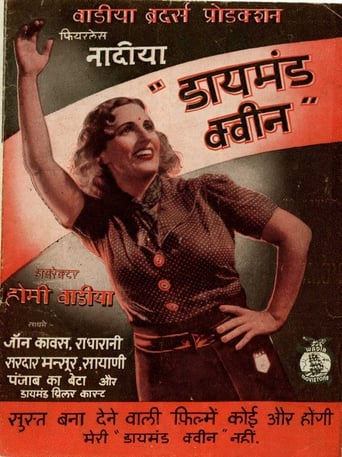
Muqabala
"Twin sisters, one frame, two fates"
Keys: Space play/pause · ←/→ 10s · F fullscreen · M mute · </> speed
About this film
Two look-alike sisters, one good and one evil, are at odds. The evil sister, a criminal, frames her innocent twin for her misdeeds. The good sister must then expose her criminal sibling to clear her name.
Cast & crew
More films like this
More from Babubhai Mistri
View all →
More about this film
About the production
Release date1942
ProductionWadia Movietone
Filmed inBombay (now Mumbai), India
Muqabala was produced during the peak of the stunt film genre in Indian cinema, with Wadia Movietone being the pioneering studio in this domain. The film featured elaborate action sequences and stunt work that were groundbreaking for their time. The production faced challenges during World War II, which affected film availability and distribution across India. The twin effect was achieved through early film techniques including double exposure and careful camera positioning, as modern digital effects were not available.
Themes
Duality and identityJustice vs. injusticeGood vs. evilDeception and truthFamily bonds and betrayal
Themes & topics
Historical background
Muqabala appeared in 1942, when wartime and immediate postwar filmmaking shaped how movies were financed, distributed, and discussed. Audiences of the day encountered the work amid shifting tastes in acting, pacing, and spectacle. Its focus on two look-alike sisters, one good and one evil, are at odds mirrors themes circulating in popular culture of that moment.
Why this film matters
Muqabala (1942) belongs to the wider archive of world cinema, documenting two look-alike sisters, one good and one evil,. Archivists and historians value such titles for what they reveal about craft, genre, and audience expectations. Restorations and festival screenings keep the work visible to viewers far beyond its first run.
Making of
The making of Muqabala represented a significant technical achievement for Indian cinema in the early 1940s. Director Babubhai Mistri, known for his innovative approach to visual effects, employed pioneering techniques to create convincing scenes featuring both twin sisters played by the same actress. The production team used a combination of double exposure, matte photography, and careful editing to achieve the twin effect. Fearless Nadia, who played both sisters, underwent extensive preparation to differentiate the characters through mannerisms and performance style. The stunt sequences were particularly challenging, as Nadia insisted on performing her own action scenes despite the increased difficulty of coordinating these shots with the technical requirements of the twin effect. The film was shot at the Wadia Movietone studios in Bombay, which were among the most advanced production facilities in India at the time.
What critics said
Press coverage from 1942 is fragmentary for many titles of this vintage; surviving notices for Muqabala tend to stress novelty, star power, or topical appeal. Later writing places the picture within its national and generic context, weighing both period conventions and moments that still land for modern viewers. Streaming and disc releases have revived discussion among classic-film audiences.
Did you know?
- Mary Ann Evans, appeared in the film, was actually Fearless Nadia, one of Indian cinema's first stunt women and action stars
- The film was directed by Babubhai Mistri, who was also known as India's first special effects wizard
- Muqabala was one of the last films produced by Wadia Movietone before the studio temporarily shut down due to World War II
- The twin sister concept was relatively novel in Indian cinema of the 1940s and became a popular trope in later films
- Fearless Nadia performed her own stunts in the film, which was unusual for actresses of that era
- The film's success led to several similar twin-themed movies in Indian cinema throughout the 1940s and 1950s
- The movie featured one of the earliest uses of split-screen techniques in Indian film to show both sisters simultaneously
- Lala Yaqoob was a popular character actor who frequently appeared in Wadia Movietone productions
- The film's action sequences were choreographed by Habib, a renowned stunt director of the era
- Despite being made during wartime, the film managed to achieve commercial success across multiple Indian regions
Visual style
The cinematography of Muqabala was handled by the Wadia Movietone's regular team of cameramen, who employed innovative techniques to capture the film's action sequences and create the illusion of twin sisters. The cinematographers utilized early forms of split-screen photography and double exposure to show both characters simultaneously, which was technically demanding for the era. The action sequences were filmed with dynamic camera movements and angles that enhanced the excitement of the stunt work. Lighting was carefully orchestrated to differentiate between the good and evil sisters, with softer lighting for the virtuous character and harsher shadows for the criminal twin. The film also featured elaborate chase sequences that required complex camera coordination and mobile filming techniques. Despite the technical limitations of 1940s equipment, the cinematography succeeded in creating a visually engaging experience that complemented the film's narrative and action elements.
Innovations
Muqabla showcased several technical achievements that were groundbreaking for Indian cinema in 1942. The film's most significant technical accomplishment was the convincing portrayal of twin sisters by a single actress, achieved through innovative use of double exposure and early split-screen techniques. The special effects team, led by director Babubhai Mistri himself, developed new methods for combining multiple takes into seamless sequences that showed both characters interacting. The action sequences featured elaborate stunt choreography that pushed the boundaries of what was typically attempted in Indian films of the period. The production also employed advanced editing techniques to create rhythm and pace in the action scenes, using quick cuts and dynamic transitions that were ahead of their time. The film's sound recording and mixing techniques were also notable, as they successfully balanced dialogue, music, and sound effects during the complex action sequences. These technical innovations not only enhanced the viewing experience but also contributed to the advancement of film production techniques in the Indian industry.
Music
The music for Muqabala was composed by the renowned music director G. D. Kapoor, who was a regular collaborator with Wadia Movietone. The film's soundtrack featured several popular songs that blended traditional Indian melodies with contemporary influences reflecting the musical tastes of the 1940s. The songs were picturized on both versions of the twin sisters, using music to emphasize their contrasting personalities and moral alignments. Notable tracks included romantic numbers for the innocent sister and more upbeat, energetic songs for the action sequences featuring the criminal twin. The background score incorporated Western orchestral elements alongside Indian classical instruments, creating a hybrid sound that was characteristic of the era's film music. The soundtrack was released on gramophone records and achieved moderate popularity, with several songs remaining in circulation on radio programs for years after the film's release.
Famous quotes
Ek insaan ki shakal do logon ka kaam nahi kar sakti" (One person's face cannot do the work of two people)
Asliyat ki roshni mein andhera kabhi tik nahi sakta" (In the light of truth, darkness cannot survive)
Jab insaan insaan se khelta hai, toh insaan hi har jaata hai" (When man plays games with man, it is man who loses)
Memorable scenes
- The climactic confrontation scene where both sisters finally face each other, with Fearless Nadia switching between characters in rapid succession using innovative editing techniques
- The elaborate chase sequence through the streets of Bombay, featuring daring stunt work and innovative camera angles
- The prison escape sequence where the innocent sister must prove her identity while avoiding capture
- The masquerade ball scene where both sisters appear in the same room, creating tension and confusion among other characters
- The final revelation scene where the evil sister's crimes are exposed through clever detective work and evidence gathering
What audiences thought
Muqabala was received enthusiastically by audiences across India upon its release in 1942. The film's combination of action, drama, and the novelty of the twin sister concept proved particularly appealing to moviegoers seeking entertainment during the difficult war years. Theaters reported full houses for extended periods, with many viewers returning for multiple viewings to appreciate Fearless Nadia's stunt work and the film's technical wizardry. Audience word-of-mouth spread rapidly, contributing to the film's commercial success in major cities including Bombay, Calcutta, and Madras. The movie's popularity was especially notable among younger audiences who were drawn to the action sequences and Nadia's charismatic screen presence. Despite wartime restrictions on entertainment and limited distribution networks, Muqabala managed to achieve significant box office success, cementing its place as especially popular films of 1942.
Film connections
Influenced by
- The Man Who Changed His Mind (1936)
- The Prisoner of Zenda adaptations
- Earlier Indian mythological tales of duality
- Hollywood stunt films of the 1930s
This film influenced
- Ram Aur Shyam (1967)
- Seeta Aur Geeta (1972)
- Don (1978)
- Kanoon Kya Karega (1984)
- Judwaa (1997)
Film restoration
Muqabala is considered a partially lost film, with only incomplete footage surviving in various archives. The National Film Archive of India (NFAI) holds fragments of the original film, but significant portions are believed to be lost due to the deterioration of nitrate film stock and inadequate preservation practices during the mid-20th century. Some complete sequences, particularly the stunt scenes, have been preserved through film enthusiasts and private collectors. The Film Heritage Foundation has made efforts to restore available footage, but a complete version of the film may no longer exist. Parts of the soundtrack have survived through gramophone record releases, providing audio documentation of the film's musical content.
Where to watch
- Film Heritage Foundation screenings and retrospectives
- National Film Archive of India viewing facilities (available portions)
- Classic film festivals specializing in Indian cinema
- Academic film archives and university collections
- Online platforms specializing in restored classic Indian films (limited availability)