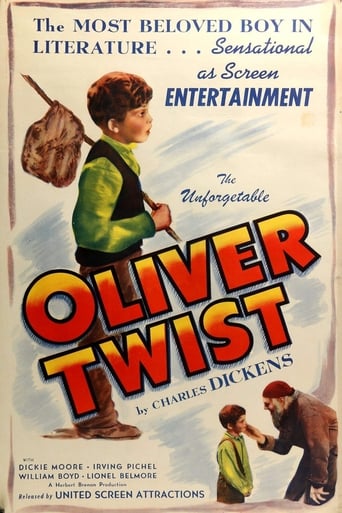
Films
1 film
About William J. Cowen
American film director who had a brief but notable career during the early sound era of Hollywood. His most significant contribution to cinema was directing the 1933 adaptation of Charles Dickens' classic novel 'Oliver Twist,' which was produced by Monogram Pictures. This film emerged during a transitional period in Hollywood when studios were adapting literary classics for talking pictures. Cowen's directorial work on 'Oliver Twist' demonstrated his ability to handle dramatic material and work with child actors, particularly Dickie Moore in the title role. Unfortunately, detailed information about Cowen's broader career trajectory, training, or other potential projects remains scarce in film history records. His apparent brief tenure as a director places him among many filmmakers who made their mark during the early 1930s but did not achieve lasting fame or extensive filmographies.
The Craft
Behind the Camera
Cowen's directing style, as evidenced in 'Oliver Twist,' reflected the early sound era's approach to literary adaptations, emphasizing dramatic storytelling and clear dialogue delivery. His work with the young Dickie Moore demonstrated an ability to elicit naturalistic performances from child actors, which was particularly challenging during the early days of sound recording.
Milestones
- Directed 'Oliver Twist' (1933) for Monogram Pictures
- Worked with child star Dickie Moore
- Adapted Charles Dickens' classic novel for early sound cinema
Best Known For
Must-See Films
Working Relationships
Worked Often With
Studios
Why They Matter
Impact on Culture
William J. Cowen's contribution to cinema, while limited in scope, represents the broader trend of early 1930s Hollywood adapting classic literature for the sound screen. His 1933 'Oliver Twist' was among the earliest sound adaptations of Dickens' work, helping to establish the character of Oliver Twist in the American film consciousness. The film's release during the Great Depression resonated with audiences who could relate to themes of poverty and social inequality, making it culturally relevant beyond its literary origins.
Lasting Legacy
William J. Cowen's legacy is primarily preserved through his 1933 adaptation of 'Oliver Twist,' which serves as an important example of early sound-era filmmaking and literary adaptation. While he did not achieve the lasting fame of many of his contemporaries, his work contributes to our understanding of how classic literature was translated to cinema during Hollywood's transition to sound. The film remains of interest to film historians and Dickens scholars studying early cinematic interpretations of the author's works.
Who They Inspired
Due to the limited scope of Cowen's known filmography, his direct influence on other filmmakers is difficult to trace. However, his work on 'Oliver Twist' represents part of the foundation upon which later directors would build their adaptations of classic literature, particularly in terms of adapting complex Victorian narratives for the constraints and opportunities of early sound cinema.
Off Screen
Very little information is available about William J. Cowen's personal life, family background, or activities outside of his brief film career. His limited filmography and the scarcity of biographical details suggest he may have been a journeyman director who worked primarily in the studio system during the early 1930s.
Did You Know?
- The 1933 'Oliver Twist' was produced by Monogram Pictures, a studio known for producing lower-budget films
- Dickie Moore, who played Oliver, would later become one of the Our Gang comedians
- Irving Pichel, who played Fagin in Cowen's version, would later become a director himself
- The 1933 adaptation was one of the earliest sound versions of Dickens' novel
- The film was released during the height of the Great Depression, which may have influenced audience reception
- Cowen's film ran approximately 70 minutes, typical of the shorter running times of the era
- This version preceded the more famous 1948 adaptation directed by David Lean
- The film was part of Monogram's attempt to produce more prestigious literary adaptations
Frequently Asked Questions
Who was William J. Cowen?
American on YTB.my. His career appears to have been brief, with this literary adaptation being his most significant contribution to cinema.
What films is William J. Cowen best known for?
Titles linked here include Oliver Twist (1933).
When was William J. Cowen born and when did he die?
Specific birth and death dates for William J. Cowen are not readily available in film history records. He was active as a director in 1933, placing his career during the early sound era of Hollywood.
What awards did William J. Cowen win?
There are no recorded awards or nominations for William J. Cowen in available film history databases. His brief career and limited filmography suggest he did not receive major industry recognition during his time as a director.
What was William J. Cowen's directing style?
Based on his 1933 'Oliver Twist,' Cowen's directing style reflected the early sound era's approach to literary adaptations, emphasizing clear storytelling and dramatic performances. He demonstrated particular skill in working with child actors, notably Dickie Moore, during a challenging period for sound recording.