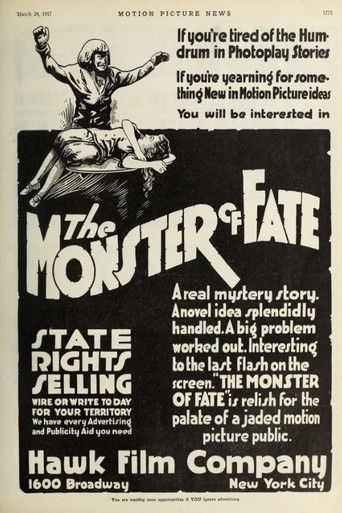
Frankenstein
"A liberal adaptation from Mrs. Shelley's famous story"
Keys: Space play/pause · ←/→ 10s · F fullscreen · M mute · </> speed
About this film
Frankenstein, a young medical student, trying to create the perfect human being, instead creates a misshapen monster. Made ill by what he has done, Frankenstein is comforted by his fiancée; but on his wedding night he is visited by the monster.
Cast & crew
More films like this
More Horror films
View all →



More from J. Searle Dawley
View all →

More about this film
About the production
Release dateMarch 18, 1910
ProductionEdison Manufacturing Company
Filmed inBronx, New York, Edison Studios, Bronx, New York
This was one of the earliest horror films ever made and the first film adaptation of Mary Shelley's novel. The production used innovative special effects for the time, including the creation sequence where the creature forms in a cauldron of chemicals. The monster's makeup was created by actor Charles Ogle himself, using a combination of cotton, putty, and various prosthetics to create the grotesque appearance. The film was shot in just three days, typical of the rapid production schedules of the era.
Themes
Scientific hubrisCreation and responsibilityThe duality of human natureReflection of inner evilThe dangers of playing God
Themes & topics
monstercreationlaboratoryweddingmirrorchemicalsmedical studentfiancéehorrorscience fictiontransformationreflectionevilobsession
Historical background
Frankenstein (1910) emerged during the silent-film era. Frankenstein, a young medical student, trying to create the perfect human being, instead creates a misshapen monster. Archival records and catalog entries help place the work within film-history surveys of the period.
Why this film matters
Preserved under Wikidata ID Q1135816, Frankenstein is valued as a screen drama within catalog and archive collections. Wikipedia's "Frankenstein (1910 film)" entry connect it to broader histories of cinema exhibition and restoration.
Making of
The film was directed by J. Searle Dawley, one of Edison's most reliable directors who had been making films since 1907. The production team faced significant challenges in creating the monster's appearance and the special effects for the creation sequence. Charles Ogle, an experienced character actor, took it upon himself to design his own makeup, creating a wild, unkempt look with heavy prosthetics that gave the creature a distinctly non-human appearance. The creation sequence was achieved through reverse photography and careful editing, showing the monster gradually forming in a cauldron of chemicals - a departure from the electrical reanimation in later adaptations. The Edison studio, known for its technical innovations, used double exposure techniques for the mirror sequence where the monster reflects Frankenstein's evil. The entire film was shot in just three days at Edison's Bronx studio, with interior sets built to represent Frankenstein's laboratory and home.
What critics said
Trade and archival sources offer limited day-one review coverage for Frankenstein. Modern reception rests on its availability in collections, repertory screenings, and reference works that document 1910 cinema.
Did you know?
- This was the first film adaptation of Mary Shelley's 'Frankenstein' and was made when the novel was still under copyright protection.
- The film was considered lost for decades until a print was discovered in the 1970s in the collection of a Wisconsin film collector.
- Unlike later adaptations, this version portrays the monster as a reflection of Frankenstein's own evil rather than a sympathetic character.
- The creation scene shows the monster forming in a cauldron of burning chemicals rather than through electricity as in later versions.
- Charles Ogle, who played the monster, also created his own makeup design, which was significantly different from the flat-topped look popularized by Boris Karloff.
- The film was produced by Thomas Edison's studio, which was one of the dominant film production companies of the early 1900s.
- At approximately 12 minutes, it's one of the shortest feature adaptations of Frankenstein ever made.
- The film was advertised as 'A Liberal Adaptation of Mrs. Shelley's Famous Story' to acknowledge the significant changes from the novel.
- The mirror effect where the monster reflects Frankenstein's evil was an original concept created for this film.
- This version introduces the character of Elizabeth as Frankenstein's fiancée, creating a romantic subplot not present in the novel's early chapters.
Visual style
The cinematography, typical of Edison productions of the era, employed static camera positions with careful staging to tell the story visually. The film used the innovative technique of reverse photography for the creation sequence, showing the monster forming from chemical elements. The lighting was dramatic for its time, using strong contrasts to create an ominous atmosphere in the laboratory scenes. The mirror sequence where the monster reflects Frankenstein's evil was achieved through careful editing and possibly double exposure techniques. The composition followed theatrical conventions, with actors positioned to maximize visibility and dramatic impact. The film's visual style established many horror conventions that would become standard in later decades, including the use of shadows and dramatic lighting to create suspense and fear.
Innovations
The film pioneered several technical innovations for its time, particularly in special effects. The creation sequence used reverse photography and careful editing to show the monster forming in a chemical cauldron, a complex effect for 1910. The makeup design by Charles Ogle was groundbreaking, using multiple layers of cotton, putty, and other materials to create a truly monstrous appearance that was unlike anything audiences had seen before. The film also experimented with psychological horror through its mirror sequence, suggesting the monster was a reflection of Frankenstein's inner evil - a sophisticated concept for early cinema. The production utilized Edison's improved film stock and cameras, resulting in relatively clear images for the period. The film's survival and restoration have also demonstrated advances in film preservation techniques, allowing modern audiences to experience this early horror classic in improved quality.
Music
As a silent film, 'Frankenstein' would have been accompanied by live musical performance during its original theatrical run. The typical accompaniment would have been a pianist or small ensemble playing appropriate mood music, often improvising based on the action on screen. Edison studios sometimes provided suggested musical cues or scores for their films, though specific documentation for this film's original musical accompaniment is not available. Modern screenings and releases typically feature newly composed scores or period-appropriate classical music. The 2010 restoration by the Library of Congress included a new musical score composed specifically for the film, attempting to recreate the emotional impact that contemporary audiences would have experienced. The absence of synchronized dialogue meant that the visual storytelling and musical accompaniment had to carry the entire narrative and emotional weight of the production.
Famous quotes
A liberal adaptation of Mrs. Shelley's famous story
Frankenstein: 'I have created a monster!'
Elizabeth: 'You must rest, my love'
Memorable scenes
- The creation sequence where the monster forms in a cauldron of burning chemicals
- The monster's first appearance in Frankenstein's laboratory
- The wedding night confrontation where the monster reflects Frankenstein's evil
- The gradual fading of the monster as it reflects its creator's inner darkness
- Frankenstein's realization that the monster is a mirror of his own soul
What audiences thought
Initial audience reactions in 1910 were mixed, with some viewers finding the monster's appearance genuinely frightening while others were amused by what now seems dated special effects. The film was popular enough to warrant wide distribution through Edison's exchange system, indicating commercial success. Contemporary audiences were particularly intrigued by the creation sequence, which was unlike anything they had seen before. When the film was rediscovered and screened in the 1970s, modern audiences were fascinated by its historical significance and its different approach to the Frankenstein mythos. Today, the film is primarily viewed by film students, historians, and classic cinema enthusiasts who appreciate its place in horror cinema history. The surviving print, available through various archives and online platforms, continues to attract viewers interested in the origins of horror cinema and early film adaptations of literary classics.
Film connections
Influenced by
- Frankenstein by Mary Shelley (1818 novel)
- The Golem (1915 film - later, but similar themes)
- German Expressionist cinema (later influence)
- Edison's previous horror experiments
This film influenced
- Frankenstein (1931)
- Bride of Frankenstein (1935)
- The Curse of Frankenstein (1957)
- Young Frankenstein (1974)
- Mary Shelley's Frankenstein (1994)
- Frankenstein (1994 TV film)
Film restoration
The film was considered lost for approximately 60-70 years until a single 35mm print was discovered in the mid-1970s in the collection of Alois Dettlaff, a Wisconsin film collector. The print was in relatively good condition considering its age. In 2010, the Library of Congress completed a restoration of the film, preserving it for future generations. The restored version is now held by several film archives, including the Library of Congress and the Museum of Modern Art. The film is in the public domain due to its age, which has contributed to its wider availability in recent years. The survival of this early horror classic is remarkable given that an estimated 90% of American silent films have been lost.
Where to watch
- Internet Archive (free public domain version)
- YouTube (various uploads with different musical scores)
- Library of Congress National Screening Room
- Kino Lorber DVD collections
- Museum of Modern Art film screenings
- Various streaming services specializing in classic cinema