

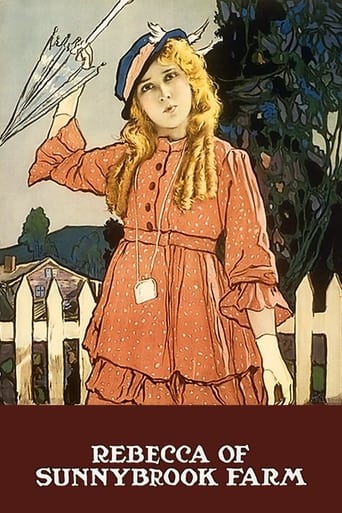
Tess of the Storm Country
"Would reprise eight years."
Keys: Space play/pause · ←/→ 10s · F fullscreen · M mute · </> speed
About this film
A young girl, squatting on a wealthy man's land fights for her fellow squatters' right to stay. It stars Mary Pickford, in a role she would reprise eight years later for the 1922 adaptation by John S.
Cast & crew
More films like this
More Drama films
View all →







More from Edwin S. Porter
View all →


More about this film
About the production
Release dateNovember 30, 1914
Box officeHighly successful - one of the biggest hits of 1914, earning over $500,000 at the box office
ProductionFamous Players Film Company
Filmed inNew York City, Fort Lee, New Jersey
Filmed during the summer of 1914, this was one of the first feature films to establish Mary Pickford as a major star. The production faced challenges recreating the squatter village setting, with elaborate sets built to depict the impoverished Storm Country community. Director Edwin S. Porter, known for his pioneering work in early cinema, employed innovative location shooting techniques that were unusual for the period.
Themes
Class inequalitySocial justicePoverty and wealthForbidden loveMoral courage
Themes & topics
Historical background
Production circa 1914 placed Tess of the Storm Country within the technical habits of its era—intertitles, studio sets, and regional distribution networks.
Why this film matters
Festival and repertory screenings keep Tess of the Storm Country in circulation among silent- and classic-film communities.
Making of
The production of 'Tess of the Storm Country' marked a significant moment in early Hollywood history. Mary Pickford, already a popular short film star, was looking to transition to feature films, and this role proved to be her breakthrough. Director Edwin S. Porter, though past his prime as an innovator, brought his considerable experience to the project. The film was shot primarily at the Famous Players studio in Fort Lee, New Jersey, which was then the center of American film production. The cast underwent extensive preparation to portray the impoverished squatters authentically, with Pickford reportedly studying the mannerisms and speech patterns of rural poor people. The production design was particularly notable for its time, with detailed recreations of squatter shanties that emphasized the stark contrast between rich and poor. The film's success surprised even its producers, leading to Pickford's contract renegotiation and establishing her as the highest-paid actress of her era.
What critics said
Specialist writers today emphasize preservation and access when a viewable copy of Tess of the Storm Country survives.
Did you know?
- This was Mary Pickford's first major feature film success, helping establish her as 'America's Sweetheart'
- The film was so popular that it was remade twice - in 1922 (also starring Pickford) and 1932
- The original novel by Grace Miller White was published in 1909 and became a bestseller
- Edwin S. Porter, the director, was a pioneering filmmaker who created 'The Great Train Robbery' (1903)
- The film's success helped establish the feature-length format as commercially viable in American cinema
- Olive Carey, who played Teola Graves, was credited under her birth name Olive Fuller Golden
- The squatter village set was so detailed and realistic that it reportedly shocked some contemporary viewers
- This was one of the first films to tackle serious social issues like poverty and class inequality
- The film's title became so iconic that 'Storm Country' entered the popular lexicon to describe any area of social struggle
- Pickford's performance in this film was praised for its naturalism, which contrasted with the theatrical acting style common in the period
Visual style
The cinematography by James Wong Howe (in one of his early assignments) employed innovative techniques for its time. The film utilized natural lighting for outdoor scenes, creating a more realistic atmosphere than the flat lighting common in studio productions. The camera work included dynamic movement during action sequences, unusual for 1914. The contrast between the bright, clean world of the wealthy Graves family and the dark, muddy environment of the squatters was emphasized through careful lighting choices and set design. The film also made effective use of close-ups to highlight emotional moments, particularly in Mary Pickford's performance, helping to establish the intimacy that would become characteristic of her star persona.
Innovations
The film featured several technical innovations for its time. Edwin S. Porter employed advanced editing techniques to create emotional rhythm and pacing, using cross-cutting between the wealthy and poor communities to emphasize social contrasts. The production utilized newly developed panchromatic film stock for certain scenes, allowing for more natural rendering of skin tones and textures. The film's elaborate sets, particularly the squatter village, represented some of the most detailed production design of 1914. The movie also experimented with location shooting, combining studio sets with exterior footage to create a more realistic environment. These technical elements combined to create a more immersive and emotionally engaging experience than was typical for films of this period.
Music
As a silent film, 'Tess of the Storm Country' was accompanied by live musical performance during its theatrical run. The original score was composed by William Furst, who created specific musical themes for different characters and situations. Tess's theme was a gentle, melancholic melody that became instantly recognizable to audiences. The squatter village scenes were accompanied by folk-inspired music, while the wealthy family's scenes used more formal, classical compositions. Large theaters employed full orchestras, while smaller venues used piano or organ accompaniment. The score emphasized the emotional content of each scene and helped guide audience responses to the social themes of the story.
Famous quotes
We may be poor, but we have our rights as human beings.
Love knows no class, but society builds walls around it.
In the storm country, we learn that strength comes not from wealth, but from character.
Every person deserves a place to call home, no matter how humble.
Justice may be blind, but it must not be deaf to the cries of the oppressed.
Memorable scenes
- Tess's passionate speech defending the squatters' rights before the wealthy landowners
- The dramatic confrontation between Tess and Elias Graves on the storm-swept hillside
- The tender meeting between Tess and Frederick by the creek, highlighting their forbidden love
- The climactic scene where Tess leads the squatters in a peaceful protest against eviction
- The emotional resolution where Tess must choose between personal happiness and community loyalty
What audiences thought
The film was a tremendous commercial success, breaking box office records across the country. Audiences were deeply moved by Tess's story and Mary Pickford's performance, with many theaters reporting sold-out shows for weeks. The film generated extensive word-of-mouth publicity, with viewers particularly responding to its sympathetic treatment of the poor and its critique of social inequality. Contemporary accounts describe audiences weeping openly during emotional scenes and applauding Tess's moments of triumph. The film's success was so pronounced that it reportedly caused a surge in public interest in squatters' rights and social reform issues. The popularity of the character led to merchandise, including Tess dolls and storybooks, making Pickford one of the first film stars to have such commercial tie-ins.
Film connections
Influenced by
- Grace Miller White's novel 'Tess of the Storm Country' (1909)
- Progressive Era social reform movements
- European social realist literature
- Earlier American social problem films
- Victorian melodrama tradition
This film influenced
- Tess of the Storm Country (1922 remake)
- Tess of the Storm Country (1932 remake)
- Stella Dallas (1925)
- The Scarlet Letter (1926)
- Street Angel (1928)
- The Grapes of Wrath (1940)
- A Place in the Sun (1951)
Film restoration
The film is considered partially lost. Only fragments and portions of the original 5-reel version survive in various film archives, including the Library of Congress and the Museum of Modern Art. Some reels were discovered in the 1970s in a private collection, but the complete film has not been preserved. The surviving footage has been restored and screened at special film retrospectives, but significant portions remain missing.
Where to watch
- Library of Congress (viewable by appointment)
- Museum of Modern Art film collection
- Silent film festivals and special screenings
- Film archives with access to restored fragments
- Not commercially available on home video or streaming platforms due to incomplete preservation