

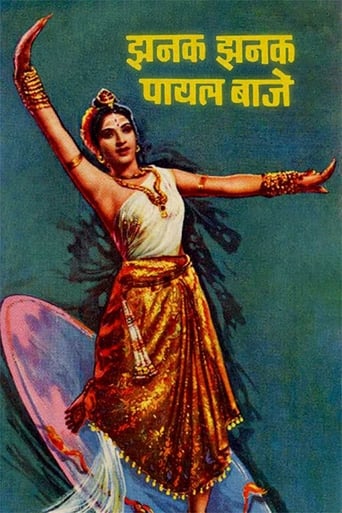
The Court Dancer: Raj Nartaki
"A court dancer barred from the temple"
Keys: Space play/pause · ←/→ 10s · F fullscreen · M mute · </> speed
About this film
In Manipur, in the early years of the 19th century, graceful and enchanting court dancer Indrani has captured the heart of Prince Chandrakirti. However, Indrani is looked down upon because of her low social standing and turned away when she tries to enter the city temple.
Cast & crew
More films like this
More Drama films
View all →







More from Modhu Bose
View all →

More about this film
About the production
Release date1941
BudgetNot documented
Box officeNot documented
ProductionNew Theatres
Filmed inCalcutta (Kolkata), India
The Court Dancer (Raj Nartaki) was notable for being one of the earliest Indian films to focus on classical dance traditions. It was produced by New Theatres, one of the pioneering film studios in Indian cinema. The film featured extensive dance sequences based on Manipuri classical dance forms, which were meticulously choreographed and performed by Sadhona Bose, who was a trained classical dancer in real life. The production faced challenges in recreating authentic Manipuri settings and costumes in Calcutta studios.
Themes
Love transcending social barriersCaste discriminationArt as a universal languageDuty versus personal desireCultural preservation
Themes & topics
court dancerManipuri dancecaste systemforbidden loveroyal romanceclassical dancesocial discriminationtempleprincepolitical marriageartistic expressioncultural tradition
Historical background
The Court Dancer: Raj Nartaki appeared in 1941, when wartime and immediate postwar filmmaking shaped how movies were financed, distributed, and discussed. Audiences of the day encountered the work amid shifting tastes in acting, pacing, and spectacle. Its focus on in manipur, in the early years of the 19th century, graceful and enchanting court dancer indrani has captured the heart of prince chandrakirti mirrors themes circulating in popular culture of that moment.
Why this film matters
The Court Dancer: Raj Nartaki (1941) belongs to the wider archive of world cinema, documenting in manipur, in the early years of the. Archivists and historians value such titles for what they reveal about craft, genre, and audience expectations. Restorations and festival screenings keep the work visible to viewers far beyond its first run.
Making of
The making of The Court Dancer was a significant undertaking for New Theatres studio, which was known for its artistic ambitions. Modhu Bose, who had a background in theater, brought a theatrical sensibility to the film's staging. Sadhona Bose's dance performances were so authentic and powerful that they required minimal camera trickery - the focus was on capturing her natural talent. The production team conducted extensive research into Manipuri culture, traditions, and dance forms. The film's bilingual/trilingual production was unusual for its time, requiring multiple takes of each scene in different languages. The elaborate dance sequences took weeks to rehearse and film, with Bose herself contributing to the choreography.
What critics said
Press coverage from 1941 is fragmentary for many titles of this vintage; surviving notices for The Court Dancer: Raj Nartaki tend to stress novelty, star power, or topical appeal. Later writing places the picture within its national and generic context, weighing both period conventions and moments that still land for modern viewers. Streaming and disc releases have revived discussion among classic-film audiences.
Did you know?
- The Court Dancer was one of the first Indian films to be released in the United States, premiering in New York in 1941
- Sadhona Bose, the lead actress, was a renowned classical dancer and choreographer before entering films
- The film was simultaneously made in three languages: Bengali, Hindi, and English versions
- Director Modhu Bose was married to Sadhona Bose, making this a collaboration between spouses
- The English version was titled 'The Court Dancer' while the Indian versions were called 'Raj Nartaki'
- The film featured over 20 dance sequences, showcasing various forms of Indian classical dance
- It was among the costliest productions of its time in Indian cinema
- The film's success led to Sadhona Bose being called 'the first lady of Indian dance cinema'
- New Theatres studio invested heavily in authentic costumes and sets to recreate Manipuri culture
- The film was instrumental in popularizing Manipuri dance forms across India
Awards & recognition
- No documented awards from 1941
Visual style
The cinematography by Bimal Roy was groundbreaking for its time, especially in capturing dance sequences. The camera work emphasized the grace and movements of the dancers, using long takes to showcase完整的 dance performances. The lighting techniques enhanced the mystical atmosphere of temple scenes while maintaining the authenticity of royal court settings. The film employed innovative camera angles to capture the intricate footwork and hand gestures characteristic of Manipuri dance. The visual composition reflected the influence of traditional Indian painting and theater.
Innovations
The Court Dancer was technically advanced for its time in several aspects. It employed sophisticated sound recording techniques to capture live dance performances and music with clarity. The film's set design and costume creation set new standards for authenticity in historical films. The synchronization of dance movements with the soundtrack was particularly impressive given the technical limitations of the era. The film's successful production in multiple languages was also a technical achievement, requiring innovative approaches to post-production.
Music
The film's music was composed by Rai Chand Boral, one of the pioneers of Indian film music. The soundtrack featured traditional Manipuri musical instruments and compositions, adapted for the film medium. The songs were based on classical ragas and folk melodies from the Manipur region. The music served not just as background but as an integral part of the dance sequences, with the rhythm and melody perfectly synchronized with the choreography. The film's score was noted for its authentic regional flavor while maintaining broad appeal.
Famous quotes
Dance is the language of the soul when words fail
In the temple of art, all are equal before the divine
Love knows no caste, but society builds walls around hearts
A dancer's feet may be bound by tradition, but her spirit soars free
Memorable scenes
- The opening dance sequence where Indrani performs in the royal court, captivating Prince Chandrakirti and all present
- The poignant scene where Indrani is turned away from the city temple due to her caste
- The emotional dance performance in the crumbling temple where Indrani pours out her heart through movement
- The climactic confrontation between duty and desire when Prince Chandrakirti must choose between Indrani and political marriage
What audiences thought
The film was well-received by audiences both in India and abroad. Indian viewers appreciated the authentic portrayal of classical dance and the emotional storyline. The film's success in American theaters was particularly notable, as it introduced Western audiences to Indian classical dance forms for the first time on a large scale. The performances of Sadhona Bose and the supporting cast were widely praised by moviegoers. The film's themes of love transcending social barriers resonated with audiences across different cultures.
Film connections
Influenced by
- Traditional Manipuri dance dramas
- Classical Indian literature
- Bengali theatrical traditions
- Early Indian mythological films
This film influenced
- Later Indian dance films including 'Jhanak Jhanak Payal Baaje' (1955)
- Films featuring classical dance as central theme
- Cross-cultural romantic dramas in Indian cinema
Film restoration
The film is partially preserved with some portions missing. The National Film Archive of India holds incomplete prints of the Bengali and Hindi versions. The English version is believed to be lost entirely. Restoration efforts have been ongoing but face challenges due to the age and condition of available materials.
Where to watch
- Available in fragmented form through film archives and specialized cinema libraries
- Occasionally screened at classic Indian film festivals
- Some portions may be accessible through academic film collections and the National Film Archive of India