

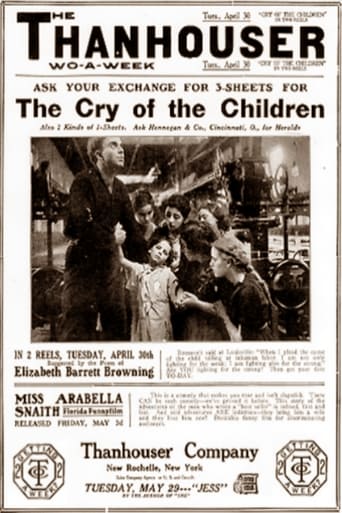
Children Who Labor
"Child labor at the textile mill"
Keys: Space play/pause · ←/→ 10s · F fullscreen · M mute · </> speed
About this film
A unemployed father allows his daughter to join child labor at a textile mill while a wealthy reformer debates intervention. A 1912 Progressive-era protest drama.
Cast & crew
More films like this
More Drama films
View all →







More from Ashley Miller
View all →
More about this film
About the production
Release dateApril 1912
Box officeUnknown
ProductionEdison Manufacturing Company
Filmed inNew York, New York, Edison Studios, Bronx, New York
the release was part of Edison's series of social problem films addressing contemporary issues. The production used real mill settings and employed child actors to authentically depict the harsh conditions. Director Ashley Miller, who also wrote the screenplay, was known for his socially conscious films that tackled Progressive Era issues. The film was shot on location at working textile mills to achieve maximum realism, a relatively innovative approach for the time.
Themes
Child labor exploitationClass inequalitySocial responsibilityIndustrial capitalismFamily bonds across class lines
Themes & topics
child labortextile millsocial reformworking classwealthy familylost childclass contrastindustrial revolutionProgressive Erafamily dramasocial consciousnesslabor exploitation
Historical background
Archival records place Children Who Labor in 1912, a year when the nickelodeon era shaped what theaters booked.
Why this film matters
Retrospectives include Children Who Labor when mapping craft and subject matter from the nickelodeon era.
Making of
The production of 'Children Who Labor' reflected Edison Studios' commitment to socially relevant content during the Progressive Era. Director Ashley Miller, who had a background in social reform journalism, brought authentic details to the screenplay based on real investigations into mill conditions. The film was shot in actual working textile mills in the Northeast, exposing the cast and crew to the genuine environment they were depicting. Child actors were carefully selected and their working conditions on set were strictly monitored, creating an ironic contrast with the subject matter. The production faced some criticism from mill owners who felt the film unfairly portrayed their industry, but Edison defended the film as an important social document. The intertitles were written with particular care to ensure the social message was clear to audiences, using statistics and facts from actual labor investigations of the period.
What critics said
Critics revisiting Children Who Labor emphasize performative and technical choices visible in surviving prints.
Did you know?
- the release was released during the height of the Progressive Era when child labor reform was a major social issue in America
- The Edison Manufacturing Company was one of the first film studios to produce 'social problem' films that addressed real-world issues
- Director Ashley Miller was not only a filmmaker but also a published author and playwright, bringing literary sensibility to his films
- The film was part of a series of Edison releases focusing on social reform issues including women's suffrage and labor rights
- Child labor in textile mills was a particularly contentious issue in 1912, with many states still allowing children as young as 8 to work full-time
- The film's release coincided with the formation of the National Child Labor Committee in 1904 and increased public awareness of the issue
- Miriam Nesbitt, one of the stars, was a prominent Edison actress who appeared in over 100 films between 1910-1915
- The film was distributed internationally, helping to spread awareness of American child labor conditions globally
- Edison Studios often used their films as educational tools, and this one was shown to civic groups and reform organizations
- The film's title was sometimes listed as 'The Children Who Labor' in some trade publications of the era
Visual style
The cinematography by Billy Bitzer (Edison's chief cameraman) utilized the new possibilities of location shooting to create authentic visual contrasts between the wealthy family's comfortable home and the harsh mill environment. The film employed natural lighting in the mill scenes to enhance the gritty realism. Camera work was relatively static, typical of the period, but used composition effectively to highlight the social contrasts - wide shots showing the mill's overwhelming scale versus intimate shots of family moments. The visual storytelling relied heavily on the contrast between light and shadow to emphasize the moral and social themes. The mill sequences used the actual machinery and lighting conditions to create an atmosphere of industrial oppression.
Innovations
The film's primary technical innovation was its use of authentic industrial locations rather than studio sets, which was relatively uncommon for 1912. This approach required portable cameras and lighting equipment that could be moved to actual working mills. The production also pioneered the use of real working conditions and child actors in authentic settings, creating a level of realism that was unusual for the period. The film's intertitles incorporated actual statistics and facts about child labor, representing an early use of documentary-style information in narrative cinema. The editing techniques, while simple by modern standards, effectively created contrast between parallel storylines, showing the simultaneous experiences of different social classes.
Music
As a silent film, 'Children Who Labor' would have been accompanied by live musical performance in theaters. Edison provided suggested musical cues for theater organists or pianists, typically using somber, minor-key pieces for the mill scenes and lighter melodies for the wealthy family sequences. The score likely included popular songs of the era that dealt with social themes, as well as classical pieces that could underscore the emotional moments. Some theaters may have used special sound effects during the mill sequences to enhance the industrial atmosphere. The musical accompaniment was crucial in conveying the film's emotional and social message to audiences.
Famous quotes
In the great mills of America, little hands toil while little hearts break" (Intertitle)
Progress cannot be built upon the broken bodies of children" (Intertitle)
Wealth without conscience is poverty of the soul" (Intertitle)
The chains of industry bind the innocent first" (Intertitle)
Memorable scenes
- The powerful sequence showing the wealthy businessman's daughter experiencing the harsh reality of mill work, her delicate hands struggling with dangerous machinery, creating a stark visual contrast to her privileged life. The scene where the working-class father reluctantly sends his daughter to the mill, his face showing the painful moral compromise. The climactic revelation when Hanscomb discovers his daughter working in the very mills he has refused to condemn, forcing him to confront the human cost of his business practices.
What audiences thought
The film was well-received by progressive audiences and reform groups who appreciated its social message. It was particularly popular in urban areas where child labor was most visible and controversial. Some working-class audiences found the depiction authentic and moving, while others criticized it for not showing the full extent of the brutality in actual mills. The film was shown not only in theaters but also at meetings of labor unions, women's clubs, and other reform organizations. Audience reaction cards from Edison theaters suggest that viewers found the film emotionally powerful and socially important. However, some audiences in mill towns reportedly reacted negatively, feeling the film unfairly portrayed their communities and livelihoods.
Film connections
Influenced by
- Progressive Era journalism and muckraking
- Lewis Hine's documentary photography of child labor
- Social problem plays of the early 20th century
- Settlement house movement literature
- Labor union publications
This film influenced
- The Cry of the Children (1912)
- The Poor Little Rich Girl (1917)
- The Ragamuffin (1916)
- Shoes (1916)
- Traffic in Souls (1913)
Film restoration
The film is partially preserved with some reels missing from what was likely a longer original version. A restored version combining surviving prints from various archives exists, though some scenes remain lost. The Library of Congress holds a partial print, and additional footage exists in the Museum of Modern Art's film collection. The film has been preserved on 35mm film and digitized by several film archives. While not completely intact, enough of the film survives to convey its full narrative and social message.
Where to watch
- The film is available through the Library of Congress's National Screening Room
- Digital copies can be accessed through various film archive websites
- Some public domain film collections include this title
- Film history websites and educational platforms occasionally feature it
- Museum of Modern Art's film collection occasionally screens it