Fabiola
"Early Christians under the shadow of Rome"
Keys: Space play/pause · ←/→ 10s · F fullscreen · M mute · </> speed
About this film
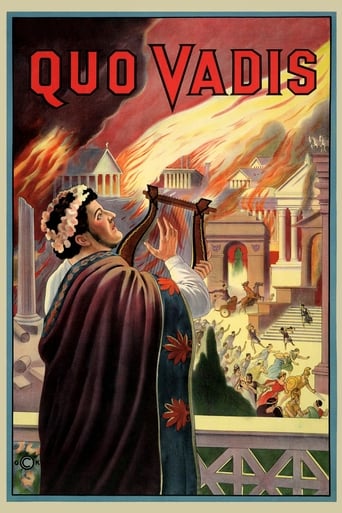
In "Fabiola" (1918) Herr Guarzzoni moved from the earliest days of Christianity when the new faith was struggling to just survive to a later period in the Roman Empire when the religion was a major force and attempting to win over Rome.
Cast & crew
More films like this

More History films
View all →


More from Enrico Guazzoni
View all →
More about this film
About the production
Release date1918
ProductionCines
Filmed inRome, Italy
Directed by Enrico Guazzoni, one of the pioneers of Italian historical epics, the film was produced during the final years of World War I, which likely impacted its production resources and distribution. The film featured elaborate sets designed to recreate ancient Rome and the Christian catacombs, typical of Guazzoni's attention to historical detail. The production utilized the large studio facilities of Cines, one of Italy's major film companies of the silent era.
Themes
Religious persecution and faithChristian martyrdomSpiritual transformationConflict between paganism and ChristianityFemale spiritual leadership
Themes & topics
ancient RomeChristian persecutionmartyrdomreligious conversioncatacombsRoman EmpireDiocletianearly Christianitynoblewomanfaith versus power
Historical background
Fabiola appeared in 1918, when the silent era before Hollywood consolidated into a studio system shaped how movies were financed, distributed, and discussed. Audiences of the day encountered the work amid shifting tastes in acting, pacing, and spectacle. Its focus on in "fabiola" (1918) herr guarzzoni moved from the earliest days of christianity when the new faith was struggling to just survive to a later period in the roman empire when the religion was a major force and attempting to win over rome mirrors themes circulating in popular culture of that moment.
Why this film matters
Fabiola (1918) belongs to the wider archive of world cinema, documenting in "fabiola" (1918) herr guarzzoni moved from the. Archivists and historians value such titles for what they reveal about craft, genre, and audience expectations. Restorations and festival screenings keep the work visible to viewers far beyond its first run.
Making of
The production of Fabiola took place during a challenging period for European cinema, with World War I affecting both resources and international distribution. Director Enrico Guazzoni, already established excelled in the historical epic genre, brought his expertise in creating spectacular Roman settings to this Christian-themed narrative. The film required elaborate construction of catacomb sets and Roman streets, typical of the ambitious scale of Italian productions of this era. The casting of Giula Cassini-Rizzotto as Fabiola represented the practice of using established theater actors for leading roles in early Italian cinema. The film's focus on Christian martyrdom and persecution reflected both the source material's religious themes and the contemporary interest in spiritual subjects during the wartime period. Production likely faced challenges common to the era, including the limitations of early cinematic technology for creating dramatic spectacle and the coordination of large crowd scenes typical of historical epics.
What critics said
Press coverage from 1918 is fragmentary for many titles of this vintage; surviving notices for Fabiola tend to stress novelty, star power, or topical appeal. Later writing places the picture within its national and generic context, weighing both period conventions and moments that still land for modern viewers. Streaming and disc releases have revived discussion among classic-film audiences.
Did you know?
- Based on the 1854 novel 'Fabiola, or The Church of the Catacombs' by Cardinal Nicholas Wiseman, which was especially popular Catholic novels of the 19th century
- Director Enrico Guazzoni was renowned for his historical spectacles, having previously directed 'Quo Vadis' (1913), one of the first feature-length epics in cinema history
- The film was part of the golden age of Italian silent cinema, when Italian films dominated international markets with their lavish historical productions
- This was one of multiple adaptations of the Fabiola story, with later versions made in 1949 and 1960
- The film's production occurred during World War I, a period when many European film industries struggled with resource shortages and distribution challenges
- Italian historical epics of this era were known for their massive sets, thousands of extras, and attention to historical detail, setting standards for epic filmmaking
- The Cines studio, where this was filmed, was one of Italy's most important early film production companies before being damaged during World War II
- The film represented a shift in Guazzoni's work from earlier Roman Empire settings to focus specifically on early Christian history
- Silent films about early Christianity were particularly popular in the 1910s as they could be marketed to both religious and general audiences
- The preservation status of many Italian films from this period is uncertain due to the nitrate film stock's tendency to deteriorate and wartime destruction
Visual style
The cinematography of Fabiola would have reflected the practices of Italian historical epics of the late 1910s, characterized by grand, sweeping compositions designed to showcase elaborate sets and large crowd scenes. The film likely employed static camera positions typical of the era, with careful framing to capture the architectural details of Roman settings and catacomb interiors. The visual style would have emphasized the contrast between the opulence of pagan Rome and the humble secrecy of Christian gatherings. Lighting techniques would have been rudimentary by modern standards but sophisticated for the time, using natural light and studio lighting to create dramatic effects, particularly in scenes depicting martyrdom or divine intervention. The black and white photography would have relied on contrast and composition to convey emotional tone and narrative significance, with careful attention to visual storytelling techniques essential for silent cinema.
Innovations
Fabiola would have showcased several technical achievements typical of Italian historical epics of its era. The film's production likely involved the construction of massive, detailed sets representing ancient Roman architecture and Christian catacombs, demonstrating advanced set design and construction techniques for the period. The coordination of large crowd scenes with hundreds or thousands of extras required sophisticated logistical planning and camera choreography. The film may have utilized early special effects techniques such as matte paintings or multiple exposures to create dramatic visions or supernatural elements. The cinematography, while technically straightforward by modern standards, would have required considerable skill in lighting and composition to capture the grand scale of the productions. The film's length and narrative complexity represented technical challenges in editing and continuity that were still being refined during this period of cinema's development.
Music
As a silent film, Fabiola would have been accompanied by live musical performance during its theatrical exhibition. The score would likely have been compiled from existing classical pieces or composed specifically for the film by a theater's musical director. Religious themes would have been underscored with solemn, devotional music, while scenes of Roman spectacle might have featured grand, dramatic compositions. The musical accompaniment would have been crucial for conveying emotional tone and narrative emphasis in the absence of dialogue. Theaters showing the film might have used organs, pianos, or small orchestras depending on their size and resources. The musical style would have reflected late Romantic and early 20th-century sensibilities, with leitmotifs possibly assigned to main characters or themes. The soundtrack would have been an integral part of the audience's experience, though specific details about Fabiola's musical accompaniment have not survived.
Famous quotes
Quotes from silent films are not typically preserved in written form, as the intertitles contained narrative exposition rather than memorable dialogue
Memorable scenes
- The catacomb sequences depicting secret Christian worship services, likely featuring dramatic lighting and large gatherings of believers hiding from Roman authorities
- Scenes of Christian martyrdom in the Roman arena, a common spectacle in films of this era
- Fabiola's conversion scene, showing her transformation from pagan noblewoman to devout Christian
- The climactic confrontation between Christian and Roman forces, showcasing the film's epic scale
What audiences thought
Audience reception of Fabiola in 1918 would have been influenced by several factors including its religious subject matter, spectacular production values, and the wartime context. The adaptation of Cardinal Wiseman's popular novel likely attracted readers familiar with the source material, while the spectacle of ancient Rome would have appealed to general audiences seeking entertainment and escapism during the difficult war years. Italian audiences of this period showed particular enthusiasm for historical epics that celebrated their cultural heritage, and films with Christian themes often resonated strongly in the predominantly Catholic country. The film's depiction of Christian persecution and martyrdom may have had special meaning for audiences experiencing the hardships of war. International reception would have been affected by wartime distribution challenges, though Italian films of this era were popular in many markets before the war disrupted global film trade.
Film connections
Influenced by
- Cardinal Nicholas Wiseman's novel 'Fabiola' (1854)
- Italian historical epic tradition
- Earlier biblical films like 'From the Manger to the Cross' (1912)
- Guazzoni's own previous epics like 'Quo Vadis' (1913)
- 19th-century Catholic literature
- Roman history and archaeology
This film influenced
- Later adaptations of Fabiola (1949, 1960)
- Biblical epics of the 1950s like 'Quo Vadis' (1951)
- The Robe (1953)
- Ben-Hur (1959)
- Other films about early Christian persecution
Film restoration
The preservation status of Fabiola (1918) is uncertain, and the film may be partially or completely lost. Many Italian silent films from this period have not survived due to the unstable nature of nitrate film stock, wartime destruction, and inadequate preservation efforts in the early 20th century. Some sources suggest fragments or incomplete versions may exist in film archives, but a complete, restored version appears to be unavailable for public viewing. The loss of this film represents a significant gap in the documentation of Enrico Guazzoni's work and the Italian historical epic tradition.
Where to watch
- Due to the apparent lost or incomplete status of Fabiola (1918), the film is not currently available through standard viewing platforms. Film archives such as the Cineteca Nazionale in Rome or other international film archives may hold fragments or incomplete versions, but these are typically accessible only to researchers and not available for public viewing. The film's absence from home video releases and streaming services reflects its preservation status rather than lack of interest in this historically significant work.