


Keys: Space play/pause · ←/→ 10s · F fullscreen · M mute · </> speed
Plot
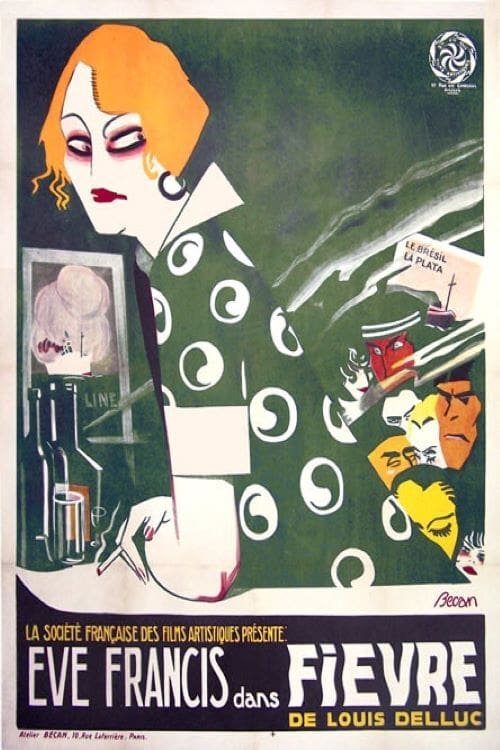
Militis, a sailor, returns to his hometown and visits a familiar bar where he encounters Sarah, a woman from his past with whom he shared a passionate romance. Despite being married to an exotic woman who nursed him back to health during a serious illness, Militis finds himself irresistibly drawn to Sarah, awakening memories of their intense relationship. As the two reconnect, the film explores the complex emotions of love, desire, and regret through a series of flashbacks and dream sequences that blur the line between past and present. The narrative unfolds with increasing psychological tension as Militis struggles between his marital obligations and his lingering feelings for Sarah. The film culminates in a poignant exploration of memory's power to haunt the present and the impossibility of recapturing lost moments.
About the Production
Release Date November 11, 1921 (France)
Production Les Films Louis Delluc
Filmed In Paris, France, Studio locations in the Paris region
Fièvre was Louis Delluc's second feature film and represents his most complete cinematic vision. The film was shot during the summer of 1921 with limited resources, requiring Delluc to be extremely creative with his visual storytelling. The production faced challenges typical of post-WWI French cinema, including film stock shortages and limited funding. Delluc employed innovative techniques such as superimposition, soft focus, and rapid editing to convey psychological states, which were revolutionary for the time. The bar scenes were filmed in actual Parisian establishments, adding authenticity to the atmospheric setting.









Themes & Topics
sailorbarlove triangleflashbackmemoryregretpassionmarriageinfidelitypsychological dramaurban settingreturn home
Historical Background
Fièvre was produced during the French Impressionist cinema movement (1918-1929), a period when French filmmakers were exploring the artistic possibilities of cinema as a medium for subjective expression and psychological depth. The film emerged in the aftermath of World War I, when French society was grappling with trauma, loss, and rapid social change. The 1920s in France saw a flourishing of artistic innovation across all media, with cinema joining literature, painting, and music in the modernist movement. The film industry was also undergoing significant changes, with smaller independent producers challenging the dominance of larger studios. Delluc, as both filmmaker and critic, was at the forefront of establishing cinema as a legitimate art form in France, arguing for its unique capabilities beyond mere entertainment. The film's exploration of memory and psychological states reflected contemporary interest in Freudian psychology and the inner workings of the human mind.
Why This Film Matters
Fièvre holds a crucial place in cinema history as one of the most accomplished examples of French Impressionist filmmaking. The film's innovative visual techniques and psychological depth helped establish cinema as a serious artistic medium capable of expressing complex human emotions. Its influence can be traced through French cinema history, particularly in the works of poetic realist directors of the 1930s and the French New Wave filmmakers of the 1950s and 1960s. The film's exploration of subjective experience and memory anticipated developments in cinematic storytelling that would only become widespread decades later. Delluc's approach to filmmaking, emphasizing visual poetry and emotional truth over conventional narrative, helped pave the way for more personal and artistic forms of cinema. The film is frequently studied in film schools as an example of early cinematic modernism and remains a touchstone for discussions about the relationship between cinema and other art forms.
Making Of
Louis Delluc approached 'Fièvre' as a cinematic poem, emphasizing visual emotion over narrative clarity. He worked closely with cinematographer Georges Lucas to develop innovative lighting techniques that would express the characters' inner states. The film's famous flashback sequences were achieved through in-camera effects and multiple exposures, requiring precise timing and coordination. Delluc encouraged his actors to express emotions through subtle gestures and facial expressions rather than the exaggerated acting common in silent cinema. The production took place during a difficult period for the French film industry, which was struggling to compete with American imports. Despite these challenges, Delluc maintained complete artistic control, refusing to compromise his vision. The film's editing style, with its rapid cuts and rhythmic pacing, was influenced by Delluc's background as a music critic and his understanding of musical composition.
What Critics Said
Contemporary critics recognized Fièvre as a significant artistic achievement, with Delluc's fellow critics praising its visual innovation and emotional depth. The film was particularly admired for its sophisticated use of cinematic techniques to convey psychological states, something that was relatively new in 1921. Critics noted the film's poetic quality and its departure from conventional narrative filmmaking. In the decades following its release, the film was largely forgotten as French Impressionist cinema fell out of favor, but it was rediscovered by film historians and critics in the 1950s and 1960s during the revival of interest in early avant-garde cinema. Modern critics now consider Fièvre one of the masterpieces of silent cinema, praising its visual beauty, emotional complexity, and innovative techniques. The film is frequently cited in scholarly works on early cinema and is regarded as one of Delluc's most important contributions to the art of film.
Did You Know?
- Louis Delluc was not only a director but also a prominent film critic who founded the film journal 'Cinéa' and later created the prestigious Delluc Award
- The film's title 'Fièvre' (Fever) refers both to the physical illness that brought Militis together with his wife and the metaphorical fever of passion and memory
- Ève Francis, who plays Sarah, was also a filmmaker herself and directed several films in the 1920s
- The film is considered a masterpiece of French Impressionist cinema, alongside works by Abel Gance and Jean Epstein
- Louis Delluc died tragically young at age 33 in 1924, making Fièvre one of his last completed works
- The film's innovative use of flashbacks and dream sequences influenced many later filmmakers, including Alain Resnais
- Gaston Modot, who plays Militis, would later become known for his role in Luis Buñuel's 'L'Âge d'Or' (1930)
- The original negative of the film was lost for decades before being rediscovered and restored in the 1990s
- Delluc wrote the scenario specifically for Ève Francis, with whom he had a close professional relationship
- The film's bar scenes were influenced by Delluc's observations of Parisian nightlife and his interest in the psychological effects of urban environments
More film details Visual style, music, quotes, restoration, and more
Visual Style
The cinematography of Fièvre, executed by Georges Lucas, is revolutionary for its time and represents some of the most innovative visual work of the silent era. Lucas employed numerous techniques that were groundbreaking in 1921, including extensive use of soft focus to indicate memory and dream states, superimposition to show the overlapping of past and present, and creative lighting to express emotional states. The film's visual style is characterized by its painterly compositions, with careful attention to light and shadow that creates a moody, atmospheric quality. The bar scenes are particularly notable for their use of naturalistic lighting and deep focus, creating a sense of realism within the film's expressionistic framework. The camera movement in Fièvre was unusually fluid for the period, with tracking shots and pans that follow characters' movements and thoughts. The cinematography emphasizes subjective experience, often showing scenes from characters' points of view or using visual distortions to indicate psychological states.
Innovations
Fièvre was technically innovative in numerous ways that were ahead of their time. The film's extensive use of superimposition and multiple exposure to show memory and dream sequences was particularly advanced for 1921. Delluc and his cinematographer developed new techniques for achieving soft focus effects that could be controlled precisely to indicate different psychological states. The film's editing style, with its rapid cuts and rhythmic pacing, was influenced by contemporary musical forms and represented a sophisticated understanding of cinematic time. The production also experimented with location shooting in actual Parisian bars, which added authenticity to the film's urban setting. The film's lighting design was particularly innovative, using chiaroscuro effects and creative use of shadows to enhance the emotional atmosphere. These technical innovations were not merely decorative but served the film's exploration of psychological states and subjective experience.
Music
As a silent film, Fièvre was originally accompanied by live musical performance, typically a piano or small orchestra in theaters. The original musical score has not survived, as was common for silent films where musicians often improvised or used compiled scores. Modern screenings of the restored film typically feature newly composed scores or carefully selected classical music that complements the film's mood and visual style. The rhythmic editing and visual poetry of the film suggest that Delluc conceived it with musical qualities in mind, and contemporary accounts indicate that he worked closely with musicians to ensure the accompanying music enhanced the film's emotional impact. The film's title, 'Fever,' suggests that the original musical accompaniment likely emphasized rhythmic intensity and emotional passion to match the visual and narrative themes.
Famous Quotes
As a silent film, 'Fièvre' contains no spoken dialogue, but its intertitles convey poetic thoughts such as 'Memory is a fever that burns in the present' and 'In the shadows of the past, we find the truth of our hearts'
Memorable Scenes
- The opening sequence where Militis first enters the bar, with its atmospheric lighting and sense of foreboding
- The flashback sequences showing Militis and Sarah's past romance, achieved through innovative superimposition techniques
- The climactic confrontation scene between Militis, Sarah, and his wife, with its complex emotional dynamics
- The dream sequence where past and present merge into a surreal visual poem
- The final scene where Militis must choose between his past and present, conveyed through subtle gestures and expressions
What Audiences Thought
Initial audience reception to Fièvre was mixed, as its unconventional narrative structure and artistic ambitions were challenging for general audiences accustomed to more straightforward storytelling. However, among cinephiles and artistic circles in Paris, the film found an appreciative audience that recognized its innovative qualities. The film's limited release and lack of commercial promotion meant it reached relatively few viewers compared to mainstream productions. In the years following its release, as tastes in cinema evolved, the film developed a cult following among film enthusiasts and scholars. Modern audiences who have had the opportunity to see restored versions of the film generally respond positively to its visual beauty and emotional power, though its pacing and narrative style can be challenging for viewers accustomed to contemporary cinema. The film's reputation has grown over time, and it is now considered an essential work for anyone interested in the history of cinematic art.
Film Connections
Influenced By
- The psychological theories of Sigmund Freud
- French Symbolist poetry
- Impressionist painting
- German Expressionist cinema
- Literary modernism
- Contemporary French theatrical traditions
This Film Influenced
- L'Âge d'Or (1930)
- L'Atalante (1934)
- Hiroshima mon amour (1959)
- Last Year at Marienbad (1961)
- The Umbrellas of Cherbourg (1964)
Film Restoration
For decades, Fièvre was considered a lost film, with only fragments known to exist. However, in the 1990s, a nearly complete print was discovered in a European film archive. The film has since been restored by film preservationists, though some sequences remain incomplete or damaged. The restored version has been screened at film festivals and cinematheques, allowing modern audiences to experience this important work of early cinema. The restoration work involved digital cleaning of damaged frames, reconstruction of missing sequences from surviving fragments, and color tinting based on contemporary descriptions of the original presentation. The film is now preserved in several archives, including the Cinémathèque Française, ensuring its survival for future generations.
Where to Watch
- The restored version of Fièvre is occasionally screened at film festivals and cinematheques specializing in classic cinema
- Some film archives and museums offer viewing appointments for researchers and film enthusiasts
- The film has been included in some DVD collections of French silent cinema, though availability is limited
- Streaming platforms specializing in classic and art house cinema occasionally feature the film
- Film studies programs at universities with strong cinema departments may have access to the film for educational purposes