
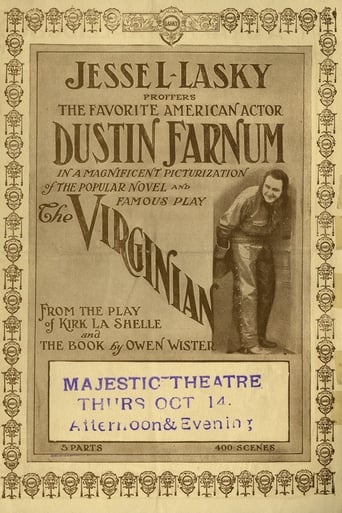
The Girl of the Golden West
"Saloon hostess, highwayman, high-stakes poker"
Keys: Space play/pause · ←/→ 10s · F fullscreen · M mute · </> speed
About this film
A saloon hostess loves Ramerrez, a notorious highwayman. Sheriff Jack Rance, who loves the girl too, instigates a card game that will determine the fate of all three of them. If she wins, the girl's lover will go free; but if she loses….
Cast & crew
More films like this
More Western films
View all →

More from Cecil B. DeMille
View all →
More about this film
About the production
Release dateDecember 1915
Box officeExact figures unknown, but it was considered a commercial success for the Jesse L. Lasky Feature Play Company
ProductionJesse L. Lasky Feature Play Company, Famous Players Film Company
Filmed inHollywood, California, Lasky Ranch - Hollywood Hills, Various California locations
This was Cecil B. DeMille's first Western film and one of the earliest feature-length Westerns. The film was based on David Belasco's 1905 play 'The Girl of the Golden West,' which had also inspired Puccini's opera 'La fanciulla del West.' DeMille insisted on authentic costumes and props, hiring actual mining equipment from California's Gold Rush regions. The production faced challenges with the elaborate saloon set, which had to be built to accommodate both the dramatic scenes and the large cast of extras playing miners.
Themes
Love vs. DutyHonor and RedemptionThe American Frontier MythFemale Agency in a Male-Dominated WorldJustice vs. Mercy
Themes & topics
Gold RushSaloonSheriffBanditPoker GameLove TriangleCaliforniaMining CampHonorRedemptionWestern FrontierGamblingEscapeMoral Choice
Historical background
Jesse L. Lasky Feature Play Company positioned The Girl of the Golden West for 1915 audiences accustomed to weekly program changes in urban theaters.
Why this film matters
Revival audiences read The Girl of the Golden West as evidence of 1915 taste for stories about a saloon hostess loves ramerrez, a notorious highwayman.
Making of
Cecil B. DeMille approached this project with meticulous attention to historical accuracy, researching California Gold Rush history extensively. He hired actual miners as consultants and technical advisors. The saloon set was among the leading elaborate built in Hollywood up to that time, featuring a working bar, gambling tables, and period-accurate decorations. DeMille was known for his perfectionism and reportedly reshot the climactic poker scene multiple times until he was satisfied with the dramatic tension. The film was shot during an unusually cold California winter, which created challenges for the cast and crew but added authenticity to the outdoor scenes. House Peters, who played Ramerrez, performed many of his own stunts, including horseback riding sequences that were considered dangerous for the time.
What critics said
Silent-era reviewers devoted little space to The Girl of the Golden West, typical for a release of its scale in 1915.
Did you know?
- This was the first film adaptation of David Belasco's play, predating the famous opera by Puccini which had premiered in 1910
- Cecil B. DeMille considered this film one of his most important early works, as it established his reputation for handling large-scale productions
- The film featured one of the first uses of artificial snow in cinema, created using cotton and salt
- Mabel Van Buren was a stage actress before this film and this was only her second motion picture appearance
- The poker game scene was considered particularly daring for its time, showing a woman gambling in a mixed-gender setting
- DeMille insisted on filming on location in the California mountains for authenticity, unusual for 1915 productions
- The film's success helped establish the Western as a viable genre for feature-length films
- Theodore Roberts, who played Sheriff Rance, was one of DeMille's favorite character actors and appeared in over 20 of his films
- The original play had been a Broadway hit starring Blanche Walsh, who was considered for the film role but declined
- The film's title was sometimes shortened to 'The Golden West' in some advertisements to save space
Visual style
The cinematography, handled by Alvin Wyckoff, was considered advanced for its time. Wyckoff employed innovative lighting techniques to create dramatic shadows in the saloon scenes, enhancing the film's emotional intensity. The use of natural light for the outdoor sequences was particularly praised, with the California mountain locations providing striking visual backdrops. The film featured several tracking shots that were technically challenging for 1915, including a sequence following a horseback chase through mountainous terrain. The poker game scene was shot with careful attention to facial expressions and hand movements, using close-ups that were still relatively rare in feature films of this era.
Innovations
The film featured several technical innovations for its time, including the use of artificial snow effects created through a combination of salt and cotton, which was groundbreaking in 1915. The elaborate saloon set incorporated working mechanical elements, including a functioning roulette wheel and card dealing devices. The film employed multiple camera angles for the poker game scene, a technique that was still being developed during this period. The production also pioneered the use of location shooting for Westerns, moving away from the studio-bound productions that were common at the time. The film's special effects, including simulated gunfights and horseback stunts, were considered particularly realistic for the era.
Music
As a silent film, The Girl of the Golden West would have been accompanied by live musical performances in theaters. The original score was composed by William Furst, who was the house composer for the Lasky Company. The music incorporated elements of American folk tunes and popular songs of the Gold Rush era, including 'Oh! Susanna' and 'Clementine.' Larger theaters would have used full orchestras, while smaller venues relied on piano or organ accompaniment. The score emphasized the romantic elements with lush strings and the action sequences with more percussive instrumentation. Some theaters reportedly used portions of Puccini's opera score for special presentations, creating an interesting hybrid of classical and popular music.
Famous quotes
A man's life is worth more than gold, but a woman's love is worth more than either." - Sheriff Rance
In this camp, we make our own justice." - Mary
Love makes fools of us all, but only the brave admit it." - Ramerrez
The cards don't lie, but sometimes the players do." - During the poker game
Memorable scenes
- The climactic poker game where Mary risks everything to save Ramerrez, with tension building as each card is dealt and the fate of all three characters hangs in the balance
- The opening sequence showing the bustling mining camp and introducing the colorful characters of the Polka Saloon
- Ramerrez's dramatic entrance into the saloon, disguised and unrecognized by all except Mary
- The final escape scene where Mary and Ramerrez ride off together as the miners watch in stunned silence
- The confrontation between Sheriff Rance and Ramerrez where the bandit's true identity is revealed
What audiences thought
The film was a popular success with audiences of its time, particularly in the American West where its authentic settings resonated with viewers. Contemporary accounts report that audiences were especially moved by the dramatic poker game scene and Mary's clever solution to her dilemma. The film's themes of love, honor, and sacrifice appealed to the moral sensibilities of 1915 audiences. Its success led to increased demand for Western features and helped establish the commercial viability of the genre. Audience response was strong enough that the film remained in circulation for several years, unusual for a feature of this period.
Film connections
Influenced by
- David Belasco's 1905 stage play 'The Girl of the Golden West'
- Puccini's opera 'La fanciulla del West' (1910)
- Contemporary Western literature and dime novels
- American frontier mythology
- Earlier short Western films by D.W. Griffith and others
This film influenced
- The Girl of the Golden West (1930) - sound remake
- The Girl of the Golden West (1938) - Jeanette MacDonald/Nelson Eddy version
- Numerous subsequent Westerns featuring strong female protagonists
- Later DeMille Westerns including 'The Plainsman' (1936)
Film restoration
The film is considered lost, like approximately 90% of American films from this period. No complete prints are known to exist in any film archives worldwide. However, some fragments and still photographs from the production survive, providing visual documentation of the film's style and content. The Library of Congress maintains a collection of production stills and promotional materials. Film historians continue to search for any surviving copies, particularly in European archives where some American films were preserved. The loss of this film is particularly significant due to its importance in DeMille's early career and the development of the Western genre.
Where to watch
- No complete version of this film is known to exist due to its lost status
- Fragments and still photographs may be viewed at the Library of Congress
- Some production stills are available in film history books and online archives
- Film historians occasionally present reconstructed versions using surviving stills and contemporary descriptions