

The Woman in Green
"Sherlock Holmes investigates when young women around London turn up."
Keys: Space play/pause · ←/→ 10s · F fullscreen · M mute · </> speed
About this film
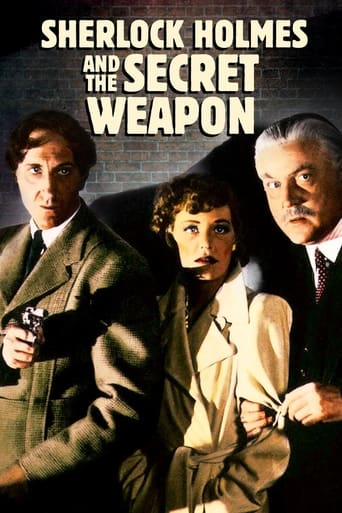
Sherlock Holmes investigates when young women around London turn up murdered, each with a finger severed. Scotland Yard suspects a madman, but Holmes believes the killings to be part of a diabolical plot.
Cast & crew
More films like this
More Mystery films
View all →
More from Roy William Neill
View all →
More about this film
About the production
Release dateAugust 18, 1944
ProductionUniversal Pictures
Filmed inUniversal Studios, Universal City, California, USA
This was the 11th of 14 Sherlock Holmes films starring Basil Rathbone and Nigel Bruce. The film was produced during World War II and, like other films in the series, featured contemporary settings rather than Victorian England to appeal to wartime audiences. The severed finger prop effects were considered quite graphic for 1944 standards. The production team reused several sets from previous Universal horror films to save costs during wartime restrictions.
Themes
Psychological manipulationJustice vs. chaosThe nature of evilLogic vs. emotionCriminal mastermind
Themes & topics
Sherlock HolmesProfessor MoriartyMurderHypnosisBlackmailSevered fingerPsychological thrillerDetectiveLondonWartimeMaster criminalMysteryCrime investigationMind control
Historical background
By 1944, distribution was widening and The Woman in Green reached audiences through the theatrical channels dominant before television.
Why this film matters
Reference works on 1944 cinema cite The Woman in Green when tracing genre and regional production patterns.
Making of
The production faced several challenges during wartime, including budget constraints and material shortages. The film was shot quickly on Universal's backlot, reusing sets from other productions to save money. Basil Rathbone and Nigel Bruce had developed such chemistry by this point that many of their scenes were improvised. Henry Daniell's portrayal of Moriarty was so menacing that the cast found him intimidating off-camera. The hypnosis sequences required special camera techniques and lighting effects to create the trance-like states. Director Roy William Neill was known for his efficient shooting style, often completing scenes in one or two takes to meet Universal's tight production schedules.
What critics said
Trade papers near 1944 listed The Woman in Green as program material rather than headline art cinema.
Did you know?
- This was one of only three films in the Rathbone-Bruce series where Professor Moriarty appears as the main villain
- Hillary Brooke, who plays Lydia Marlowe/Moriarty's sister, also appeared in 'Sherlock Holmes and the Secret Weapon' (1942) but as a different character
- The film's premise of severed fingers was considered quite shocking for 1944 audiences
- Henry Daniell, who played Moriarty, was a veteran character actor who specialized in playing sophisticated villains
- This was director Roy William Neill's 8th of 12 Sherlock Holmes films he would direct for Universal
- The film was based in part on Arthur Conan Doyle's 'The Adventure of the Empty House' and 'The Final Problem'
- Unlike most films in the series, this one was not directly based on any single Conan Doyle story
- The hypnosis scenes were considered particularly innovative for their time
- The film's release coincided with the Allied liberation of Paris during World War II
- Basil Rathbone was so identified with Holmes that he reportedly grew tired of the role and wanted to move on to other projects
Visual style
The film employed classic film noir lighting techniques, with dramatic shadows and high-contrast photography that enhanced the mystery atmosphere. Cinematographer Virgil Miller used low-key lighting to create tension in the murder sequences and hypnosis scenes. The camera work emphasized the psychological nature of the story through close-ups during the hypnotic sequences. The film's visual style reflected the influence of German Expressionism on American film noir, with angular compositions and dramatic use of darkness. The Universal backlot sets were enhanced through creative lighting to create a convincing London atmosphere.
Innovations
The film featured innovative special effects for the hypnosis sequences, using double exposure and matte shots to create trance-like visuals. The severed finger effects were accomplished through clever camera angles and prosthetic work that was convincing for its time. The sound design for the hypnosis scenes used experimental techniques to create disorienting audio effects. The film's efficient production schedule demonstrated Universal's mastery of the B-movie formula, delivering high-quality entertainment on limited budgets and tight schedules. The lighting techniques used to create the film noir atmosphere influenced subsequent mystery and horror productions.
Music
The musical score was composed by Hans J. Salter, a prolific Universal composer who worked on many of the Holmes films. The music featured recurring motifs for Holmes, Moriarty, and the mysterious 'woman in green.' The score used orchestral arrangements that emphasized tension and mystery, with particular emphasis on strings and woodwinds during the psychological sequences. The hypnosis scenes featured experimental electronic sounds created through studio techniques, adding to the otherworldly atmosphere. The soundtrack was typical of Universal's approach to mystery films in the 1940s, balancing atmospheric music with moments of dramatic intensity.
Famous quotes
Holmes: 'The game is afoot!'
Moriarty: 'I am the Napoleon of crime, Holmes. The Napoleon of crime!'
Watson: 'Holmes, this is monstrous! Absolutely monstrous!'
Holmes: 'When you have eliminated the impossible, whatever remains, however improbable, must be the truth.'
Moriarty: 'You're the only one who ever matched me, Holmes. The only one.'
Holmes: 'Elementary, my dear Watson.'
Watson: 'But Holmes, how did you know?'
Holmes: 'The devil, Watson, is in the details.'
Memorable scenes
- The opening sequence where the first murdered woman is discovered with her severed finger, establishing the film's shocking premise
- The hypnosis scene where Moriarty demonstrates his power over his victims through psychological manipulation
- The final confrontation between Holmes and Moriarty on the rooftop, featuring their classic battle of wits
- The scene where Holmes deduces the connection between the murders and blackmail scheme through his characteristic logical reasoning
- The tense sequence where Watson is nearly hypnotized by Moriarty, showing the psychological danger facing the heroes
What audiences thought
The film was well-received by wartime audiences who appreciated its blend of familiar characters with contemporary settings. Theater owners reported good attendance, particularly from audiences seeking escapist entertainment during the war years. The film's relatively short runtime (68 minutes) made it popular for double bills. The Rathbone-Bruce Holmes films had developed a loyal following by 1944, and this entry satisfied fans' expectations while introducing the compelling Moriarty character. The film's success helped ensure the continuation of the series for several more years.
Film connections
Influenced by
- Arthur Conan Doyle's Sherlock Holmes stories
- German Expressionist cinema
- Film noir
- Psychological thrillers of the 1940s
- Universal horror films
- Wartime propaganda films
This film influenced
- Subsequent Sherlock Holmes adaptations
- Psychological thriller films of the 1950s
- Television mystery series
- Modern detective films with psychological elements
Film restoration
The film is well-preserved and has been restored multiple times. It exists in the Universal Pictures archives and has been released on various home media formats including DVD and Blu-ray. The film entered the public domain in the United States, which has contributed to its wide availability on various streaming platforms and public domain collections.
Where to watch
- The film is available on DVD and Blu-ray from various distributors including Universal Studios Home Entertainment
- Streaming on Amazon Prime Video
- Available on YouTube through public domain uploads
- Streaming on Tubi
- Available on The Roku Channel
- Part of the Sherlock Holmes collection on various streaming services
- Available for digital purchase on iTunes and Google Play